formularioRDF
The itinerary <em>TITULORECORRIDO</em> has been successfully created. Now you can add in works from the Collection browser
<em>TITULOOBRA</em> added to <em>TITULORECORRIDO</em> itinerary

Close Continuar a ficha de la obra Continuar a ficha de la obra
02-06-2026
Vicente Cutanda y Toraya

Madrid, 1850 - Toledo, 1925

See author's file

Epilogue

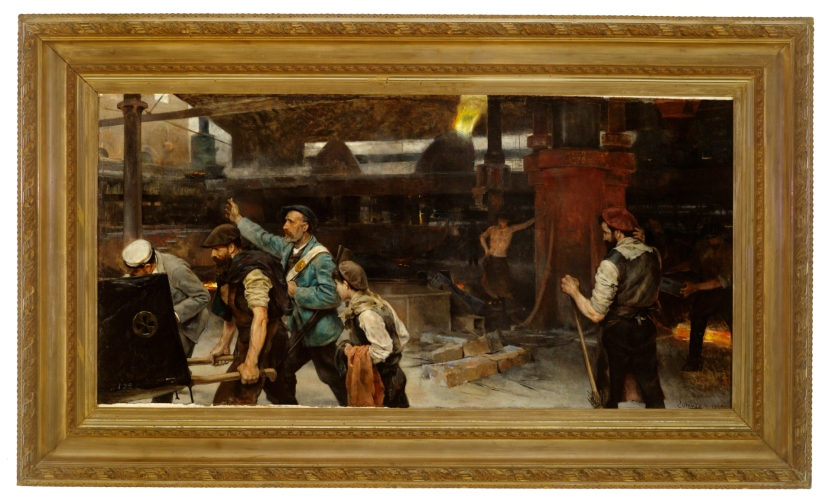
1895. Oil on canvas.
On display elsewhere

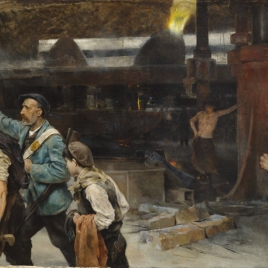
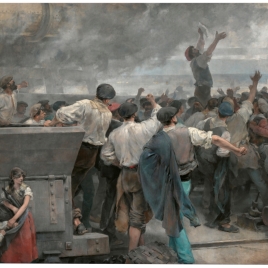
Social demands began to make their way from reality into Spanish art starting in the 19th century, particularly as a result of the Industrial Revolutions and the profound changes they brought to labor conditions. These shifts were artistically reflected in works that dignified workers´ concerns, often depicting scenes inspired by labor strikes at blast furnaces.

Cutanda found in the strikes a pressing and timely subject that had brought social issues to the forefront of Spanish public consciousness. He drew especially from the strike declared on May 13, 1890, which was triggered by the dismissal of five workers from the La Orconera company in Bilbao for their participation in organizing the May Day celebrations. In the early years, employers sought to suppress such organizing efforts, frequently leading to the outbreak of strikes. This marked the beginning of a new era of labor unrest, with successive episodes of industrial action in the years that followed. These events catalyzed the organization of workers in the province of Biscay and facilitated the rise of the Socialist Party, a leading actor in these developments.

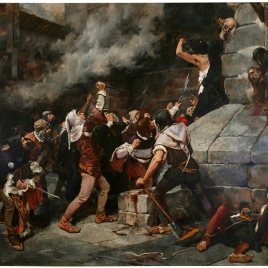
Cutanda’s painting A Workers´ Strike in Biscay (P7793), exhibited at the 1892 International Fine Arts Exhibition in Madrid, was awarded a first-class medal. The May Day holiday had only recently been established in 1889 as International Workers’ Day.

Cutanda specialized in themes related to labor struggles for illustrated journals, influenced by the painter and illustrator Dudley Hardy, whose now-lost 1889 painting The Dock Strike served as a model. In search of visual and social references, Cutanda visited factories in Le Creusot (Bourgogne-Franche-Comté), Bordeaux, and Bilbao from late 1890 or early 1891 onward. There, he dedicated himself to studying both the environments of industrial labor and the workers themselves—not merely their physical appearances or tasks, but also their roles within the broader context of social struggle. His aim, as he stated, was "to be able to characterize the anarchist, the measured worker, the worker who, lacking his own will, is led by the more extreme ones, and so many others who make up the nuanced collective of the working class."

This pursuit of faithfully representing workers according to their social consciousness was entirely novel in Spain.

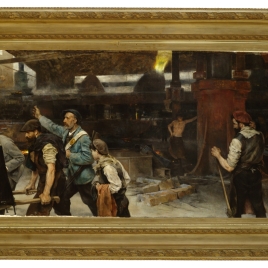
The painting’s title is telling: these working conditions culminate in death. A man, solemn-faced, carries a heavy burden from one end of the scene—presumably the body of a deceased worker. A child looks on, holding what appears to be the dead man’s clothes, while another man at the far right watches with resigned expression, hand to his neck. The work denounces the vulnerability of children faced with the harsh realities of labor and their exploitation. The presence of revolution is suggested by a single figure: an armed man in a blue jacket—the only colorful element in an otherwise dark, ochre-toned palette typical of Cutanda’s work—raising his arm in a gesture of assistance or protest.

Barón, Javier, 'Vicente Cutanda. Una huelga de obreros en Vizcaya'. Arte y transformaciones sociales en España (1885-1910), Madrid, Museo Nacional del Prado, 2024, p.373-378 nº.275 [o.r: nº.273, nº.274]

Technical data

Imagen del carrusel
Imagen del carrusel
Inventory number
P006647
Author
Vicente Cutanda y Toraya
Title
Epilogue
Date
1895
Technique
Oil
Support
Canvas
Dimension
Height: 76 cm; Width: 151 cm
Provenance
Acquired from the artist for the Museo del Prado, 1895; Museo de Arte Moderno, 1896-1971
Entry date
1971

Bibliography +

Espinós, A.; Orihuela, M. y Royo Villanova, M. [et al.], El "Prado disperso". Cuadros depositados en La Coruña II. La Coruña. Diputación, Boletín del Museo del Prado, VIII, 1987, pp. 141.

Noticias. Levantamiento definitivo de depósitos. La Coruña. Archivo del Reino de Galicia, Boletín del Museo del Prado, 16, 1995, pp. 94.

Noticias. Depósitos temporales. La Coruña. Museo de Bellas Artes, Boletín del Museo del Prado, 16, 1995, pp. 94.

Museo Nacional del Prado, Museo del Prado: inventario general de pinturas. Nuevas Adquisiciones. Museo Iconográfico. Tapices, III, Museo del Prado, Espasa Calpe, Madrid, 1996.

Sagasta y el Liberalismo Español, Fundación Argentaria, Madrid, 2000, pp. 350.

Iglesias Cano, Maria del Carmen (ed.), Encrucijada de culturas, Ibercaja, Zaragoza, 2008.

Díez, J.L (dir.), Pintura del Siglo XIX en el Museo del Prado. Catálogo general, Museo Nacional del Prado, Madrid, 2015, pp. 143.

Alarcia Cartaya, Verónica, Realismo como denuncia social en España: el pintor Vicente Cutanda., [TFG. Universidad del Pais Vasco], 2018, pp. 25.

Barón, Javier, 'Vicente Cutanda. Una huelga de obreros en Vizcaya', Arte y transformaciones sociales en España (1885-1910), Museo Nacional del Prado, Madrid, 2024, pp. 373-378 nº.275 [o.r: nº.273, nº.274].

Other inventories +

Inv. Nuevas Adquisiciones (iniciado en 1856). Núm. 1226.
1226 / Autor D. Vicente Cutanda y Toraya / un cuadro titulado "Epílogo" / adquirido en la cantidad de 2000 ptas / alto ancho [a lápiz= 0'77 1'45] // [nota al margen=] Adquirido en virtud de Real orden fecha 20 Julio 1895 // [con otra grafía=] Cedidos a la Escuela de Bellas artes de Coruña Agosto 1896

Inv. General del Museo de Arte Moderno, 1899-1902. Núm. 869.

Registros-Inventarios Museo Nacional de Arte Moderno, 1900-1936. Núm. 51-C.

Inscriptions +

Cutanda. 1895
Signed and dated. Front, lower right corner

T. 1226
Inscribed in blue. Front, lower left corner

Exhibitions +

Arte y transformaciones sociales en España (1885 - 1908)
Madrid
21.05.2024 - 22.09.2024

Art and Social Change in Spain (1885-1910)
Madrid
21.05.2024 - 22.09.2024

El Tragaluz Democrático. Política de vida y muerte en el Estado Español (1868 - 1975)
Madrid
24.03.2023 - 23.07.2023

Zaragoza y Aragón: Encrucijada de Culturas
Zaragoza
05.06.2008 - 19.10.2008

Sagasta y el liberalismo español
Madrid
15.12.2000 - 15.04.2001

Location +

La Coruña - Museo de Bellas Artes de La Coruña (Deposit)

Update date: 02-06-2026 | Registry created on 14-05-2016

Visor 360

Drag with the cursor to rotate the piece

Other works by Vicente Cutanda y Toraya

Print on demand

Print artworks available in our catalogue in high quality and your preferred size and finish.

Image archive

Request artworks available in our catalogue in digital format.

Up