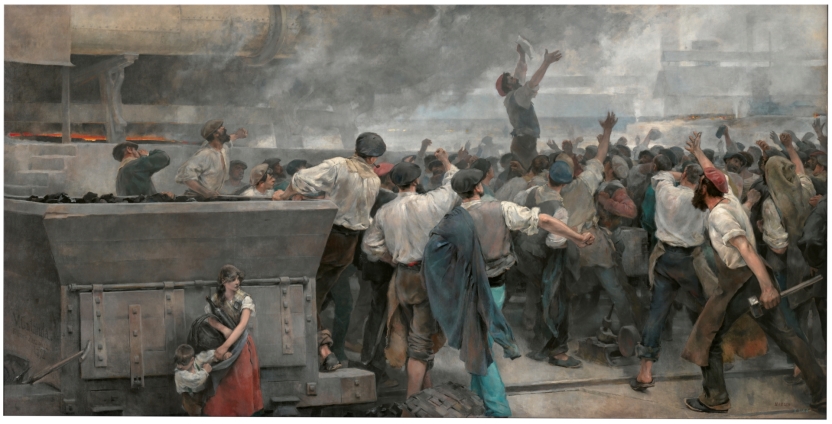
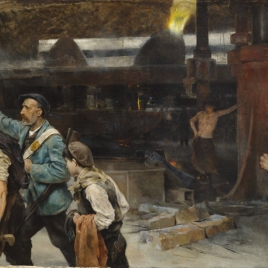
Workers on Strike in Vizcaya
1892. Oil on canvas.Room 061A
Social demands transitioned from the realm of reality into Spanish art beginning in the 19th century, especially as a result of the Industrial Revolutions and the changing labor context they brought about. These transformations were reflected in artistic representations of such environments, dignifying workers’ concerns in a series of paintings inspired by the strikes of blast furnace workers—such as “Epilogue” (P6647). These themes also captured the interest of other artists who adopted a more expressive and dramatic approach, including Juan Luna, José Uría, and Manuel Villegas.
Bilbao’s intense industrialization made it a hotspot for numerous strikes. The strike declared on May 13, 1890—triggered by the dismissal of five workers from the company La Orconera due to their involvement in organizing the May Day celebrations—marked the beginning of sustained labor unrest in the city. The following years saw further episodes of industrial action, which spurred the organization of workers in Biscay and contributed to the rise of the Socialist Party, a central actor in these events.
Cutanda identified strikes as a timely and potent subject that had brought social issues to the fore in Spain. It suited his expressive and synthetic style, which had originally drawn inspiration from Eduardo Rosales at the start of his career. He chose this theme for his painting “A Workers’ Strike in Biscay”, which he presented at the 1892 International Exhibition of Fine Arts in Madrid, where it received a first-class medal.
Cutanda became known for his depictions of labor struggles in illustrated periodicals, influenced by the painter and illustrator Dudley Hardy. Hardy’s now-lost 1889 work “The Dock Strike” served as a model for Cutanda’s approach. Seeking authentic references, the artist visited factories in Le Creusot (Bourgogne-Franche-Comté), Bordeaux, and Bilbao between late 1890 and early 1891. There, he studied the labor settings and the workers themselves—not only in their external appearance or occupation but also in terms of their position within the social struggle. As he stated, his aim was "to characterize the anarchist, the tempered worker, the worker who, lacking his own will, is led by the more radical ones, and so many others who embody the nuances within that vast collective of laborers." The goal of faithfully representing workers according to their degree of social consciousness was entirely new in Spain.
Although he had visited several mining and metallurgical centers, Cutanda ultimately chose to situate his painting in Bilbao, a decision that led to the final title—A Workers’ Strike in Biscay—the result of his ongoing study from life. By November 1891, he was already working on the large canvas, initially intended to be titled “The Strike”. This choice of setting aligned with the spirit captured in his pen drawing A Biscayan Miner, “vigorously executed,” which the artist had sent in October to the editorial office of “El Liberal” for an exhibition benefiting the victims of the floods in Consuegra and Almería, held on December 17 in the Bosch salons in Madrid. At the time, it was noted that the artist aimed “to physically stereotype the true type of our Biscayan workers, avoiding the vulgarity popularized by servile artists who fail to select their models; on the contrary, with true aesthetic scrupulousness, he carried out his work of selection.”
By August, the painting—set in the blast furnaces—was already completed in his Zaragoza studio, located in Plaza de las Eras, next to the granary known as the Cabildo de la Diezma. The work was already fitted with a frame designed to resemble riveted iron plates, so convincingly rendered in wood that at the Fine Arts Exhibition, it was mistaken for actual metal.
Cutanda treated the subject with compositional balance, allocating space to both the metallurgical background in the upper section and the workers themselves. The three central figures introduce the dynamic composition, which converges on the figure of the orator—his dark silhouette standing out against a bright background and surrounded by the raised arms of his fellow workers. Although criticized by some, such as Federico Balart, for depicting the figures from behind, this choice was effective in emphasizing the collective unity of the workers by forgoing individualized facial features. The two foreground figures on the left, intended as a visual counterpoint yet lacking proportional coherence with the rest, were also subject to critique, as were certain drawing inaccuracies.
The grayish palette reflects a concern for faithfully capturing the factory atmosphere, as do the smoke, steam, and fire—almost the only vibrant color present. The brisk execution underscores the energy of the scene.
Beyond the criticism leveled at social painting by Pedro de Madrazo, who saw such themes as overly circumstantial, and Balart’s objections to its execution, the painting was generally regarded as episodic yet powerful. It was especially valued by proponents of naturalism and progressive circles, such as Francesc Pi i Margall. In addition to its wide reproduction in the press, a reversed version of the image was later published as an illustration accompanying a commentary on May Day.
Barón, Javier, 'Vicente Cutanda. Una huelga de obreros en Vizcaya'. Arte y transformaciones sociales en España (1885-1910), Madrid, Museo Nacional del Prado, 2024, p.373-378 nº.273 [o.r nº274, nº.275]