The painter Ricardo Arredondo
1896. Oil on canvas.Room 062A
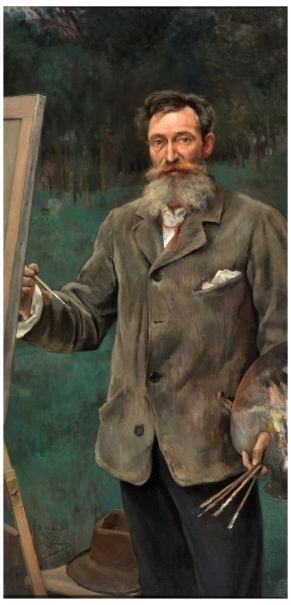
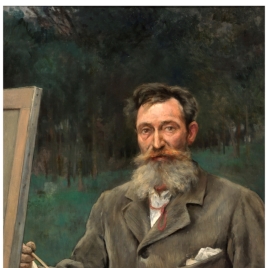
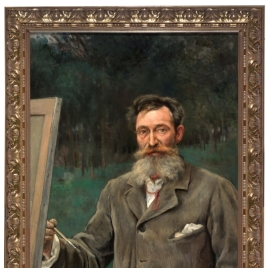
The painter Ricardo Arredondo stands in front of his easel with his palette in his hand, and casually looks at his friend and portraitist Vicente Cutanda. It is an open-air portrait. The artist uses a loose technique, depicting the painter half length. His head is uncovered, and his naturally dishevelled hair ruffled by the blustery country air. The grove of trees and pines in the immediate background softens the harsh landscape that surrounds Ricardo Arredondo.
Ricardo Arredondo Calmache (Cella, Teruel, 23 October 1850 – Toledo, 5 December 1911) was one of the painters of Toledo, a professional archaeologist of the historic city who captured its sights and quarters, making his work of great documentary value today. He actively participated in the Monuments Commission as a memeber. He also took an active part in the artistic direction of restoration work, such as that of the Puerta de Bisagra, or architectural and town-planning tasks, creating the Paseo de Cambrón or drawing the plans for the Rojas Theatre, in collaboration with Amador de los Ríos. Ricardo´s political position as a councillor on the Toledo town council favoured his artistic and restoration work. For all these reasons he was known at the time as the painter of Toledo, where he lived from the age of eleven.
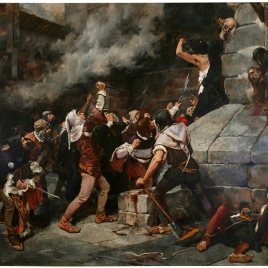
Arredondo had dealings with Vicente Cutanda, a painter who embraced Social Realism after a trip to Italy, during which he worked outside of Spanish circles at the Institute of Fine Arts in Rome. No doubt it was in Toledo that Arredondo and Cutanda came into contact with each other.
This drawing depicts the figure outside, in a country landscape. There is no panoramic or historical view of the horizon, which blends into nature, and appears as a mere fragment. This is the result of Cutanda modernising style and his acceptance of a realism en plein air, a style which finds its representation especially in Beruete and in the aesthetics of the disciples of Haes, who linked up with the modernising tradition of the Golden Age and with Velázquez. This style is more in line with the modern landscape painting of fin-de-siècle Spanish realism than with the socialising and epic verism that Cutanda brought from Italy. It is not surprising that he used this realist formula for this picture, because he was undoubtedly familiar with the ways of the new landscape. He was also in contact with Beruete, connoisseur, protector, and landscape painter of the city.
Díez, J.L (dir), Artistas pintados. Retratos de pintores y escultores del siglo XIX en el Museo del Prado, Madrid, Ministerio de Educación y Cultura, Dirección General de Bellas Artes y Bienes Culturales, 1997, p.164-165