The promise, after the storm, Asturias
1903. Oil on canvas.On display elsewhere
The work was conceived as part of a group of three paintings, the other two titled “Departure for the Fishing” and “The Shipwreck”. Artists such as Vicente Cutanda and Juan Martínez Abades had previously presented sequential episodes of a narrative in their submissions to the National Exhibitions. Álvarez Sala, who had already painted a Shipwreck on the Coasts of Gijón for the 1892 Exposición Internacional de Bellas Artes, began work on this painting in 1902—the only one of the projected triptych that was ultimately completed. The theme of struggling against a dangerous sea had also been explored by various artists, particularly in Brittany. Among them, Alfred Guillou—whose naturalist approach is close to that of Álvarez Sala—and, in a more expressive register, Charles Cottet.
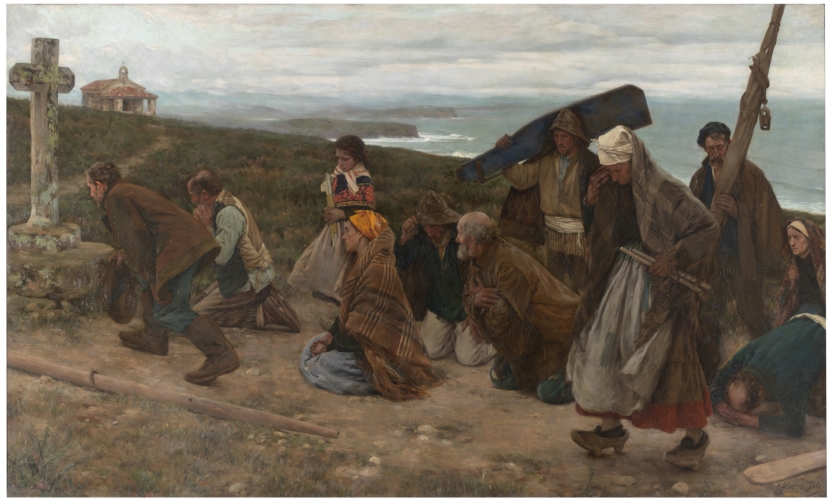
The motif of fishermen fulfilling a vow after surviving a shipwreck had already been treated in 1892 by the Alicante-born painter Heliodoro Guillén in “The Last Storm” (Madrid, Museo Nacional del Prado, on deposit at the Museo de Bellas Artes Gravina, Alicante). In Álvarez Sala’s painting, the composition is quite different—slightly oblique—set in a landscape rendered with striking realism. The figures are varied, as the artist used multiple models, avoiding the repetition common in other works of social painting. The diversity of ages and genders, along with the photographic cut-off on the right side—as if others might continue the procession—emphasize the social and familial makeup of the group and the generational continuity of maritime labor, which included women in land-based roles. Regional identity is marked by specific elements: the sailor’s beret as he holds the rolled-up sail, the large red-and-black shawl worn by the girl, and the madreñas (traditional wooden clogs) on the feet of the elderly woman.
The placement of the boat’s components—a mast, a rolled sail, a rudder blade, and an oar—and their sober materiality lend the scene a compelling verisimilitude. The setting is the eastern coast of Gijón, the artist’s hometown, as seen from Cape San Lorenzo looking out to sea. Having studied this landscape in winter, Álvarez Sala convincingly captured the succession of coastal headlands shrouded in mist, the sky and sea rendered in subdued tones with broad yet precise brushwork.
The procession is shown paused in prayer before a stone cross whose octagonal arms recall the one located in Campo Valdés, facing the sea. The girl and the elderly woman carry candles to be offered to Nuestra Señora de la Providencia, whose hermitage appears in the background. After being destroyed by fire in 1895, the shrine was reopened for worship in the summer of 1898.
The painting was already well advanced by September 1902. In 1903, the artist struggled with inclement weather—which may have caused a bout of influenza—as well as difficulty in securing models. He noted: “I’m discouraged by the thought of this climate and this light, so changeable and impossible.” Facing the northern landscape proved especially challenging after his stay in Rome, but Álvarez Sala managed to execute the scene with full credibility.
Despite its artistic merits and favorable placement in the 1903 Exposición Nacional de Bellas Artes in Madrid, the painting—though supported for a Second-Class Medal by Joaquín Sorolla, president of the jury, and by Alejandro Saint-Aubin and Manuel Ramírez—received only a recommendation for decoration. Sorolla himself published a critique on July 5 in El Comercio. News that the painting had been acquired by a private individual for donation to the Museo de Arte Moderno was seen as a form of restitution. The buyer was the painter Aureliano de Beruete, who had also been awarded a Second-Class Medal. Beruete likely appreciated the refinement of the landscape’s greys, and later wrote to Álvarez Sala from Munich to congratulate him when, at the 1905 International Exhibition, the painting was finally awarded a Second Medal—alongside other Spanish works that had previously received First Medals in Madrid.
Barón, Javier, 'Ventura Álvarez Sala. La promesa, después del temporal, Asturial'. Arte y transformaciones sociales en España (1885-1910), Madrid, Museo Nacional del Prado, 2024, p.202-203 nº.107