Emigrants
1908. Oil on canvas.Room 061A
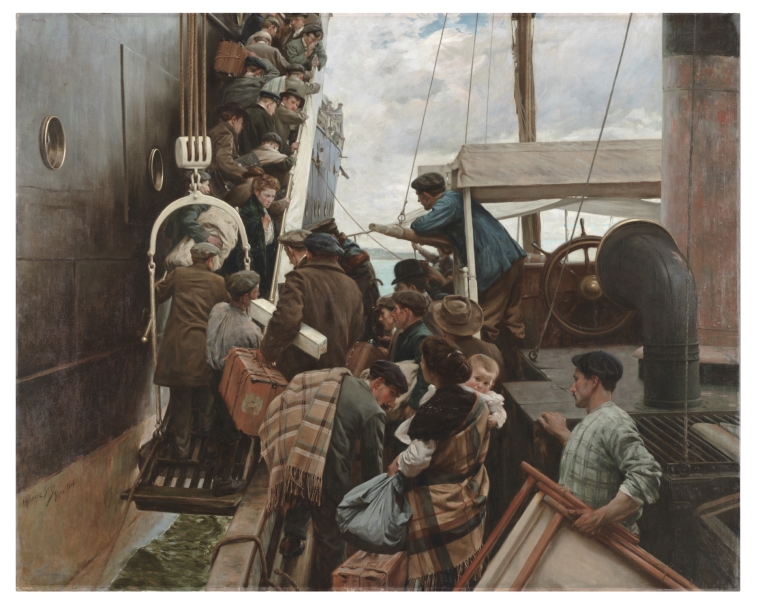
In “Emigrants”, the artist engages with a subject of deep social resonance, particularly relevant to northern regions of Spain, including Asturias. Early critical responses were favorable and grasped the artist’s intention to convey tension through the compressed arrangement of the emigrants’ figures.
Markedly influenced by photography in both viewpoint and the compositional cropping at the edges, this work was awarded a Second-Class Medal at the Exposición Nacional de Bellas Artes in 1908. It naturalistically depicts a common scene in northern Spain during the late 19th and early 20th centuries: emigration to the Americas. Several painters—among them Rafael Romero de Torres, Eliseu Meifrén, Joan Llimona and Juan Martínez Abades—had already addressed the theme of transatlantic migration in the years prior. At the same 1908 exhibition, the Aragonese artist Juan José Gárate also treated the subject.
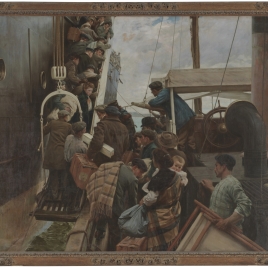
Among all these interpretations, Álvarez Sala’s vision is the most closely aligned with reality: devoid of sentimentality or rhetorical exaggeration, it bears close comparison to documentary photographs. In an early drawn sketch, likely representing the initial concept, the artist portrayed the emigrants already on board, alongside their belongings. He abandoned that idea in a second sketch, which laid out the final composition. Since Gijón’s port of El Musel was not equipped for emigrant boarding until 1910—and for large transatlantic ships until 1913—embarkation at the time had to occur offshore, with motorboats ferrying passengers from the dock to the ship.
The artist drew both preparatory works in black pencil and used white chalk to highlight the lighting, which plays a key role in the second sketch and was followed faithfully in the brightest areas of the final canvas. To emphasize the massive scale of the ship, he cropped it vertically above the boarding rail. The arrangement of the figures—progressing from the boat at the lower right to the top of the boarding staircase—grows increasingly compressed, giving the impression of the crowded mass awaiting on the ship’s deck. The precision of the draftsmanship, the photographic naturalism of the many figures’ postures, the restrained color palette dominated by ochres and greys (including the dirty tones of the sea), and the cohesive execution all make this one of the most compelling representations of the reality of emigration.
However, the very qualities that define its realism—emotional restraint, lack of emphasis, and neutral everyday tone—led some critics to regard the work as cold or lacking in expressive force. While the photographic framing lends the composition a distinctly modern character closely aligned with naturalism, the high number of meticulously rendered figures, praised by some, was deemed excessive by others, at a time when such detail was increasingly seen as a relic of the past. Nevertheless, the controlled chromatic range, dominated by subdued earth tones and greys, and the painter’s assured technique, give the painting formal unity and lasting impact.
Barón, Javier, 'Ventura Álvarez Sala. Emigrantes'. Arte y transformaciones sociales en España (1885-1910), Madrid, Museo Nacional del Prado, 2024, p.325-326 nº.228