Learning by heart
1898. Oil on canvas.Room 061A
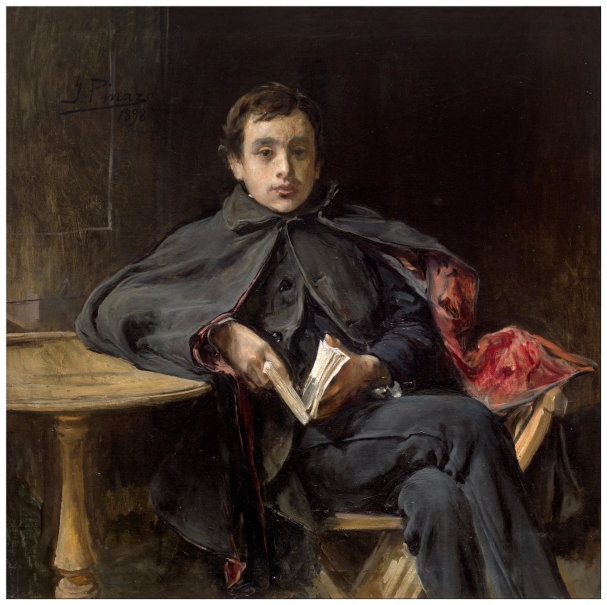
Ignacio Pinazo, an artist fundamentally intuitive and deeply drawn to the representation of everyday life, found particularly fitting models for his work in his own sons, José and Ignacio—the younger of whom, sharing his name, became a central figure in many of his compositions. Pinazo trained both children in drawing and painting; they would later distinguish themselves as painter and sculptor, respectively. In contrast to this practical and experiential form of learning, the rote memorization required by certain subjects at the official School of Fine Arts in Valencia—where the younger Ignacio enrolled at the age of nine—must have posed a far greater challenge for them.
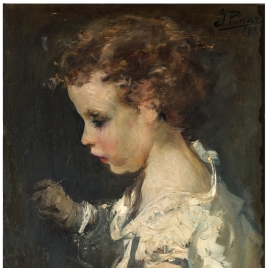
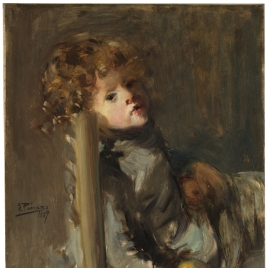
Ignacio’s charm, the ease of his movements, and his spirited character were captured in numerous works that portray him absorbed in the task of studying. One such drawing bears the inscription mal estudiante ("poor student"). In it, the boy reclines in his chair, one arm on the table and the other draped over the backrest, a posture that clearly conveys boredom and fatigue. A second drawing and two loosely executed oil studies depict him in a more focused pose, with his right elbow on the table, supporting his head in his hand, though the other arm still rests on the chair back. In all cases, a book or notebook lies atop a satchel on the table.
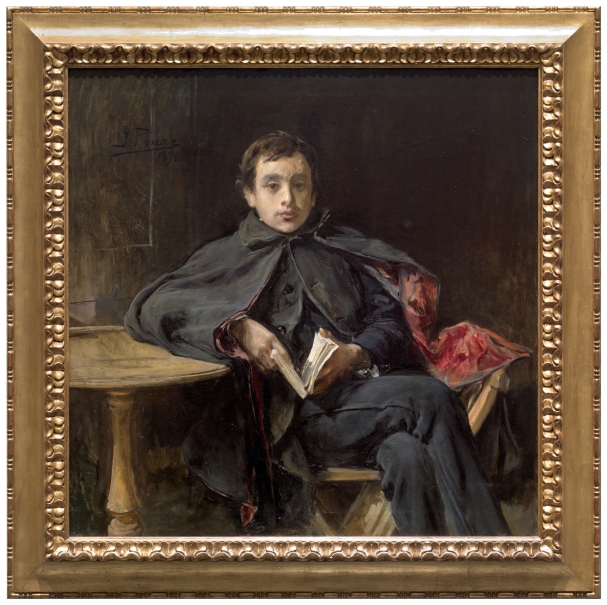
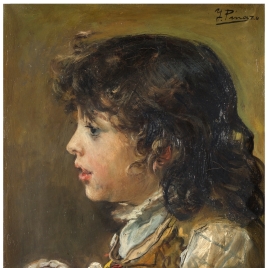
In the final painting housed in the Museo del Prado, Ignacio’s demeanor and expression appear more introspective. He holds his book, partially open, in both hands and is dressed formally as a schoolboy, in long trousers, a jacket, and a gray capelet lined with pink. To explain the transformation of the boy into a more mature adolescent between the initial sketches and the completed canvas, Manuel González Martí suggested that Ignacio had contracted typhus, which forced his father to interrupt the work. By the time the boy recovered, he had grown significantly. However, given that the earliest studies date to 1893 and the final painting was completed in 1898—when the model was already fourteen or fifteen—Pinazo must have entirely reworked the composition, preparing a new study of the head to reflect the change.
Pinazo returned to this theme in 1904 with the canvas “On the Eve of Exams”, in which a weary student is shown asleep at his desk.
Awarded the First Medal at the 1899 National Exhibition of Fine Arts, reveals the influence of Golden Age painting, particularly that of Velázquez, evident in the broad brushwork, dominant tonalities, and the dim interior that suggests a sense of spatial depth. Echoes of El Greco—an artist whom Pinazo openly admired—were also noted by contemporary critics. The painting occupies a hybrid position between genre scene and portrait and was occasionally exhibited as the latter. Two years before completing the work, Pinazo had stated in his acceptance speech to the Royal Academy of Fine Arts of San Carlos that the finest paintings since the Renaissance had been portraits. He added, with explicit reference to those two masters: “Indeed, in the finest works of Velázquez, El Greco, and other artists, we see that portraiture—both individual and of manners—has served as the touchstone for assessing each artist’s degree of talent, observation, and sensitivity.” In this regard, Pinazo’s engagement with reality reflects a kind of emotional expressiveness that is absent in the work of certain other naturalist painters of his time.
Barón, Javier, 'Ignacio Pinazo Camarlench. La lección de memoria'. Arte y transformaciones sociales en España (1885-1910), Madrid, Museo Nacional del Prado, 2024, p.172 nº.82