The friend (In Cordoba)
1901. Oil on canvas.On display elsewhere
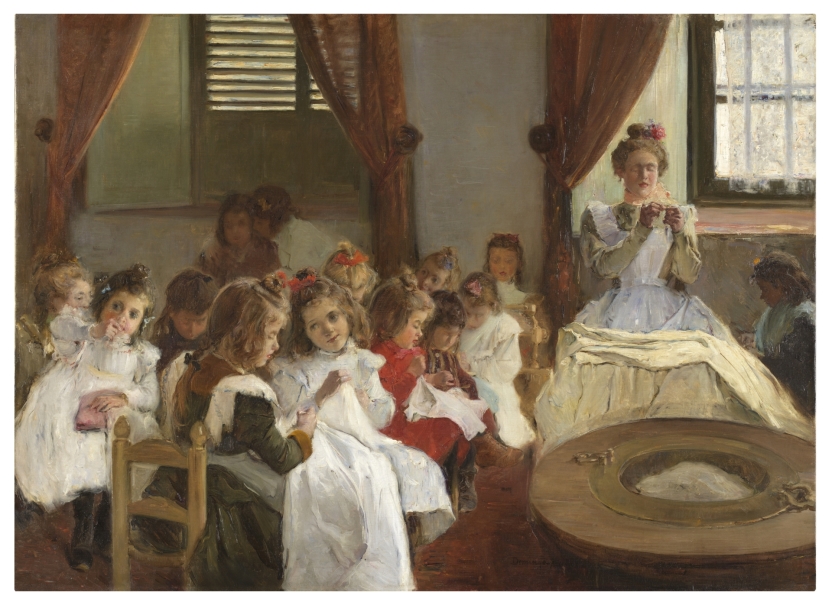
In the second half of the 19th century, the debate surrounding women’s education was both active and wide-reaching, supported by the voices of some of the most prominent thinkers of the period, from Concepción Arenal to Emilia Pardo Bazán. These figures championed women’s right to access education and knowledge. The political project of bourgeois liberalism established a social order in which men and women were segregated into distinct spheres. This framework necessitated the implementation of an educational system that addressed the roles assigned to each gender separately. The Moyano Law (1857) institutionalized differentiated education for boys and girls in Spain, laying the foundation for a profoundly unequal legal and political system that remained firmly in place throughout the following century. Artistic imagery sanctioned by the official academic system—such as this painting—served to reinforce the most conservative positions of that discourse, advocating for a minimal education oriented toward domestic life. It is no coincidence that this work received a Second-Class Medal at the 1901 National exhibition of Fine Arts, and that public collections contain other examples of similar iconographic interest and comparable quality, acquired for the same reasons.
In this painting, Muñoz presents a scene infused with the irresistible charm of a delightful group of young girls learning to embroider, gathered around the woman responsible for their instruction. In Córdoba, such female caretakers—tasked with educating small girls—were known by the term that gives the painting its title. These "friend schools" offered rudimentary training focused on domestic tasks during early childhood. The painter—whose greatest successes came as an illustrator—applied his distinctive graphic style here: spontaneous, free, and informal. This aesthetic approach enabled him to convey the immediacy of the lively group of girls on the left, whose movement he accentuates through the handling of painterly material and the end of his brush.
These informal kindergartens are documented throughout the 19th century thanks to valuable literary sources, including Serafín Estébanez Calderón—who described them in “La miga y la escuela,” part of his Escenas andaluzas (Madrid, 1847)—and they continued into the early 20th century with Juan Ramón Jiménez: “If you came, Platero, with the other children, to the miga, you would learn the ABCs and write your first strokes.” For boys, such schools were often recalled as places of harsh discipline and little learning—experiences later remedied through more formal instruction. For girls, however—as immortalized by Cecilia Böhl de Faber (Fernán Caballero) in “La gaviota” (1849) and “La familia de Alvareda” (1849), especially in rural settings—these schools formed the basis of their training as future mothers and household managers. Like the boys, they memorized the basic tenets of Christian doctrine, but their instruction focused primarily on the domestic responsibilities that lay ahead, in accordance with what the law allowed. Fernán Caballero’s pedagogically driven prose offers a wealth of details that have since helped reconstruct the activities of the Friends schools, and her accounts also provide the costumbrista backdrop against which this painting unfolds.
Indeed, historians of education have recognized these institutions as a distinct educational reality in regions such as Andalusia, Extremadura, and both Castiles. While they functioned as informal schools for children of both sexes, they often extended for girls until the age of twelve or fourteen.
Paradoxically, the first institution to house this painting, following its transfer from the Museo de Arte Moderno, was the Escuela Normal de Maestras in Madrid, as per the Royal Order of 22 September 1919.
G.Navarro, Carlos, 'Domingo Muñoz y Cuesta. la amiga (En Córdoba). Arte y transformaciones sociales en España (1885-1910), Madrid, Museo Nacional del Prado, 2024, p.174-175 nº.83