Work, rest and family
1903. Oil on canvas.On display elsewhere
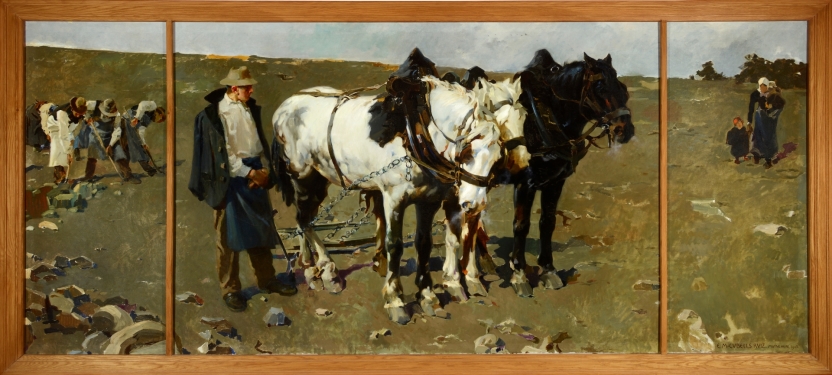
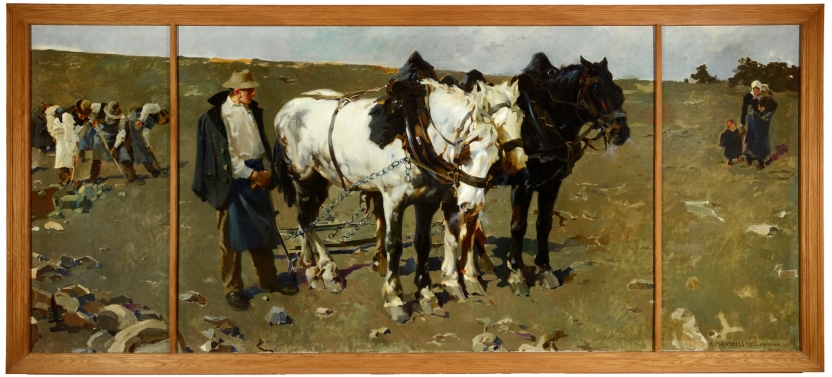
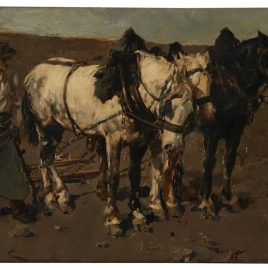
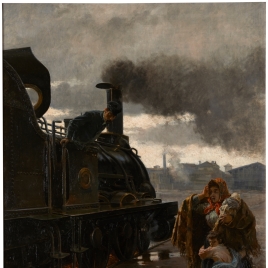
This work marked a renewal in the treatment of rural labor, a theme previously addressed by other artists through a naturalist lens. The triptych format was frequently adopted by artists seeking to move beyond that style, offering a broader vision often imbued with a degree of symbolism. It allows for the depiction of three scenes, unified by the continuity of the horizon line. The juxtaposition of nouns in the title—each corresponding to one panel—reflects a distilled, essential vision of agricultural life, transcending the instantaneous and circumstantial character typical of earlier naturalism. In keeping with this, the composition is not dominated by the act of Labor itself, but rather by the serene balance of Rest. The artist reinforced this sense of timelessness through the use of a classical architectural frame, complete with base, pilasters, a frieze of Ionic palmettes, and a cornice encompassing the ensemble. Though the original frame has been lost, the artist had prepared a preliminary study with a triptych frame in the same format as the final painting.
The sketch-like execution of figures and background, as well as the flattened landscape, signal Martínez Cubells’ pursuit of innovation during this phase of his career—one shaped by travels to Belgium and the Netherlands and a formative stay in Munich, the city where he signed the most significant works of his career. His skill in depicting horses had already been demonstrated in Winter in Munich (also held at the Museo del Prado), a widely praised work that earned him a Second Medal at the 1901 National Exhibition. As in that painting, his desire for realism extends in the present triptych to the depiction of the animals’ breath in the cold rural atmosphere.
He submitted this piece to the 1904 Exhibition, where it was awarded a First-Class Medal. The writer Ramiro de Maeztu, echoing the remarks of several painters upon seeing a reproduction of the work in a British magazine under the title Off Duty, accused it of plagiarizing a painting by an alleged artist named Snadstrom. Much later, José López Jiménez, writing under the pseudonym Bernardino Pantorba, referred again to the alleged plagiarism, which in fact involved the Swedish painter Harriet Sundström (1872–1961). Her work was also a triptych, but with the animals positioned in reverse, lacking a central human figure, and differing in several other significant respects. The controversy sparked a wave of criticism, which intensified once the painting was awarded a medal. The artist himself was compelled to defend his work in a letter asserting that many individuals could attest that his idea for the painting predated the alleged source. While clear differences exist between the two works, it is notable that Sundström had also worked in Munich with Heinrich von Zügel (1850–1941), a painter specialized in animals, with whom Martínez Cubells had likewise studied.
Some of the very features that drew criticism—such as the thinness of the pictorial surface, the looseness of the brushwork, and the absence of atmospheric perspective—are precisely those that mark a modern departure from prior academic conventions. Other critics accused the artist of indecisiveness in his handling and described the painting as a “large sketch.” Nonetheless, the strongest defense of its restrained execution and its “laconic” quality—especially in contrast to the expressive pictorialism of Eduardo Chicharro’s triptych, the most popular candidate for the First Medal—came from respected critics such as Francisco Alcántara and Antonio Cánovas y Vallejo.
The central figure in the preparatory oil sketch recalls, in reversed pose, the Marteleur by Constantin Meunier, and also wears a rigid apron. Perhaps aware of this resemblance, the artist altered the character’s posture in the final version of the painting.
Barón, Javier, 'Enrique Martínez Cubells. Trabajo, descanso y familia'. Arte y transformaciones sociales en España (1885-1910), Madrid, Museo Nacional del Prado, 2024, p.95-96 nº.5