formularioRDF
The itinerary <em>TITULORECORRIDO</em> has been successfully created. Now you can add in works from the Collection browser
<em>TITULOOBRA</em> added to <em>TITULORECORRIDO</em> itinerary

Close Continuar a ficha de la obra Continuar a ficha de la obra
02-06-2026
Laureano Barrau Buñol

Caldetas, Barcelona, 1863 - Ibiza, 1957

See author's file

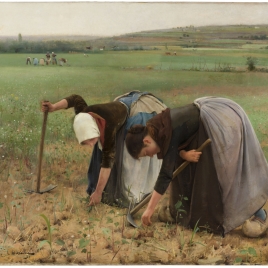
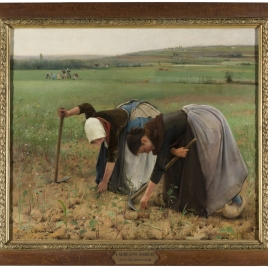
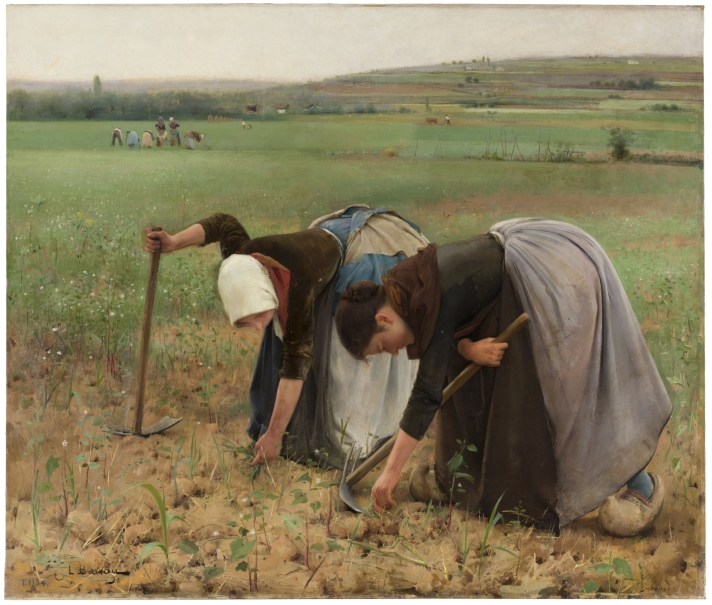
Women weeding the field

1891. Oil on canvas.
Room 061A

The painting depicts women engaged in agricultural labor, working with their hands and a hoe to remove weeds (or thistles) that have grown several weeks after sowing.

After receiving his artistic training in Rome and Paris and exhibiting several historical paintings, Barrau settled in 1891 in Olot (Girona), where he remained for a couple of years. At that time, the city was becoming an important center for the serial production of religious imagery and had attracted a number of Catalan landscape painters associated with the so-called Olot School, known for their melancholic approach to nature. The pictorial sensibility of this work—with its subdued, greenish tonality and the treatment and depth of the landscape, particularly the vaporous rendering of the middle ground where other peasants are seen performing various tasks—reveals the artist’s connection to that aesthetic ethos. This connection is reinforced by Barrau’s treatment of the subject: a tranquil, uncritical image of rural life, devoid of any reflection on the physical hardship or the daily self-sacrifice that defines the lives of these peasant women.

Nonetheless, contemporary critics focused exclusively on the painting’s relationship to French art, even criticizing it for relying too heavily on foreign models. Indeed, as has been noted, the composition recalls “Les Sarcleuses” (New York, Metropolitan Museum), painted by Jules Breton in 1860. While the subject matter is similar, Barrau’s interpretation diverges significantly from that of Breton and from much of the French painting that addressed similar themes. Barrau narrows the scene to just two women—compared to Breton’s six—and raises the horizon line, thereby emphasizing the prominence of the ploughed fields. Moreover, whereas French artists often used dramatic lighting contrasts and set such scenes at dusk or sunset, Barrau opts for the grey tonality of an overcast day, subtly blurring the background so that the horizon seems to dissolve into a fine mist.

Thus, while the influence of French realism is undeniable—and perhaps explains the positive reception the work received at the 1892 Salon—Barrau also clearly drew on the visual strategies of the Olot School.

This painting was, in fact, the first in a series of works from the final decade of the century in which Barrau focused on peasant labor. In these, he would return to the device of placing his figures in landscapes with elevated horizons, minimal skies, and similarly treated vegetation.

Martínez Plaza, Pedro José, 'Laureá Barrau. Escardadoras'. Arte y transformaciones sociales en España (1885-1910), Madrid, Museo Nacional del Prado, 2024, p.146 nº56
Technical data

Imagen del carrusel
Imagen del carrusel
Inventory number
P007667
Author
Laureano Barrau Buñol
Title
Women weeding the field
Date
1891
Technique
Oil
Support
Canvas
Dimension
Height: 160.5 cm; Width: 188 cm
Provenance
Acquired from the artist, 1892; Museo del Prado 1892–1896; Museo de Arte Moderno, 1896–1971
Entry date
1971

Bibliography +

Museo Nacional del Prado, Museo del Prado: inventario general de pinturas. Nuevas Adquisiciones. Museo Iconográfico. Tapices, III, Museo del Prado, Espasa Calpe, Madrid, 1996.

Orihuela, Mercedes y Cenalmor, Elena, El "Prado disperso". Obras depositadas en Córdoba y Sevilla. II. Sevilla. Capitanía General, Boletín del Museo del Prado, 20, 2002, pp. 161.

Coll Mirabent, Isabel, Laureà Barrau, Barcelona, 2003, pp. 66.

Díez, José Luis (dir.), Pintura del Siglo XIX en el Museo del Prado: catálogo general, Museo Nacional del Prado, Madrid, 2015, pp. 90.

Martínez Plaza, Pedro José, 'Laureá Barrau. Escardadoras', Arte y transformaciones sociales en España (1885-1910), Museo Nacional del Prado, Madrid, 2024, pp. 146 nº56.

Other inventories +

Inv. Nuevas Adquisiciones (iniciado en 1856). Núm. 1134.
1134 / Autor D. Laureano Barrau / Un Cuadro titulado "Las Escardadoras" / Alto 1'60 = Ancho 1'90 / [con otra grafía=] Pasó al Museo de A. M.

Actas del envío de cuadros del Prado al Museo de Arte Moderno. Núm. 1134.

Catálogo Museo de Arte Moderno, 1899. Núm. 31.
SECCIÓN DE PINTURA EN SUS DIVERSAS CLASES, DIBUJOS Y GRABADOS EN LAMINAS. / BARRAU (D. Laureano) [...] 31.- Las escardadoras. / Alto 1'60 metros. Ancho 1'90 metros.

Catálogo Museo de Arte Moderno, 1900. Núm. 35.
SECCIÓN DE PINTURA EN SUS DIVERSAS CLASES, DIBUJOS Y GRABADOS EN LÁMINAS. / Barrau (D. Laureano) [...] 35.- Las escardadoras. / Alto 1'60 metros. Ancho 1'90 metros.

Registros-Inventarios Museo Nacional de Arte Moderno, 1900-1936. Núm. 6-B y 11-B.

Inscriptions +

L. Barrau / 91
Signed and dated. Front, lower left corner

MAM 6 (B)
Inscribed in red color. Front, lower right corner

T. 1134
Inscribed in blue. Front, lower left corner

Exhibitions +

Arte y transformaciones sociales en España (1885 - 1908)
Madrid
21.05.2024 - 22.09.2024

Art and Social Change in Spain (1885-1910)
Madrid
21.05.2024 - 22.09.2024

Location +

Room 061A (On Display)

Expuesto
Update date: 02-06-2026 | Registry created on 19-02-2016

Visor 360

Drag with the cursor to rotate the piece

Print on demand

Print artworks available in our catalogue in high quality and your preferred size and finish.

Image archive

Request artworks available in our catalogue in digital format.

Up