The little naturalists
1893. Oil on canvas.Not on display
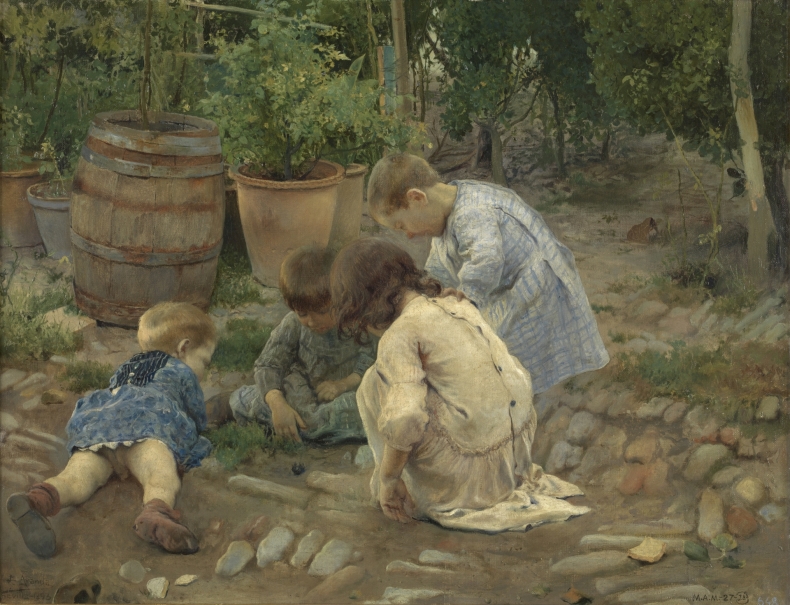
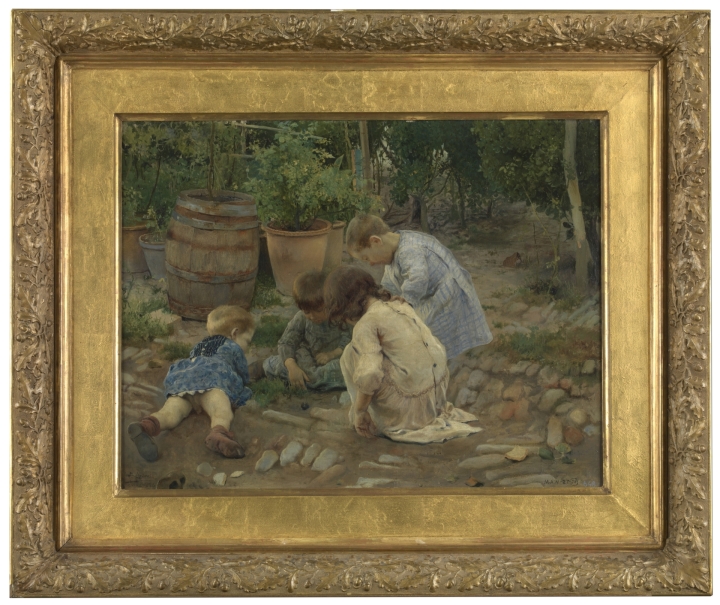
José Jiménez Aranda painted this work shortly after his definitive return to Seville, his native city, from which he had departed in 1871. The scene depicts four children on the ground in a courtyard or garden, completely absorbed in observing a beetle they have turned upside down. The title alludes to the children´s purely playful interest in entomology.
The painting is related to “Butterfly, the Girl Among Flowerpot” (Oviedo, Museo de Bellas Artes, Pedro Masaveu Collection), an unfinished work that remained in the artist’s studio until his death. In that canvas, set in a similar courtyard or garden—possibly the very same one as in the Prado painting, as suggested by the patterned stone flooring and the shape and coloration of some flowerpots—a girl looks up at a butterfly flying above her head. Her appearance closely resembles that of the seated girl in the Prado painting, and she may in fact be the same model.
In this work, the artist brings together his mastery of figure painting with his interest in the natural world, an interest that became especially pronounced in the landscapes of his later period, owing to his closeness to the Alcalá de Guadaíra school of painters. Indeed, some have linked this work directly to one of his stays in that Sevillian town.
The painting was exhibited at the 1894 Exposición del Círculo de Bellas Artes in Madrid, where it was met with unanimous praise, particularly for its technical excellence but also for the aptness of its subject matter. As Blanco Asenjo noted: “It possesses the precision of drawing and grace of composition that distinguish such a distinguished master. Moreover, the subject is tender and delicately felt. Those children examining an insect are truly beautiful. In both idea and execution, it is among the most successful works on display.”
Similarly, Aurelio Ribalta praised “the exquisite skill of its author” and described the artist as “a keen observer, expert draftsman, and gifted colorist.” Ribalta also highlighted “the French fashion” of the piece, alluding to a perceived dependence on French artistic content and pictorial language. Indeed, the subject was unusual within the context of contemporary Spanish painting, particularly within genre scenes, which rarely included themes of this kind—hence Ribalta’s remark. Nonetheless, the treatment of the vegetation and ground, as well as the meticulous rendering of the children’s clothing, are entirely consistent with Jiménez Aranda’s personal style, leading “El Imparcial” to conclude that it was a work “as polished and meticulous as all his others.”
Martínez Plaza, Pedro José, 'José Jiménez Aranda. Los pequeños naturalistas'. Arte y transformaciones sociales en España (1885-1910), Madrid, Museo Nacional del Prado, 2024, p.171-172 nº81