José Jiménez Aranda
Sevilla (Spain), 7.2.1837 - Sevilla (Spain), 6.5.1903Gifted with extraordinary drawing skills that would characterize the development of his entire career, Jiménez Aranda began his training in 1851 at the Academy of Seville, along with the painters Manuel Barrón (1814-1884) and Eduardo Cano de la Peña (1823-1897). In 1864, as a genre painter, he began to participate in the National Exhibitions of Fine Arts, obtaining his first honorable mention that same year. In 1868 he moved to Madrid and there he got to know first hand the work of Velázquez and Goya, who impressed him deeply.
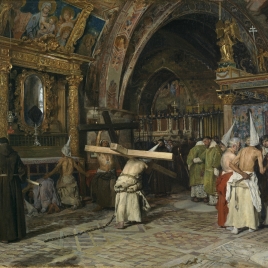
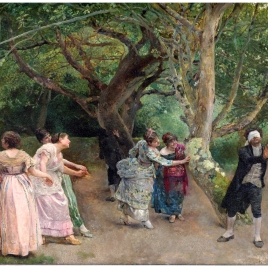
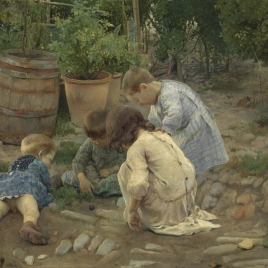
Between 1871 and 1878 he remained in Italy, where he came into contact with Mariano Fortuny, who had a great influence on the young artist, perceptible in paintings such as "Penitentes en la Basílica Inferior de Asís" (P7777). On his return he spent a brief period in Valencia and then settled in Seville, where he remained for three years. In 1881, he traveled to Paris, and there he devoted himself to "tableautin" painting, in which he became a recognized specialist and with which he achieved great commercial success; he executed paintings mostly set in the 18th century, with gallant scenes - courtly or popular - such as "La gallina ciega" (P7755). On this trip, both the artist and his brother, also a painter Luis Jiménez Aranda (1845-1928), were in contact with the realist painting of Jules Bastien Lepage (1848-1884), who would influence the plastic art of both artists. In 1890 José returned to Madrid, where he presented "Una desgracia" (Cádiz, private collection) at the Nacional, for which he received a first medal; it is a painting that condensed his formal maturity and his realist interests understood from a clearly French point of view. Jiménez Aranda lost his wife and daughter in the cholera epidemic that devastated Madrid in 1892. That fateful event led him to move back to Seville, where he was first appointed a member of its Academy and then lectured at its school. After moving back to Seville, he preferred to dedicate himself to painting small scenes of daily life, in which he did not abandon, however, the realistic language he had already adopted, among which "Los pequeños naturalistas" (The Little Naturalists), of 1893, stands out.
Jiménez Aranda dedicated a large part of his career to graphic illustration. Among his main projects is the monumental edition of "El Quijote del centenario", in which the artist undertook the preparation of six hundred and eighty-nine "gouaches" -for which he deployed countless drawings- published in four volumes between 1905 and 1909 (C. G. Navarro in: El siglo XIX en el Prado, Museo Nacional del Prado, 2007, pp. 474-475).
The image with his portrait corresponds to the Museo del Prado drawing D009293.