The vaccine
Ca. 1911. Oil on canvas.On display elsewhere
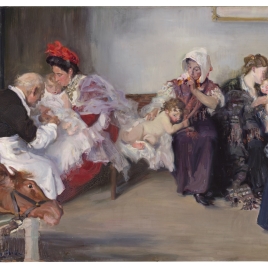
In the 1890s, several painters depicted scenes of childhood vaccination, using a compositional approach similar to that seen in this work. For example, “The vaccination” (whereabouts unknown), presented by Vicente Gómez Novella in 1892, included the doctor or vaccine administrator, the child receiving the shot, and the calf or cow—since cattle were commonly used for smallpox vaccinations, which is almost certainly the subject represented here. These same protagonists appear in a similar configuration in “Vaccination Center” by Manuel González Santos (P7693), painted a few years later. Although such vaccinations were sometimes administered in private homes (with the practitioner and calf making house calls), they were also conducted in groups at purpose-equipped medical facilities.
This is the context Borrás presents, describing some of the medical tools—such as a dropper and bottles—and arranging various children whose expressions of fear or indifference form the painting’s most emotionally resonant element.
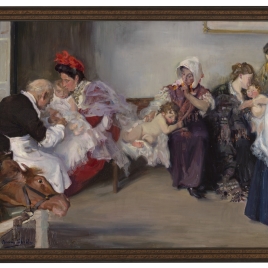
Because of its thematic relation to these other works, this painting had until now been dated to around 1890 or 1900 and referred to under the title “Childhood Vaccination”. Its provenance remained unknown, first appearing in the 1954 inventory of the Museo de Arte Moderno, with no details of its acquisition. This uncertainty is compounded by the differences between its signature and those found on the artist’s other works from between 1890 and 1905 (which typically featured firmer handwriting and the initial of his first name preceding his surname), and by the unusual nature of its support: the work consists of a single piece of canvas with a lower strip of pine wood affixed to the stretcher using two nailed corner blocks and a central nail. The signature appears on this added section. The join between the panel and the canvas is covered with ground preparation on the front. This type of addition is extremely rare in modern painting, where extensions were usually made using more canvas—by enlarging or altering the stretcher and sewing together two pieces of fabric.
We believe this painting is the same one Borrás submitted in 1911 during the competitive examination for the position of professor of color at the Escuela de Bellas Artes de Barcelona. The assigned subject was The Vaccine, and according to contemporary press reports, the artist submitted two works: one vertical-format painting showing a mother with her child seen from behind—resembling the figure at the far right of the present work—and another in horizontal format, which must be the Prado painting. It is true that the published photographs of the winning entry at the time did not show this second painting in full, but only its left half; however, the reproduction was clearly cropped, as demonstrated by the incomplete figure of the child at the right. Comparing these photographs to the Prado painting confirms they are one and the same. It is possible that, while working on the painting, Borrás decided to add the lower wooden section—perhaps due to an error in measuring the competition’s required dimensions. Alternatively, he may have added it after winning the competition.
Technical studies carried out by the Museo del Prado’s Department of Technical Documentation in January 2024 (including radiography, infrared imaging, and XRF analysis) confirm what a surface analysis already suggested: that both parts of the composition were painted in close succession, and that there are almost no significant changes in the composition—except for a slight extension of the skirt of the woman on the right, added when the wooden panel was incorporated.
The artist likely gave the painting to his brother Gabriel, a restorer at the Museo de Arte Moderno, whose name appears on the back of the painting as its owner. It is possible that Gabriel deposited it at the Museum with the expectation of a future acquisition that never materialized.
The painting technique differs notably from Borrás’s earlier large-format works and is instead more closely aligned with those he exhibited from 1905 onward, particularly in Barcelona, where Vicente Borrás was residing.
Martínez Plaza, Pedro José, 'Vicente Borrás Abella. La vacuna'. Arte y transformaciones sociales en España (1885-1910), Madrid, Museo Nacional del Prado, 2024, p.230-232 nº130