formularioRDF
The itinerary <em>TITULORECORRIDO</em> has been successfully created. Now you can add in works from the Collection browser
<em>TITULOOBRA</em> added to <em>TITULORECORRIDO</em> itinerary

Close Continuar a ficha de la obra Continuar a ficha de la obra
02-06-2026
Luis Graner y Arrufi

Barcelona, 1863 - Barcelona, 1929

See author's file

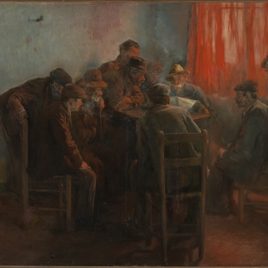
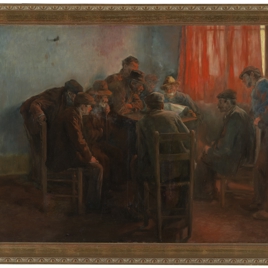
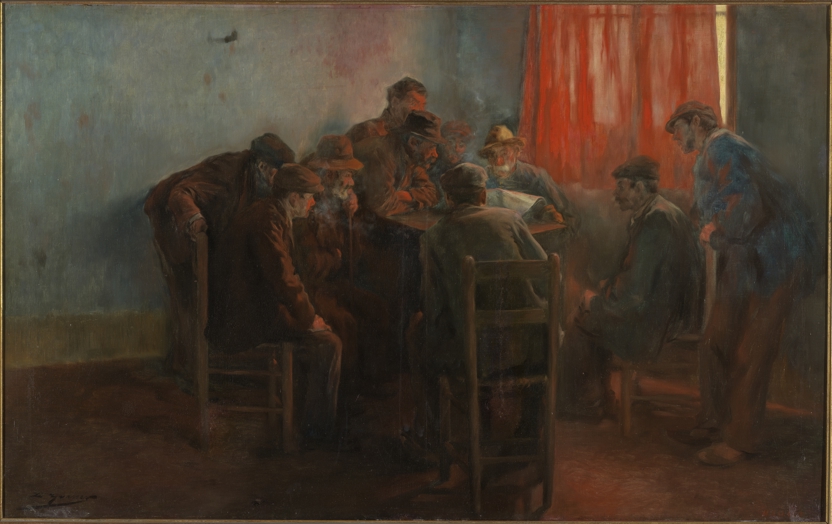
The Red Committee

1901. Oil on canvas.
Room 061A

Lluís Graner was an active figure within the “Modernisme” movement, alongside artists such as Rusiñol and Casas, but his modernity was expressed most distinctively through his brief yet significant role as a theatrical entrepreneur. Between 1904 and 1908, he organized the “Espectacles i Audicions Graner”—first at the Sala Mercè and later at the Teatro Principal in Barcelona. These performances were so innovative in conception that, in addition to text, scenography, and music, they incorporated early cinematic elements, at a time when film was still in its infancy.

Graner’s shift toward theatrical experimentation was prompted by disappointment: in the 1904 National exhibition of Fine Arts in Madrid, he received no award despite submitting eight paintings, two of which were large-scale. As a painter, Graner did not align himself with the burgeoning Impressionist or Symbolist styles—then the dominant markers of pictorial modernity across the Western world. Instead, his work remained grounded in naturalism, enriched by a near-constant preoccupation with the interplay of light and shadow. This approach often produced results reminiscent of a modern reworking of Baroque tenebrism. As a result, his paintings, typically set in dark interiors or nighttime exteriors, frequently feature a dramatic focal point of light—be it fire or sunlight filtering through a window.

In this particular work, the contrast in lighting is more subdued than in others. The diffuse daylight entering through a window, partially veiled by a curtain, suggests that the presumed syndicalists depicted in this clandestine meeting do not wish to be seen from outside. The painting—already titled “The Red Committee” at the time of its creation, with the curtain itself notably red, whether intentionally or not—clearly alludes to the labor struggle in Catalonia, a region that, due to its advanced industrialization, was frequently marked by labor unrest.

Nevertheless, the “Red Committee” portrayed here, composed of ten figures, must be understood in a general or symbolic sense, as no specific syndicalist organization bearing that name is known to have existed at the time. The painting may be linked to the republican groups promoted by Alejandro Lerroux under the banner of “Red Youth” or “Red Ladies.” Notably, the year the painting was completed—1901—was also the year Lerroux arrived in Barcelona.

The subject matter of this painting, which received a Second-Class Medal at the 1901 National exhibition of Fine Arts in Madrid, is therefore fully aligned with the new thematic orientation of artworks that succeeded the long-dominant tradition of history painting, now transformed into works of explicit social content.

Fontbona, Francesc, 'Lluis Graner. El comité rojo'. Arte y transformaciones sociales en España (1885-1910), Madrid, Museo Nacional del Prado, 2024, p.387-388 nº.281
Technical data

Imagen del carrusel
Imagen del carrusel
Inventory number
P006387
Author
Luis Graner y Arrufi
Title
The Red Committee
Date
1901
Technique
Oil
Support
Canvas
Dimension
Grosor: 2 cm; Height: 100.5 cm; Width: 160 cm
Provenance
Acquired from the author for Museo de Arte Moderno, 1901; Museo de Arte Moderno, 1901–1971; Museo Nacional Centro de Arte Reina Sofía, 2016
Entry date
2016

Bibliography +

Pantorba, Bernardino de, Historia y crítica de las Exposiciones Nacionales de Bellas Artes, Jesús Ramón García Rama, Madrid, 1980, pp. 176.

Bernal Muñoz, José Luis (ed.), Arte y literatura en la edad de plata. La mirada del 98, Ministerio de Educación y Cultura, Madrid, 1998, pp. nº 68, pp. 125-126.

Torres Villanueva, Eugenio, 'Cambios económicos y fuerzas sociales', En: Regeneracion y Reforma . España a Comienzos del Siglo XX, Fundacion BBVA, Madrid, 2002, pp. 325-377 [376-377].

Orihuela, Mercedes y Cenalmor, Elena, El "Prado disperso". Obras depositadas en Almería y Jaén. Jaén. Museo, Boletín del Museo del Prado, 23, 2005, pp. 127.

Iglesias Cano, Maria del Carmen (ed.), Encrucijada de culturas, Ibercaja, Zaragoza, 2008, pp. 408 nº.261.

Díez, José Luis (dir.), Pintura del Siglo XIX en el Museo del Prado: catálogo general, Museo Nacional del Prado, Madrid, 2015, pp. 246.

Fontbona, Francesc, 'Lluis Graner. El comité rojo', Arte y transformaciones sociales en España (1885-1910), Museo Nacional del Prado, Madrid, 2024, pp. 387-388 nº.281.

Other inventories +

Inv. General del Museo de Arte Moderno, 1899-1902. Núm. 1026.

Registros-Inventarios Museo Nacional de Arte Moderno, 1900-1936. Núm. 48-G y 84-G.

Inv. Museo Nacional Centro de Arte Reina Sofía. Núm. AS00023.

Inscriptions +

L. Graner
Inscribed in dark color. Front, lower left corner

M.A.M. 48 (G)
Inscribed in red color. Front, lower right corner

Exhibitions +

Arte y transformaciones sociales en España (1885 - 1908)
Madrid
21.05.2024 - 22.09.2024

Art and Social Change in Spain (1885-1910)
Madrid
21.05.2024 - 22.09.2024

Zaragoza y Aragón: Encrucijada de Culturas
Zaragoza
05.06.2008 - 19.10.2008

Regeneración y reforma. España a comienzos del siglo XX
Bilbao
09.04.2002 - 19.05.2002

Regeneración y reforma. España a comienzos del siglo XX
Madrid
01.01.2002 - 27.03.2002

Arte y literatura en la Edad de Plata. La mirada del 98
Málaga
01.10.1998 - 01.11.1998

Arte y literatura en la Edad de Plata. La mirada del 98
Madrid
04.05.1998 - 21.06.1998

Location +

Room 061A (On Display)

Expuesto
Update date: 02-06-2026 | Registry created on 02-03-2017

Visor 360

Drag with the cursor to rotate the piece

Other works by Luis Graner y Arrufi

Print on demand

Print artworks available in our catalogue in high quality and your preferred size and finish.

Image archive

Request artworks available in our catalogue in digital format.

Up