Salus infirmorum
1896. Oil on canvas.Room 061A
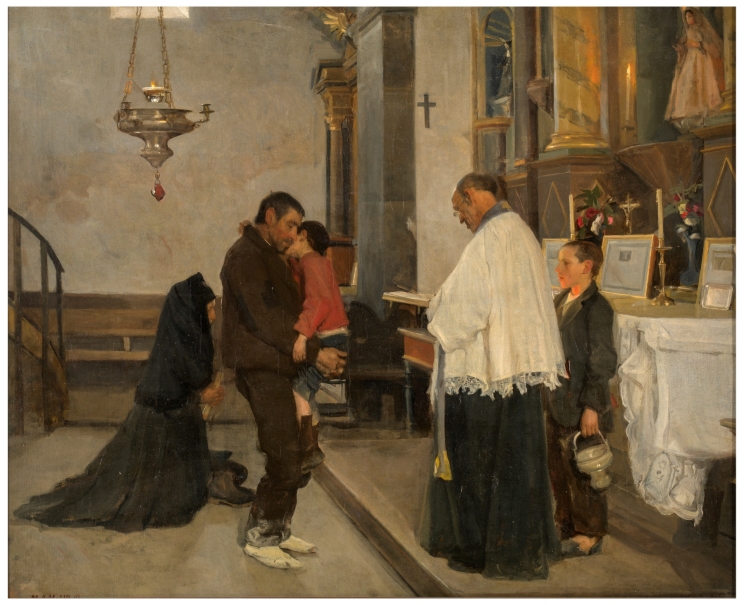
This is one of the finest works of the artist. He found in the seclusion and simplicity of his figures a sympathetic way of expressing his religious sentiments in a naturalistic manner. He painted the piece in 1896 from life, in the interior of the parish church of San Miguel de Pajares, near his family home, where the artist used to go during the summers. Similar themes, with similar compositions before the altar, were frequent in the last decade of the century, which saw an intense interest in these subjects, combining the religious motif with a highly naturalistic treatment. This is the case with Jean-Eugéne Buland´s “Before the Relics” (Troyes, Musée des Beaux Arts) and, in Spain, “Ex voto” (1892, private collection) and “The Kiss of the Relic” (1893, Bilbao, Museo de Bellas Artes) by Joaquín Sorolla and “The Offering” (private collection), a work by José Benlliure set in Italy. An iconographic antecedent even closer to the “Salus infirmorum” is the painting of the same name by the Sevillian Alfonso Cañaveral (1855–1932) in Rome. In fact, the subject was part of an early Romantic tradition cultivated by French artists in Rome such as Léopold Robert and Jean-Victor Schnetz, who combined the simplicity of popular religious sentiment with a faithful rendering of the characters and attire of the Italian peasants. But in the spirit of the fin-de-siècle, the emphasis on physical helplessness added a nuance related to the themes that had triumphed in social painting.
In Menéndez Pidal´s intimate work, the spirit of humility and faith of the peasant carrying his child in his arms is reflected in his bowed head and in the fact that, as a sign of respect, he is shown without his boots, revealing his white stockings. The study of artificial light (one of whose spotlights is hidden) is very characteristic of the artist. With this careful and restrained naturalistic effect, he sought to emphasise the spirituality of the scene. The colour, very measured in its balance between cold and warm tones, and the loose, precise brushstrokes are typical of his best creative period. Menéndez Pidal´s devotion to Mary, inspired him to paint, among other works, a Virgin of the Rosary, now lost, for the convent of Santo Domingo in Oviedo. Once the painting was finished, and as it was not known that a new National Fine Arts Exhibition would be held in 1897, the artist sent it to the prestigious International Exhibition in Munich, finally being awarded the first medal in the 1899 National Exhibition.
Barón, Javier, 'Luis Menéndez Pidal. Salus Infirmorum'. Arte y transformaciones sociales en España (1885-1910), Madrid, Museo Nacional del Prado, 2024, p.196 nº.104