Vision of Saint Francis of Assisi
1888. Oil on canvas.On display elsewhere
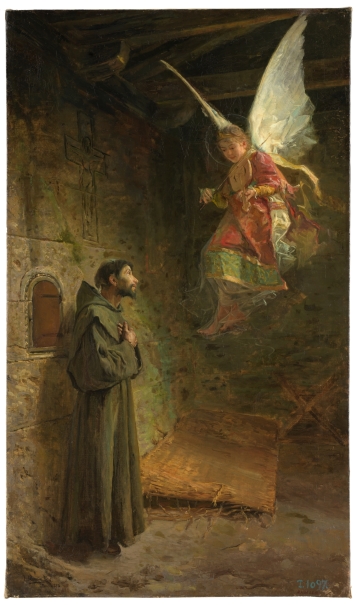
The artist, who had been living in Italy since 1885 thanks to an extraordinary grant from the Ministry of Public Works to further his studies, painted this work in Florence in 1888. In addition to the painter´s deep religious sentiment, the visit to Assisi must have inspired him at a time when many Spanish artists, including José Jiménez Aranda, José Gallegos and, above all, the Benlliure brothers, were painting while residing in the Italian town. Furthermore, at that time the decoration of the basilica of San Francisco el Grande was under way, on which his master Alejandro Ferrant, among others, was working and in which Menéndez Pidal himself would decorate a vault some years later in 1917.
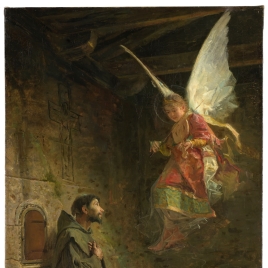
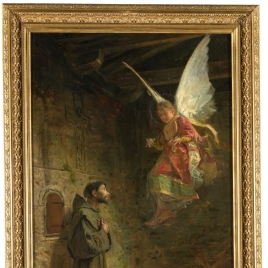
The prevailing spirituality of the last decades of the century had led to a rise in the figure of the saint and of I Fioretti di San Francesco, who is depicted here by the artist, who recreates an iconography common in Counter-Reformation painting from the late 16th century onwards. The painter must have been familiar with the examples of Ribalta (P001062) and Murillo (San Fernando Academy, Madrid), as well as that of Ludovico Cardi, II Cigoli (Florence, Uffizi), but none of them influenced him. To the contrary, the type of the saint is closer to Saint Francis Embracing Christ on the Cross. That work by Murillo was well-known to Menéndez Pidal, as it was located in Museo de Bellas Artes in Seville, where the artist had begun his career as a painter in 1875–76, by precisely copying works by the Sevillian artist. The atmosphere of the work, the interior and the bed are also reminiscent of the mature paintings of Domenico Morelli (1826–1901), a painter well known to Spanish artists. The technique used for depicting the angel is loose. There is no outline drawing, the wings and veils appear as transparencies and the colouring is richer than in the rest of the painting. All these aspects are related to the painting of his master Ferrant, whose watercolours suited an ethereal figure, like that of a vision of ecstasy. It is likely that the artist was also influenced by his master in Florence, Stefano Ussi, who had clarified his palette in his maturity, on the chromaticism.
Given that the painting was of regular size, Menéndez Pidal made a sketch (E. Masaveu Collection, Gijón, Asturias), in which the main motif is not the Angelic Concert, as in the final work, but the same counter-reformist theme depicted by José de Ribera in his Vision of Saint Francis in the Museo del Prado (P001107), with which the painter was well acquainted. In the painting, the light comes from outside, the saint is standing, and the angel in the sketch becomes a young musician angel; both figures occupy almost the entire composition and take on greater importance, as does the interior, especially the couch. The careful depiction of the latter shows an attention to humble objects which, as in the saint´s realistic and ardently numinous physiognomy, recalls the spirit of 17th-century Spanish painting, although the type of angel is foreign to that tradition, as critics noted when it was exhibited in Madrid.
The artist submitted the canvas for the competition organised by Abelardo de Carlos, director of La Ilustración Española y Americana, in June 1888. Nevertheless, it was finally rejected as it did not meet the conditions required.Barón, Javier, Luis Menéndez Pidal en el Prado. Boletín del Museo del Prado, Madrid, Museo del Prado, 2004, p.66-69