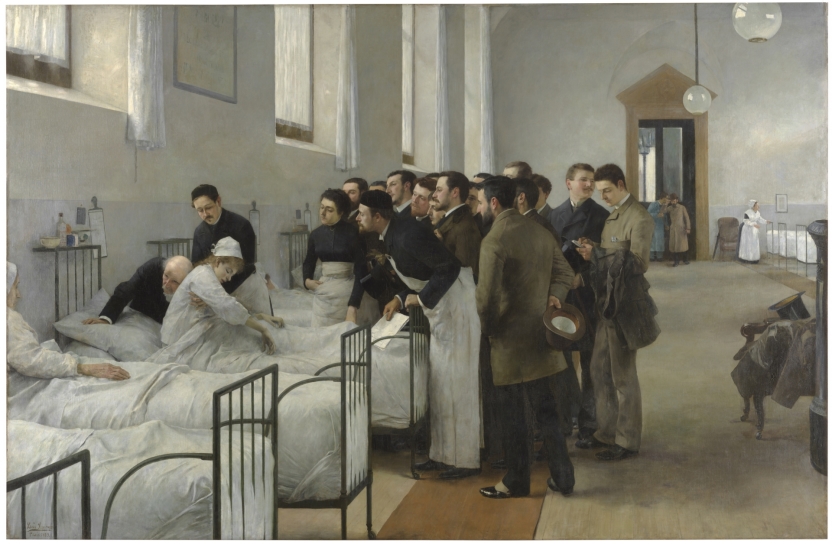
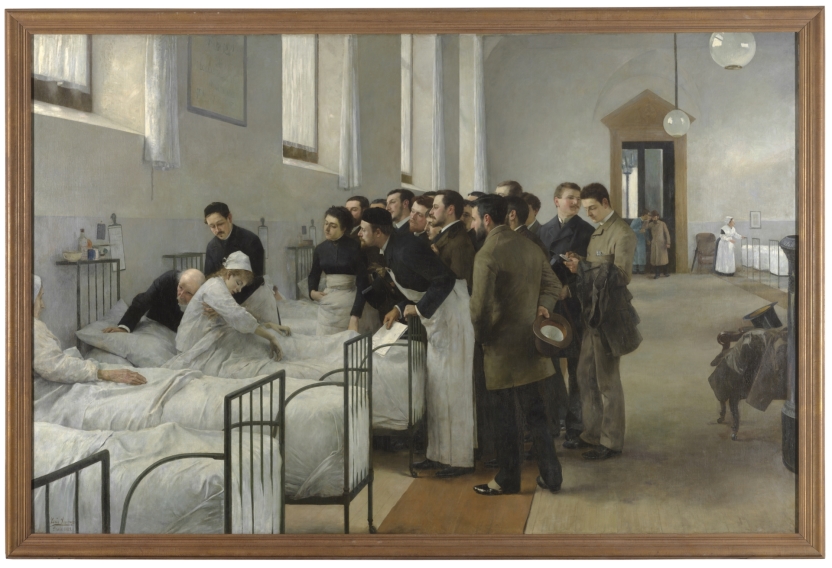
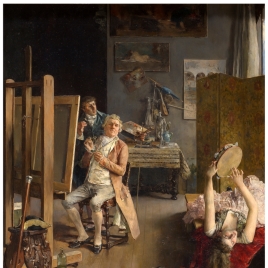
A Hospital Ward during the Chief Physician’s Round
1889. Oil on canvas.Room 061A
Awarded an unexpected Medal of Honor at the 1889 Universal Exposition in Paris—an accolade accompanied by the bestowal of the Knight´s Cross of the Legion of Honor—this painting marked the beginning of the emergence of social painting in Spain. The artist, who had been living in France for over a decade and dated the painting in Paris, was well acquainted with the naturalist style that had developed there in previous years, and applied it to a medical subject that was very much in vogue at the time. Initially, he had planned to send a painting depicting King Alfonso XII’s visit to the cholera hospital in Aranjuez. However, prompted by suggestions concerning the Parisian destination of the work, he changed course. Moreover, that subject had already been treated by José Bermudo Mateos in his 1887 submission to the Exposición Nacional de Bellas Artes in Madrid (Madrid, Museo de Historia).
The diagonal composition lends drama to a space whose lighting is regulated by a succession of windows, producing an atmosphere of pale, whitish tones. This clarity reinforces the sense of clinical asepsis associated with hospitals—a concern that began to gain traction following the hygienic reforms advocated by Gustav Adolf Neuber in 1884. The chief physician’s street clothes rest on a chair at the right, marking the beginning of a shift in hospital protocols toward greater hygiene. His two assistants and the nurse wear gowns, though the rest of the attendees do not. The painting thus aligns with new visual modes of representing hospitals, focusing on both surgical procedures and diagnostic examinations or clinical lessons—the latter two combined in this scene.
The artist’s search for precision, in some sense paralleling that required in medical practice, is evident in the rendering of the fainting posture of the tubercular girl and in her hands, which contrast with those of the woman in the bed in the foreground.
Overall, the painting was well received, as critics perceived it to be aligned with a modern current that moved beyond history painting, while achieving precision and quality. In 1889, when it won the prize in Paris, it was largely due to jury president Ernest-Louis Meissonier, who remarked that amid so many history paintings, this was “the true note.” This comment was favorably echoed by the Spanish press, particularly by Eusebio Blasco—also a contributor to Le Figaro—who praised the work for its modernity. Conversely, other media outlets, whose favored history painters had been overlooked, claimed that Jiménez Aranda’s painting had been awarded “because of its subject matter” and the artist’s established reputation in Paris. The perceived slighting of major historical works by Antonio Gisbert, Francisco Pradilla, and José Moreno Carbonero provoked indignation from several writers, including Emilia Pardo Bazán, who felt compelled to defend them against what she saw as the circumstantial nature of Aranda’s painting. Aranda himself wrote her a polite letter in response.
The French press, for its part, welcomed the painting, albeit without offering in-depth commentary. Despite its size, the canvas was shown in numerous exhibitions. In 1890, it was exhibited at the Sala Parés in Barcelona, prompting substantial reviews from both Yxart and Oller. At the Exposición Nacional de Bellas Artes in Madrid in 1892, the painting continued to generate divided opinions. Some critics misunderstood the objectivity and clinical atmosphere of the hospital that the artist had captured, describing the canvas as “stark, cold, monotonous; only the white note is visible everywhere,” and deemed the painting to lack emotional depth. It was also accused—especially by Yxart and Blanco Asenjo, who referenced “Gervex, Dantan, and Gelhay”—of being overly derivative of French painting. Moreover, some charged that it had been created with the aid of a camera obscura.
It is true that the work reveals an understanding of French painting—unsurprisingly, given that the artist lived in Paris and regularly exhibited at the city’s Salons. He also presented the painting at the 1891 Universal Exposition in Budapest, and tellingly, when it was included in the Spanish section of the 1893 World’s Columbian Exposition in Chicago, American viewers remarked that it could just as easily have belonged in the French section.
The influence of photographic composition is evident, but it was the most effective visual means for faithfully representing the hospital ward. The cropped foreground serves to draw the viewer directly into the scene.
Barón, Javier, 'Luis Jiménez Aranda. Una sala del hospital durante la visita del médico en jefe'. Arte y transformaciones sociales en España (1885-1910), Madrid, Museo Nacional del Prado, 2024, p.219-220 nº.123