In the Painter's Studio
1882. Oil on panel.Not on display
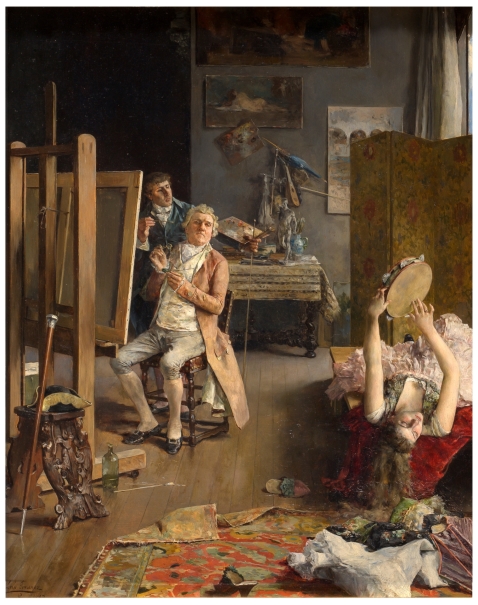
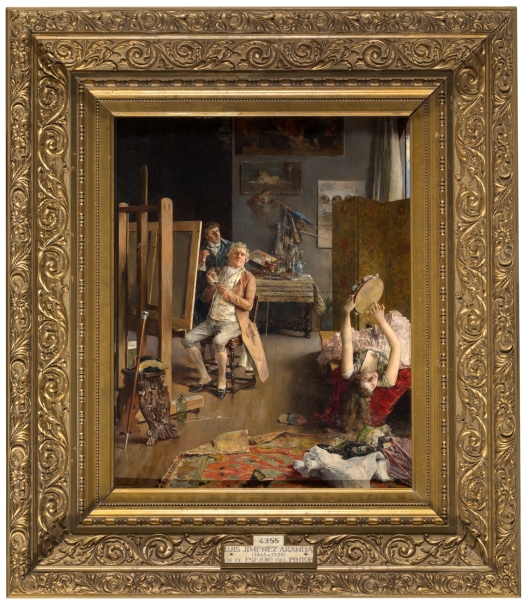
The painter realistically portrays a young woman posed lying down with a tambourine which she seems to be playing. In the background, among numerous objects, a mandolin hangs on the wall. The tambourine itself is a unimembranophone, consisting of a drumhead made of animal skin, which is attached to a circular frame of light-coloured wood. It is large and the rim is painted in colour: a red border and a black line. The pairs of zills protruding from the rim are visible. The model poses pretending to actually play the tambourine. She is holding the instrument with her left hand while with her right hand she is striking the tambourine with two or three fingers. It is played either by striking the drumhead with the back of the hand, rubbing it with the fingers using the roll, as depicted in the work, or by shaking the instrument to make the zills sound. It is a common instrument that appears in folk dances and in a great deal of folklore in Mediterranean Europe, often played by women.
The mandolin, hanging among other objects behind the painter, has a piriform body with a convex back, a circular sound hole, a short neck, and a slanted guitar-style pegbox. The number of strings and other details are unclear. The mandolin is a metal-stringed instrument played with a mandolin pick. It is shaped like a small lute and its use has been documented in Italy since the 17th century. It is an instrument for amateurs and popular music, which spread throughout Europe during the 18th century, becoming fashionable in the 19th and 20th centuries. The Neapolitan mandolin, the most common, has four sets of doubled strings, and the Milanese one has six single strings. Both the tambourine and the mandolin in the painting are among the objects the painter has in his studio and which probably serve as models (Proyecto Iconografía Musical, U.C.M.).
Other objects in the studio include a sword, a parasol, a plaster figure, various pieces of furniture and paintings. They also include The Painter’s tools, such as an easel, palette, brushes, and a green glass bottle with a very short neck. It is a Bordeaux bottle that seems to have been used to contain liquids used for painting, such as turpentine or oils.
Fernández Navarro, José María; Capel del Águila, Francisco, El vidrio en la pintura del Museo Nacional del Prado, Madrid, Consejo Superior de Investigaciones Científicas, 2012, p.45