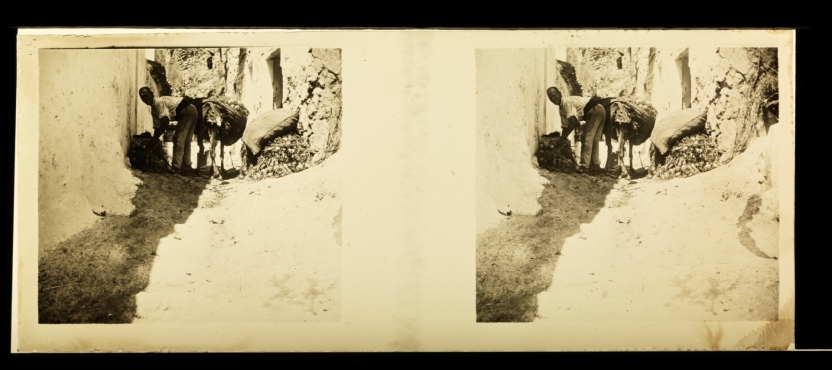
Man with a donkey on calle de la Sartén in Buñol (Valencia)
Ca. 1915. Gelatin / Collodion on glass plaque.Not on display
The many tasks associated with rural labor—nearly as varied as the regions in which they were performed—were highly appealing subjects for amateur photographers, who traveled from place to place with their cameras in search of the perfect image. Many engaged in stereoscopic photography, which marked a true revolution in the medium and encouraged the development of early collective initiatives. The exchange of stereoscopic plates was a common practice among enthusiasts, and as a result, collections often include photographs by different authors, even if their identification proves challenging. Such is the case with the archive of painter Cecilio Pla, from which this plate originates.
The photograph captures a scene in Buñol, a town in the interior of the province of Valencia where Pla and his family spent their summers. During those years, Buñol—known at the time as the “Valencian Switzerland”—was a popular destination among the bourgeoisie, a fact also reflected in contemporary painting. A local villager, sheltered in the shade cast by the surrounding houses, loads the saddlebags of his donkey on a narrow street where the remainder of an onion harvest is also visible. The steep road leads up to the castle, its tower just barely visible in the tight photographic composition. From an ethnographic perspective, the image is of particular interest for its depiction of tools such as saddlebags and for documenting a type of rural labor representative of agricultural practices throughout much of Spain.