An autopsy
1890. Oil on canvas.On display elsewhere
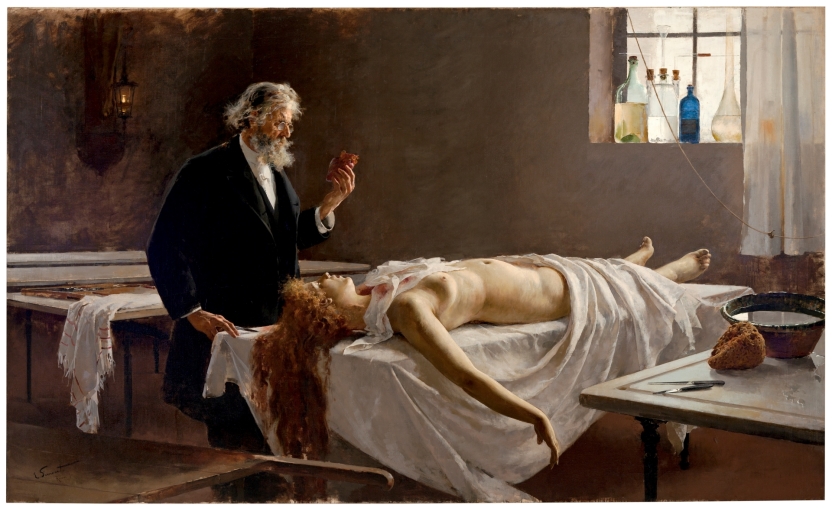
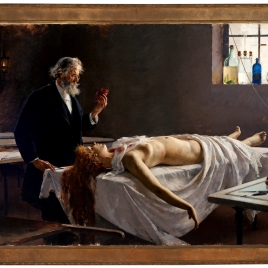
While in Rome on a state-funded art scholarship, Simonet wrote to his father on January 20, 1890: “I’ve begun with the sketches for my first-year submission. It’s a modern subject and represents the autopsy of the heart. You may find the subject choice surprising, but since it’s so difficult to guess the taste of the jury, I chose this one to see if it hits the mark. I won’t describe the subject, as without seeing it you wouldn’t get an accurate idea; I’ll send a photograph later to show to Mr. Muñoz [Degrain], whose authoritative opinion I would greatly value before beginning the final work.” He completed the preparatory work quickly, and just three months later, on April 29, he reported: “Tomorrow I’ll go to the hospital one last time to study the dead model, and I’ll finish my submission this very week.” On May 1, he submitted the painting, officially a nude study, to Vicente Palmaroli, director of the Spanish Academy in Rome. Although the work was expected to be shown at that year’s Exposición Nacional in Madrid, the submissions from the Academy in the Gianicolo did not arrive in time for the competition. Instead, they were exhibited from mid-June in the upper galleries of the Real Academia de Bellas Artes de San Fernando.
Critics generally agreed that Simonet’s was the most outstanding piece among the submissions. The only dissenting voice was Ceferino Araujo, who objected to its “repulsive subject, which inspires no sentiment other than disgust,” though he conceded the quality of the male figure. The seasoned critic detected a “lack of virility” in the painting—a claim countered by a young Antonio Cánovas y Vallejo, who wrote that Simonet was “fully devoted to the virile displays of the modern school.” Among the younger generation, the painting was embraced as an emblem of the realist renewal in Spanish painting, both thematically and formally. Cánovas emphasized that the artist had “kicked aside all the old, costume-laden subjects [...] and turned to study a scene dressed and executed in a modern manner,” and he even praised Simonet as a thinker—“a profound thinker”—for the very conception of the work.
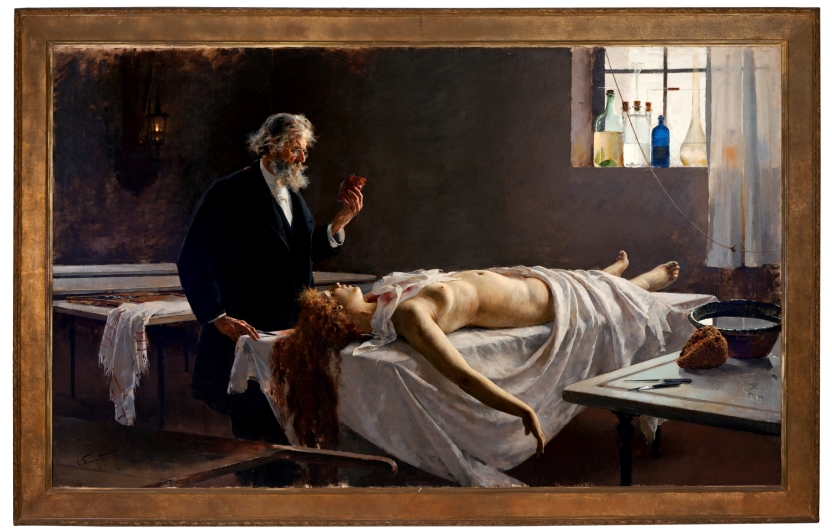
Francisco Icaza also defended the painting against Araujo, arguing that it depicted a scientific subject and that science, by nature, could not be repulsive. He and others appreciated the visual analogy between science and painting, evident in the scene’s synthetic and focused composition—reduced to just two figures—and in the artist’s technical adaptability to render each object with a range of brushwork and textures. The canvas indeed showcases virtuosic effects of lighting—such as the glass jars before the window and the shadowy background—and striking sensory contrasts between the marble surfaces, the emaciated corpse, and the white shroud covering it. This fidelity to detail stemmed from extensive life studies of both the setting and the human figures.
Yet critic Luis Alfonso nuanced this reception: “Whoever rejects the painting for being too realistic is missing the point entirely [...]. There is poetry in Simonet’s painting—bleak, morbid poetry in the manner of Edgar Allan Poe, if you will—but poetry nonetheless.” This insightful association with Romantic Gothicism, prompted by the physician’s contemplative pose—more meditative than scientific—reveals a symbolic subtext and connects the work to European precedents the artist may have had in mind, such as Gabriel von Max’s “The Anatomist” (1869, Neue Pinakothek, Munich) and Henri Gervex’s “Dr. Péan Performing Surgery Before an Audience” (1887, Musée d’Orsay, Paris). These antecedents—especially the former—embody the darker strain of Symbolism. Like Simonet’s painting, they portray male doctors studying female cadavers—the heart, in this case, interpreted as a metaphor for female emotion. As Ludmilla Jordanova has argued, such depictions reflect a form of patriarchal hegemony over the female body that underpinned many scientific images in 19th-century realist visual culture.
The painting is most commonly referred to by the apocryphal title “And She Had a Heart”, a reading that underscores its patriarchal interpretation. Not surprisingly, this perspective has prompted speculation about the identity, circumstances, and past of the dead woman portrayed by Simonet, as well as subjective remarks about her appearance. Nevertheless, the painting has enjoyed a long afterlife in popular culture, disseminated through countless mechanical reproductions of varying quality, and it has influenced contemporary art—most notably Barbara Kruger’s “No Radio” (1988, San Francisco Museum of Modern Art).
G.Navarro, Carlos, 'Enrique Simonet. Una autopsia'. Arte y transformaciones sociales en España (1885-1910), Madrid, Museo Nacional del Prado, 2024, p.220-222 nº.124