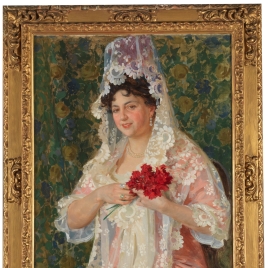
Asunción Castro Crespo, the painter's wife
1914. Oil on canvas.On display elsewhere
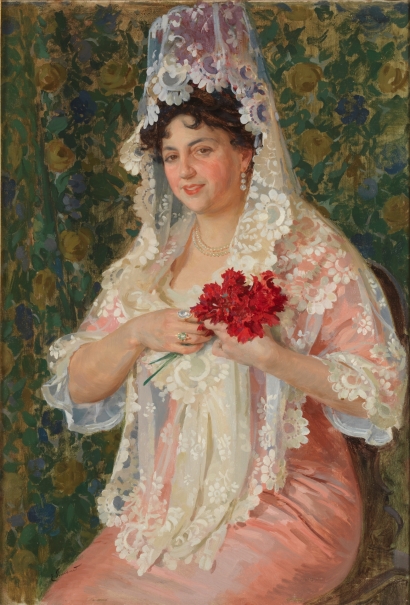
The painter carried out this portrait during the first months of 1914, when his wife was pregnant with her son Bernardo, who was born in Madrid on 20 March. She is depicted wearing a lace mantilla, which was a common trend in female portraits since the 19th century and became rather frequent during the first decades of the 20th century. The painter often used his wife as a model for his works, as she herself would later remember in 1964. Sometimes, these sessions spanned six or seven hours in his study; the harmony of her body and the gentleness of her facial features were aligned with his interests as an artist. Among other compositions, she was the model for the nude of Venus in The Judgment of Paris (Museo de Bellas Artes in Málaga), completed in 1904. In his painting, he portrayed her before she tuned 40, seated, with a satin pink dress and lace mantilla, with an ornamental comb, necklace and pearl earrings. Her right hand, with rings on her index and ring fingers, holds red carnations, a symbol of true love.
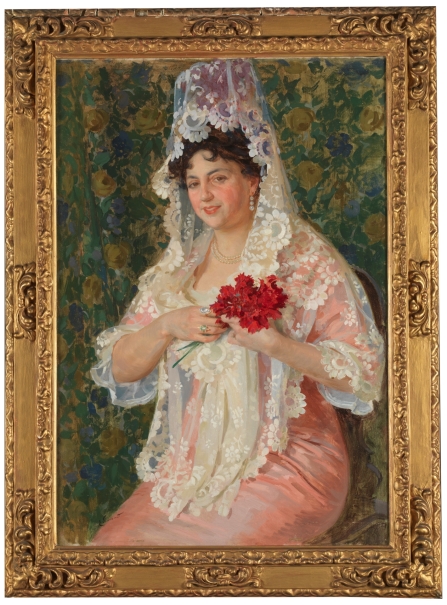
The figure stands out over an ornamental background with leaves and flowers. This background was executed with a smooth resolution that perfectly reveals its preparation. The curved fall of the string of flowers drawn in the left part of this portrait evinces a fold of a drapery. The matte tones in the cloth highlight the brightness of the dress and the brilliance of her skin, in which –as is typical of the painter’s work – blue, red and pink tones can be observed. Hues of blue are also perceptible in the folds of the dress, granting the attire vibrant brightness. The painter’s wife’s cheerful appearance along with her attire led the artist to present this painting under the title of A maja. This presentation took place in the Fine Arts Exhibition that opened on 1 March at the Academia de Bellas Artes in Málaga. The portrait was published under that title in both national and local illustrated press at that time. The artist framed the painting in a rich golden moulding with ornamentation in the corners and middle (Barón J. in: 2015 Activities Report, Museo del Prado, 2016, p. 86).