Portrait of a Lady
Ca. 1815. Oil on canvas.On display elsewhere
This female effigy was once attributed to the Andalusian artist José Gutiérrez de la Vega (Seville, 1791–Madrid, 1865) who worked in the pictorial tradition of Murillo. However, this claim became untenable from a formal point of view after analysing the aesthetic and technical characteristics of the piece, and in 1999 the work was given its current attribution.
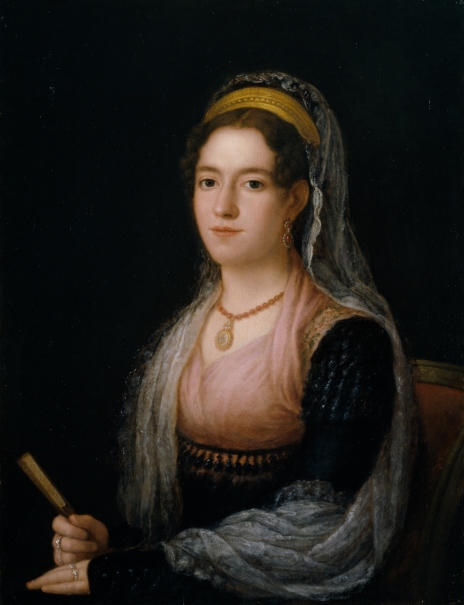
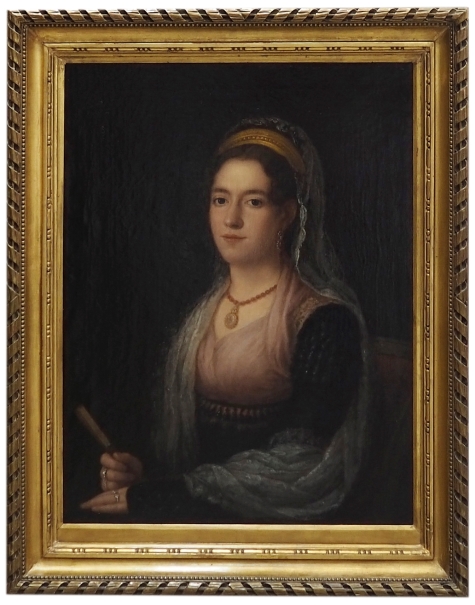
The painting depicts an elegant lady whose attire serves as evidence of her affluent social status. Half of her body is visible, and part of the armchair she sits on is perceptible behind her back. She is depicted in a three-quarter pose, with her face turned slightly to the left in relation to her body so that she is not fully facing the front. She stands out against a dark neutral background that, together with well-calculated uniform lighting, grants the figure a strong sense of volume that helps it to successfully obtain sculptural qualities even though there is a certain stiffness accentuated in her features by the grimace on her face. She is a woman with large eyes, marked eyebrows and a firm nose. She has a mole on the lower part of her nose that slightly livens up her serene yet rigid facial features, probably imposed by the stern general attitude that the sitter herself exhibits.
She is dressed in the fashion of the time (according to the traditions of the Empire style) and is wearing jewellery that enhances her natural attractiveness. These accoutrements contribute to the effect of discreet lavishness that she conveys to the viewer. Her exposed forehead is ennobled by an austere, middle-parted hairstyle, which is gathered in a bun halfway down her head and is held up by an ornate diadem headband, probably made of gold (or gilt metal). This type of diadem headband was sometimes held in place by a comb, decorated around the border with a series of tiny half-spheres as was customary at the time. A light-coloured lace mantilla protects her jewellery and neatly styled hair and drapes down over her shoulders and arms before it ends up gathered with refined carelessness under her breasts. This mantilla is being used as a shawl, halfway between a garment for warmth and an ornamental garment. Her neck flaunts a beaded necklace apparently made of coral from which dangles a gold medallion. Her outfit is completed by a dress with sleeves; her bust is covered by a type of jerkin made of a different fabric where delicate tones contrast with the dark colouring of the main garment. Her hands are visible, her fingers of both hands wear gold rings with rhinestones, and her right hand firmly holds a fan.
Everything in the work leads us to believe that this is a female portrait somewhere between protocol and everyday life, either of an aristocratic or bourgeois origin. This fact can be deduced from all the motifs present that were common to both categories, which gradually merged between 1800–1850 and were not easily distinguishable from one another in terms of their representation on the canvas.
Luna, J. J., Retrato de señora (h. 1815). En Barón, J.: El retrato español en el Prado. De Goya a Sorolla, Madrid, Museo Nacional del Prado, 2007, p.68, n. 6