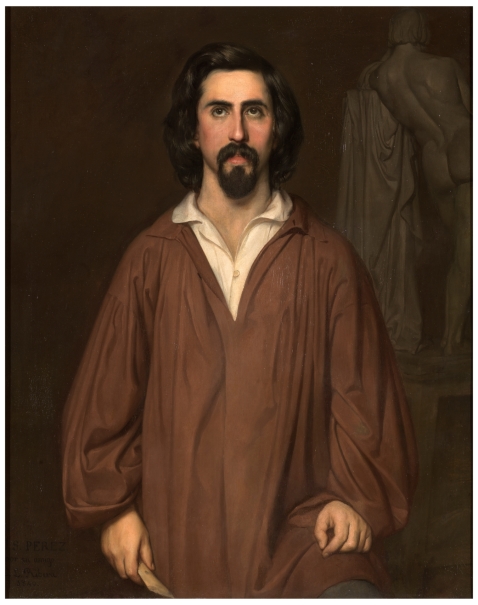
Portrait of the sculptor José Siro Pérez
1840. Oil on canvas.Room 062A
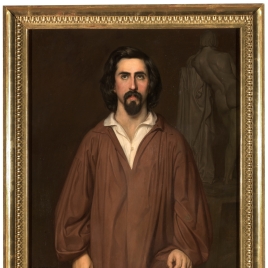
This is an important portrait in the early production of Carlos Luis de Ribera y Fievée, probably painted in Paris where the artist attended the workshop of Paul Delaroche (1797–1856). Its very sober, restrained, rigorously frontal interpretation reveals the influence of his French master, who had assimilated models inspired by the painting of the Quattrocento during his stay in Italy. The influence of purism is evident in the carefully studied drawing and the static, frontal composition. The raised eyes recall Ribera’s dedication to religious painting, who that same year presented two works in this genre along with two other portraits at the Salon. It was also common in works in this genre by other French painters such as Ingres and his pupils, including Jules-Claude Ziegler. The carefully studied colouring of the background, with its brown hues, is in harmony with that of the sculptor’s smock.
According to the label on the back of the canvas, the person portrayed represents the sculptor José Siro Pérez García (Madrid, 1809–Madrid, 1887), who was working during those years in Paris under the instruction of the French sculptor, David d’Angers (1788–1856). A year earlier, Federico de Madrazo had portrayed him in the French capital in a drawing preserved in the Museum, which belonged to the collection of effigies of artists and friends that he donated to the Museo del Prado (D005376). In his correspondence with his father José, Federico de Madrazo himself referred to the sculptor’s valuable activity in Paris, even though he also commented (in a letter dated 27 April 1837) that it was a pity he had moved there at a relatively advanced age for what was then usual in terms of his training. He collaborated with El Renacimiento, the Semanario Pintoresco Español and was founder, inspector of department chairs and finally president of the Sociedad El Fomento de las Artes (Society for the Promotion of the Arts). He worked in funerary sculpture and as a decorative artist. As an advocate of republican ideas, he made a bust of Francisco Pi y Margall, who presided his funeral.
Dressed in an open white shirt under the sculptor’s work smock, his dedication is revealed by the chisel he holds in his hand and in the carved marble figure that recalls the models of Praxiteles, interpreted with a vigorous rather than sensual and gentle character.
The sculptor’s friendship with Ribera and the reciprocity in the portraits are confirmed by the existence of one in a bust he made three years later, which he presented at the Fine Arts Exhibition at the Academia de San Fernando in 1844. Its plaster cast is kept at the same institution (E281).
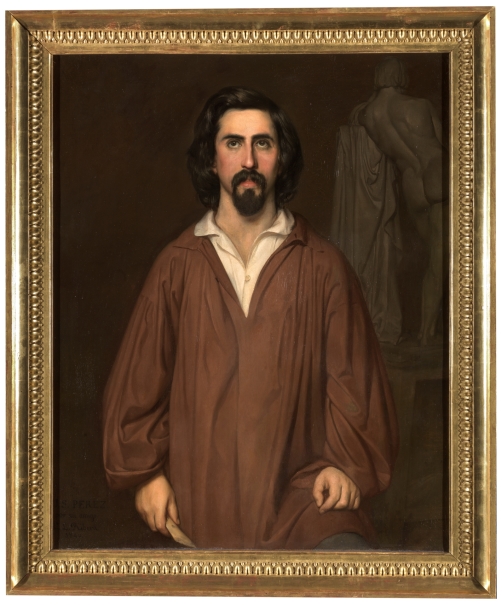
The painting preserves its double wedge stretcher (probably the original) and its frame, carved and gilded, with interlaced water leaves and alternating burnished and matte gold.
Barón, Javier, 'Carlos Luis de Ribera. El escultor José Siro Pérez'. en: Memoria de actividades 2021 Museo Nacional del Prado, Ministerio de Cultura y Deporte, 2022, p.57-59