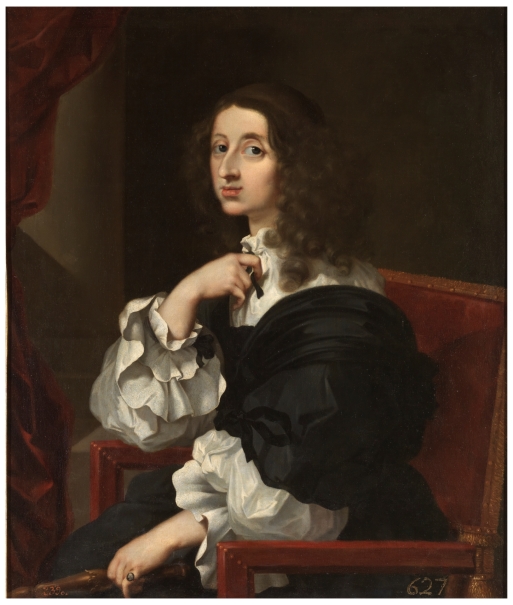
Queen Christina of Sweden
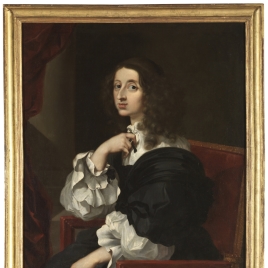
Ca. 1653. Oil on canvas.Not on display
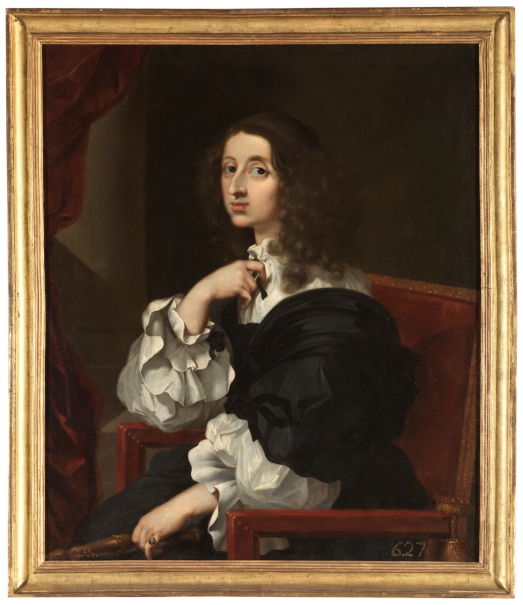
Sébastien Bourdon’s arrival in Stockholm in 1652 and his appointment as court painter in the service of Christina of Sweden (1626–1689) marked a significant shift in the construction of the public image of the queen. It was Bourdon who was responsible for some of the portraits that best defined Christina of Sweden as a ruler. They include the present one, in which the queen, seated on a splendid chair upholstered in red velvet trimmed with gold braid, holds the sceptre in her left hand as the symbol of royal power.
The queen wears a simple black silk dress against which her white puffed-sleeved undershirt stands out, tied at the neck with a thin black ribbon. The latter element was more characteristic of men’s clothing and reveals Christina of Sweden’s liking for wearing masculine dress. In fact, according to Bolich, over the following years she would adopt male clothing, a privilege granted by the pope which she regularly made use of.
The queen’s only adornment is the ring worn on the little finger of her left hand. The fact that it is a cameo references her interest in classical antiquity. As a great lover of literature and the arts, her reign saw a renaissance of art, culture, and science in Sweden, which became a destination for writers, astronomers, philosophers, musicians, and painters (such as Bourdon), who sought the queen’s patronage.
Another autograph version is held at the Musée des Beaux-Arts in Béziers (inv. 896.1.6). The Bayerische Staatsgemäldesammlungen in Munich holds an older copy that is slightly larger (inv. 4210, 125´3 x 10⁶´3 cm). Other copies are kept at Versailles (inv. MV 3463) and the Nationalmuseum, Stockholm (inv. NMGrh 2318). Although the latter has been regarded as the most significant of the copies of this portrait in the Nationalmuseum, it is not the only one held there; several others bear witness to the success of Bourdon’s design in shaping Queen Christina’s official image. Notable examples include NM Grh1992 (oil on canvas, 142 x 111 cm), and the miniatures based on the same model by Pierre Signac (NMB 2316, 11 x 8.5 x 1.5 cm) and by an unknown artist (NMGrh 3157, 7.2 x 5.4 cm).
García Pérez, Noelia, The female perspective II. Women art patrons of the Museo del Prado (1602-1700), Madrid, Museo Nacional del Prado, 2024, p.41 nº9