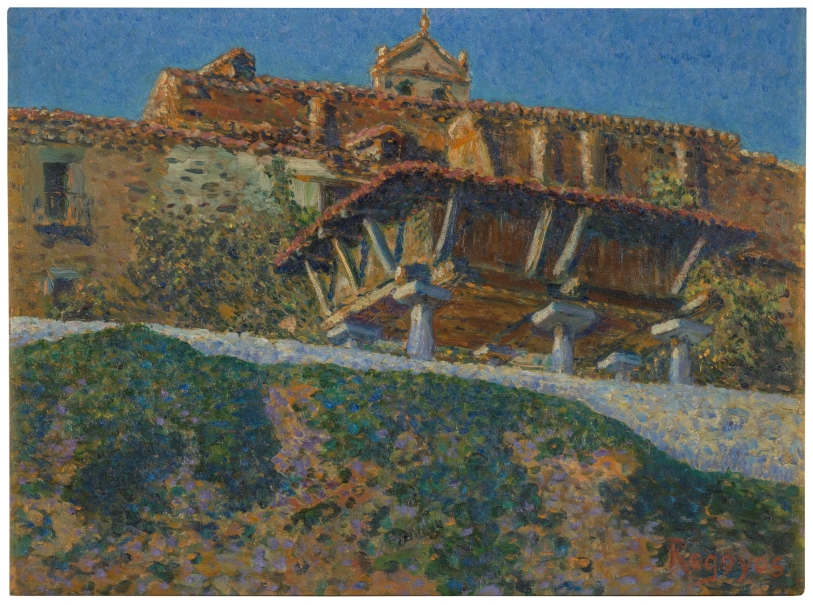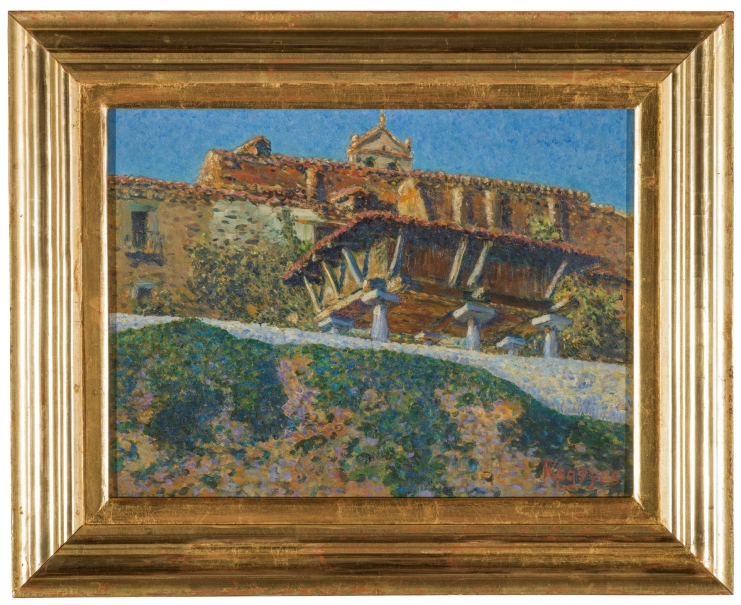
Raised granary (Asturias)
1891. Oil on panel.Room 060A
Regoyos was in close contact with prominent Belgium artists – amongst whom was Theo van Rysselberghe, who made a portrait of him (P4663) – and French artists, amongst whom were Camille Pissarro, Georges Seurat and Paul Signac. As a result of his friendship and participation in several exhibitions with these artists, he assimilated Pointillism into his practice, a barely represented style within Spanish painting, of which this landscape is an example. Painted in August 1891, this landscape is evidence of his initial interest in pointillist technique.
The painting, which was made from life during his trip to Asturias with the musicologist Charles Bordes, does not depict an hórreo (raised granary) in the town council of Quirós, as it was first recorded in the museum catalogue. This error was maybe due to the confusion with various pastel versions of Slow dance (Museo de Bellas Artes de Asturias in Oviedo; private collection) which is set there. The painting actually depicts an ancient panera (which is roofed, whilst an hórreo is not) at the foot of Mount Naranco, north of Oviedo. A singular building can be identified in the upper register: the pre-Romanesque Naranco Palace, which back then still kept the transversal belfry and other parasite buildings that surrounded it, and which, to some extent, masked it. As a result, it went unnoticed by specialists until 2013, when it was mentioned in a short biography of the artist. The way in which Regoyos portrays it – not only in this work, but in another vertically oriented painting of little size and importance (canvas, 32.5 x 21.5 cm, private collection), which was painted during this very same sojourn, from a low perspective – is original and allows it to be seamlessly integrated with the panera, located below its southern wall. All this reveals the artist’s interest in the representation of landscapes and popular architecture as a whole, a characteristic feature of his work. In Granada, he added medieval architecture, the importance of which he was certainly aware.
Barón, Javier, Darío de Regoyos. Hórreo (Asturias), Madrid, Museo Nacional del Prado, 2018, p.52-54