formularioRDF
The itinerary <em>TITULORECORRIDO</em> has been successfully created. Now you can add in works from the Collection browser
<em>TITULOOBRA</em> added to <em>TITULORECORRIDO</em> itinerary

Close Continuar a ficha de la obra Continuar a ficha de la obra
02-06-2026
Joachim Patinir

Dinant (Belgium), 1480 - Antwerp, 1524

See author's file

Rest on the Flight into Egypt

1518 - 1520. Oil on panel.
Room 055A

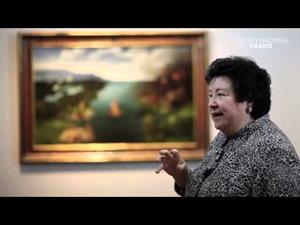
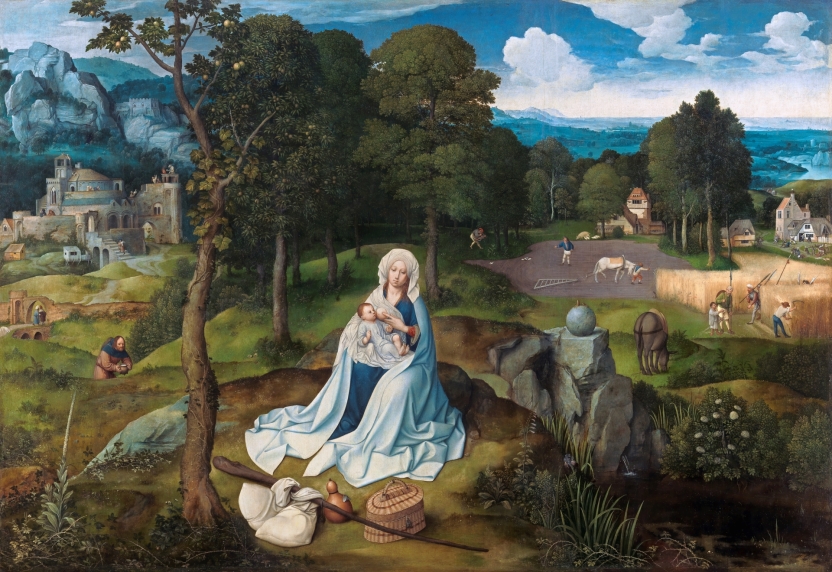
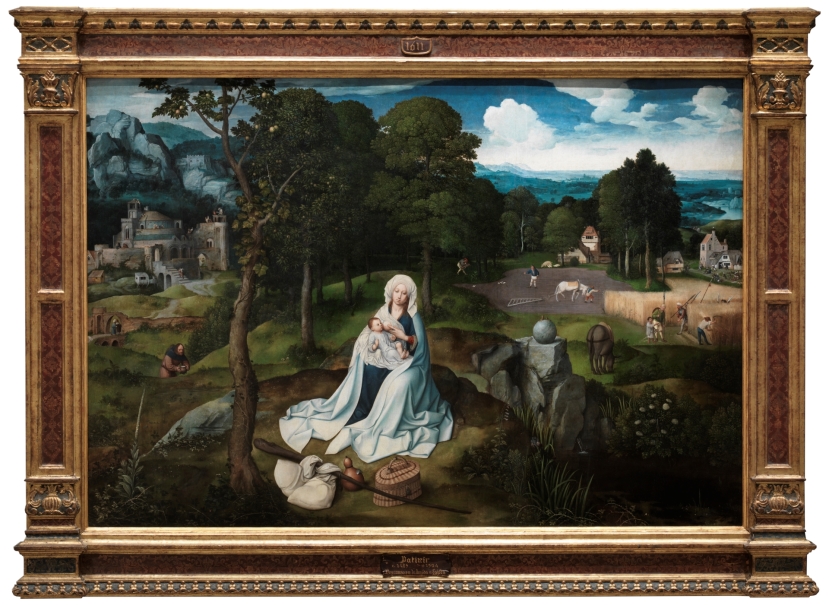
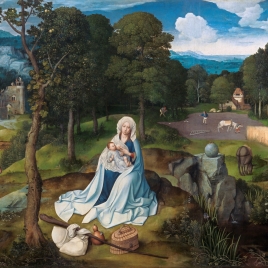
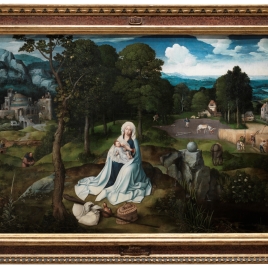
The Virgin and Child are placed on a hill in the centre of the foreground, isolated from the rest of the figures, as in the Berlin panel (Gemäldegalerie ). The dark forest here begins in the middle ground behind the Virgin, merging with the background landscape to one side of the main figure. The countryside to the right, with the motifs of the farm, the village in the middle ground and the city in the distance, is clearly separated from the area on the left, where the city of Heliopolis appears at the foot of the mountain. This natural solitude is linked with the higher foreground by the colour of the terrain and the intricate pathways along which St Joseph ascends with the container of food in his hands.

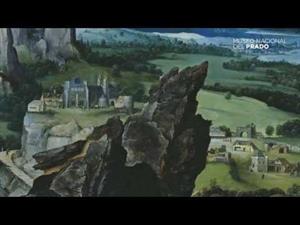
Patinir follows the same iconographic type, with some variants, used in the paintings of the same theme in the Museo Thyssen, the central panel of the triptych formerly in the Kaufmann collection in Berlin and now in Wiesbaden, and the version at the Gemäldegalerie in Berlin. In this way, he followed a type created by Hans Memling in a panel in the Louvre panel, which was the first to link the Virgin and Child with passages from the flight into Egypt, and subsequently developed by Gerard David, in works in the Prado and Washington, among other locations, and later by other painters, among them Patinir and Joos van Cleve in his Brussels panel. As Falkenburg points out, there is no prior tradition for this theme, which is defined by the episodes from the flight included on a smaller scale in the landscape. In the Rest at the Prado, Patinir incorporates the Massacre of the Innocents in the far right background, as he does in the Wiesbaden triptych and in the Berlin Gemäldegalerie panel. On the same side, in the middle ground, he situates the miracle of the wheatfield, as in the other two panels. What varies in the Prado panel is the position and prominence of the fall of the idols of Heliopolis, which appears in two different places. The stone ball with a pair of feet to the right of the Virgin is all that remains of a pagan image, while the city rises in the middle ground on the left. Amidst its Romanesque or Gothic buildings, the idols can be seen plunging from a tower, while the worshippers can be seen in an adjacent building making offerings to one of their gods, whose head resembles that of a rat. Other allusions to the flight into Egypt are the white saddlebags tied to St Joseph`s staff, the wicker basket and the water gourd with its stopper at Mary`s feet in the foreground. So too are St Joseph himself, shown in the middle ground on the left, and the feeding ass, represented on the other side from the rear in abrupt foreshortening.

The tree next to Mary and the spring near the rocks to her right are unrelated to the miracle of the palm tree which took place during the rest on the flight into Egypt. Both belong to a different iconographic tradition, that of the earthly paradise, which is connected with the Virgin of Humility through the image of Mary seated upon the ground. Patinir here represents the Virgin as Madona lactans, as Mater misercordia, thereby ascribing an important role to her in the incarnation and the redemption. Despite this, by placing her high up in a position of prominence, the painter makes her stand out for her majesty rather than for the type of humility rendered by Jan van Eyck in his drawing St Barbara Seated in Antwerp. Patinir enlarges the space devoted to the earthly paradise. The apple tree with its meagre fruit to the left of Mary is the tree of good and evil, dry as a result of the original sin, but sprouting new shoots after the incarnation of Christ, the beginning of redemption. The grapeless vine wound around the tree is an allusion to Christ`s words I am the vine, and is associated with his death on the cross and the coming of redemption, as is the ivy which also winds around it, likewise symbolic of Christ`s death on the cross and eternal life. The chestnut tree in the middle ground to Mary`s left is associated with the resurrection, and its fallen fruits, some of which have opened to reveal the chestnuts inside, allude to the Immaculate Conception and Mary`s chastity. The plentiful flowers and plants in the foreground also have Christological or Marian meanings, as Falkenburg has explained. They, and the two trees, refer not only to original sin and redemption through the passion and death of Christ, but also to the compassio of the Virgin, an iconographic theme which is, it should be remembered, one of her seven sorrows, as she herself intimates with a low and pensive gaze that casts the shadow of the passion over the happy days of childhood.

The characteristics of the Rest on the Flight into Egypt at the Prado confirm that it belongs to a later date than other panels on the same subject attributed to Patinir. Everything seems to indicate that it was executed between 1518 and 1520, at the beginning of the artist`s last phase of activity, as the dendrochronological analysis confirms. The details of the drawing, the material used, and the colour application methods observable both in X-rays and on the surface all point to an autograph work by Patinir (Silva, P.: Patinir. Essays and critical catalogue, Museo Nacional del Prado, 2007, pp. 182-193).
Multimedia

Technical data

Imagen del carrusel
Imagen del carrusel
Inventory number
P001611
Author
Joachim Patinir
Title
Rest on the Flight into Egypt
Date
1518 - 1520
Technique
Oil
Support
Panel
Dimension
Height: 121 cm; Width: 177 cm
Provenance
Royal Collection (Acquired by Felipe II at the auction of the Prior Fernando de Toledo and sent to the Monastery of El Escorial, Madrid, sixth delivery, July 8, 1593).
Entry date
1839

Bibliography +

Noul, M., Sotomayor, F., Muguruza, P., Les chefs-d'oeuvre du Musée du Prado, Musée d'Art et d'Histoire, Ginebra, 1939, pp. 32.

Koch, Robert A., Joachim Patinir, Princeton University Press, Princeton, 1968, pp. 17, 18, 37-39, 49, 50.

Cuttler, Charles D., Northern Painting. From Pucelle to Bruegel. Fourteenth, Fifteenth and Sixteenth Centuries, Holt, Rinehart and Winston, Nueva York, 1968, pp. 426.

Franz, Heinrich Gerhard, Niederlandische Landschaftesmalerei in Zeitalter des Manieri, Akademische DruckU.Verlagsanstalt, Graz, 1969, pp. lám.19.

Sánchez Cantón, Francisco Javier, Museo del Prado. Catálogo de las pinturas, Museo del Prado, Madrid, 1972.

Friedländer, Max J., Early netherlandish painting IX 2: Joos van Cleve, Jan Provost, Joachim Patenier, A.W.Sijthoff, Leyden-Bruselas, 1973, pp. 122 nº235 lám.224-225.

Poli, I. de, Bruegel, Editorial Marin, Baecelona, 1977, pp. 108.

Pons, Maurice, Patinir Ou L'Harmonie du Monde, Robert Laffont, Paris, 1980, pp. 108.

Haeck Dufey, Le theme du répos pendant la fuite en Egypte, Revue belge d'archéologie et d'histoire de l'art, 1980, pp. lam.10.

Haak, Bob, The Golden Age. Dutch Painters of the Seventeenth Century, Harry N.Abrams, Nueva York, 1984, pp. 134/ lám.273.

Museo Nacional del Prado, Catálogo de las pinturas, Museo del Prado, Madrid, 1985, pp. 496.

Mingote Calderón, Jose Luis., Iconografía y tradición oral. El milagro del campo de trigo en la huida a Egipto., Revista de dialectología y tradiciones populares, XLI, 1986, pp. 109-133.

Hendrick, Jacques, La Peinture Au Pays de Liege XVI, XVII et XVIII Siecles, Editions du Perron, Liege, 1987, pp. 29/ lám.11.

Falkenburg, Reindert L., Joachim Patinir. Landscape as an image of the pilgrimage of life, John Benjamins Publishing Company, Amsterdam. Filadelfia, 1988, pp. 48-49/ lám.1.

Réau, Louis, Iconographie de L'Art Chretien. T. I. Introduction Generale, Kraus Reprint, Millwood, 1988, pp. 280.

Warma, Susanne Juliane, The Paintings of Giambettino Gignaroli (1706-1770), Umi, Ann Arboe,Michigan, 1988, pp. 70.

Balis, A (dir.), La pintura flamenca en el Prado, Ibercaja Fonds Mercator, Amberes, 1989, pp. 74.

Saxl, Fritz, La vida de las imágenes: estudios iconográficos sobre el arte, Alianza Editorial, Madrid, 1989, pp. 100.

Hervella Vázquez, José., El tema de la huida a Egipto en el arte orensano. Influencia de los apócrifos., Cuadernos de arte e iconografía, II, 1989.

Museo Nacional del Prado, Museo del Prado. Inventario general de pinturas (I) La Colección Real, Museo del Prado, Espasa Calpe, Madrid, 1990, pp. nº413.

Gemin, M., Nuovi Studi Su Paolo Veronese, Arsenale Editrice, Venecia, 1990, pp. 192/ lám.150.

Leplat,B, Sur le tableau de la confrerie du Puy D´Amiens. La Vierge du Palmier, Bulletin de la Société des Antiquaires de Picardie, 2 Tri, 1991, pp. 31-34.

Alberti, R., Mirar un cuadro en el Museo del Prado, R.T.V.E. y Lunwerg Editores, Madrid, 1991, pp. 52.

De Bruegel a Rubens. L'Ecole de Peinture Anversoise 1550-165, SnoeckDucalu & Zoon, Antwerpen, 1992, pp. 222.

Checa Cremades, Fernando, Felipe II: mecenas de las artes, Nerea, Madrid, 1992, pp. 407.

Checa Cremades, Fernando (Com.), Felipe II, un monarca y su época. Un príncipe del Renacimiento, Sociedad Estatal para la Commemoración de los centenarios de Felipe II y Carlos V, Madrid, 1998, pp. 431.

Silva Maroto, Pilar, Pintura flamenca de los siglos XV y XVI: guía, Museo del Prado, Aldeasa, Madrid, 2001, pp. 158.

Finaldi, Gabriele, 'Fragmentos de género en la pintura religiosa del Museo del Prado' en Historias Mortales: La vida cotidiana en el arte, Galaxia guttenberg, Barcelona, 2004, pp. 131.

Museo Nacional del Prado, Patinir. Estudios y catálogo crítico, Museo Nacional del Prado, Madrid, 2007, pp. 182-193.

Falkenburg, Reindert L., The land of unlikeness : Hieronymus Bosch, "The Garden of Ea..., W Books, 2011, pp. 133.

García-Frías Checa, Carmen, 'De la grandeza y variedad de la pintura que hay en esta casa' La colección pictórica de Felipe II en El Monasterio de El Escorial, De El Bosco a Tiziano: arte y maravilla en El Escorial, Patrimonio Nacional, Madrid, 2013, pp. 35-51 [37, 41 f.12].

Pérez Preciado, José Juan, "Antes morir que discutir". Sobre las atribuciones históricas de la pintura neerlandesa antigua en el Museo del Prado (1912-33), Boletín del Museo del Prado, XXXVII (55-57), 2019-2021, pp. 190-211 [208].

Other inventories +

Catálogo Museo del Prado, 1854-1858. Núm. 413.

Inv. Real Museo, 1857. Núm. 413.
Patenier. (Joaquin) / 413. / Descanso en la huida à Egipto. / La virgen sentada en medio de un pais frondoso y ameno da el pecho á su divino hijo. Se ve en segundo termino á san Jose trayendo un cuenco lleno de agua. En lontananza varios campesinos y soldados que van en seguimiento de la sagrada familia. Algunos idolos rotos y templos paganos arruinados indican el triunfo de la ley de gracia. (E.) (tabla.) / Alto 4 pies, 4 pulg; ancho 6 pies, 4 pulg.

Catálogo Museo del Prado, 1872-1907. Núm. 1519.

Catálogo Museo del Prado, 1910. Núm. 1611.

Catálogo Museo del Prado, 1942-1996. Núm. 1611.

Inscriptions +

Nuestra Señora con el Niño en los / brazos. / Este Cuadro procede del Escorial y / estaba en la pieza del Oratorio de la En-/fermeria / Lucas de Olanda
Handwritten label. Back, lower central area

Exhibitions +

Itinerario: Un paseo Botánico por el Museo del Prado
Madrid
29.10.2024 - 30.03.2025

A Botanical Stroll through the Prado
Madrid
28.10.2024 - 30.03.2025

Patinir
Madrid
03.07.2007 - 07.10.2007

Location +

Room 055A (On Display)

Expuesto
Update date: 02-06-2026 | Registry created on 28-04-2015

Visor 360

Drag with the cursor to rotate the piece

Other works by Joachim Patinir

Print on demand

Print artworks available in our catalogue in high quality and your preferred size and finish.

Image archive

Request artworks available in our catalogue in digital format.

Up