River landscape with figures
1850. Oil on canvas.Not on display
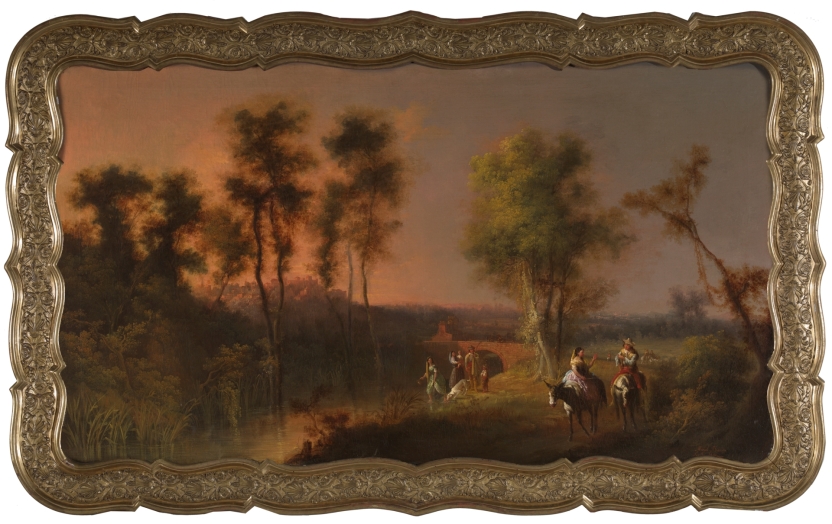
This painting depicts a river landscape, signed in Seville in 1850. For this reason, it belongs to the mature phase of the artist’s early years, far from his better-known works of utterly descriptive and topographical landscape views of Andalusian cities. On the contrary, this is a fantasy landscape, showing Barrón’s more creative side, as well as his ornamental sense of landscape, which was to the taste of the wealthy bourgeoisie of his time.
This work depicts the riverbanks – interwoven with trees and reeds – suffused with the last light of dusk. In the foreground, two peasants are riding along whilst engaging in an enthusiastic dialogue. As they pass by, they draw the attention of another group of people who have stopped on the bank to refresh themselves and collect some water. Other walkers can be perceived journeying through the path and the bridge in the background. To the left, the variegated silhouette of a hamlet perched on a hill can be glimpsed behind the trees as well as other buildings that are lost on the horizon.
Despite its status as a study landscape, this painting originated in the artist’s imagination and was produced with the somewhat conventional compositional devices that Barrón utilised in other instances. This canvas is an important testimony of the different influences that came together during this artist’s training: not only the great Flemish landscape painters but also 17th-century Italian genre painters, whom he probably discovered in the Museo del Prado, like many other landscape painters of the Romantic period. Indeed, Barrón demonstrates that he had seriously studied the Baroque painters from the Flemish school in his elaboration of vegetation and the distribution of different geographical elements; his paintings, crowded by small figures executed in vigorous impasto, are strongly reminiscent of the genre scenes by the bamboccianti as well as of Rosa da Tivoli’s animal paintings. All things considered, Barrón does not restrain himself in revealing his undisputed ornamental taste; his thorough, delicate and patient technique in depicting every leaf in the foliage; his rich and colourful figures; his artistic prowess in the exquisite rendering of light in cloudscapes with enhanced yet somewhat inharmonious hues; as well as his refined adroitness in the gradation of the spatial arrangement, resulting in a landscape of manifest plastic beauty, to which the original flamboyant frame also contributes.
Díez, José Luis, Paisaje fluvial con figuras. en: Un mecenas póstumo: el legado Villaescusa. Adquisiciones 1992-1993, Madrid, Museo del Prado, 1993, p.90-92