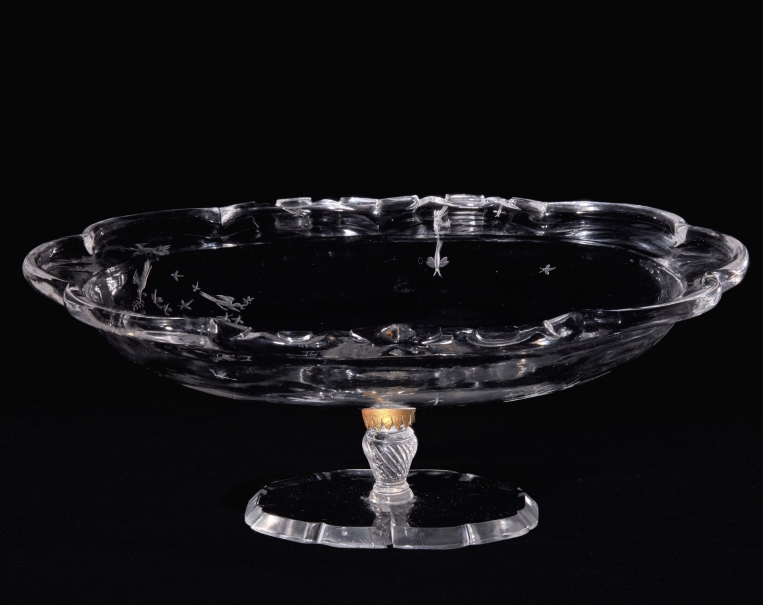
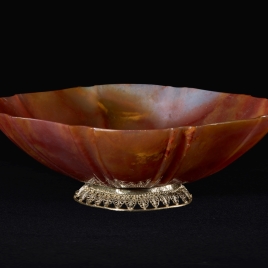
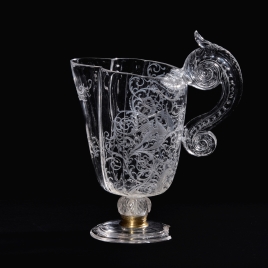
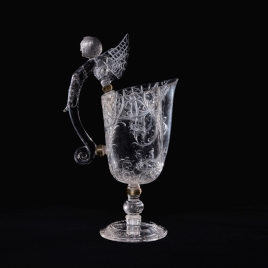
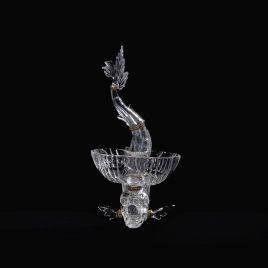
Rock crystal salver with lobed rim
1670 - 1689. Rock crystal / Hyaline quartz.Room 079B
This piece has recovered its original appearance thanks to the recent identification of its foot and stem among odd fragments preserved at the Museo del Prado. It is therefore now shown whole for the first time since the 19th century. It consists of a shallow oval body with a diminished arch profile and ten lobes on the thick flange, on whose broadest part eight notches have been cut, possibly to hold double handles. In the centre is an oval moulding and the fitting for the baluster stem, which rests upon an unadorned oval foot. With its simple forms and the presence of certain small decorative features, like birds devouring insects, solitary insects and tendrils, all scattered around the surface in an attempt to disguise the impurities of the crystal, the piece can be ascribed to the circle of the late 17th century Milanese artist Giovanni Battista Metellino.
In the inventory that was made of the Dauphin’s collection at Versailles in 1689, the piece was given a very high value, since the crystal is of very fine quality. The large size of the tray also raised its price.
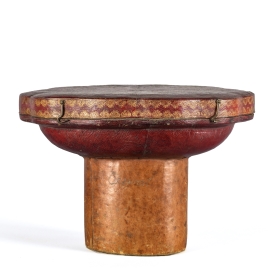
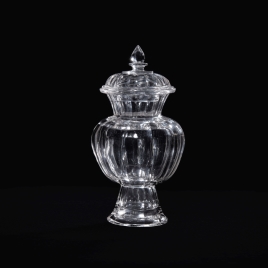
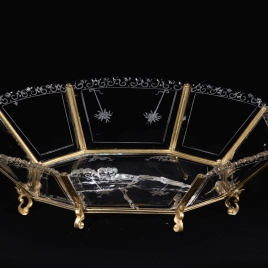
Both Louis XIV and the Dauphin owned a large number of objects from Metellino’s workshop. Besides the presence of insects and small birds on unadorned grounds, or decorated only with some vegetable motif, other characteristics of this workshop include the use of patterns that reach the very edges of the vessels, as though their development had been interrupted, and the use of undulating floral motifs, which sometimes raise the suspicion that a cracked vessel might have been reused. Also appearing on occasions are crudely carved human or animal figures, whose squat form gives them a faintly grotesque look. Schematic landscapes, vines, vine leaves and bunches of grapes are other frequent motifs on pieces of this type, which are complemented with inexpensive mounts, usually stamped or filigreed in silver gilt with a rope pattern running around the rim, with the addition of the occasional stone. These characteristics are shared by vessels O99, O106, O107 and O113 at the Prado. Louis XIV’s collection also contained a large number of vessels with these characteristics, some of which are preserved at the Louvre while others have vanished, although their appearance can be deduced from the descriptions in the inventories. Most of the pieces with these characteristics were acquired between 1684 and 1701, and the rest on odd occasions, as far as we can deduce from the records kept of the royal collections. Between 1685 and 1687, the king acquired numerous pieces directly from Milan, among them some cuvettes with handles that may be among the pieces preserved at the Louvre. There are items in Munich and Vienna that can be related to this group, and similar vessels are also preserved in Dresden. These were acquired by King Augustus II of Poland in Milan between 1724 and 1725 from the heirs of the decorative artist Giovanni Battista Metellino.