Saint Agnes
1637. Oil on canvas.On display elsewhere
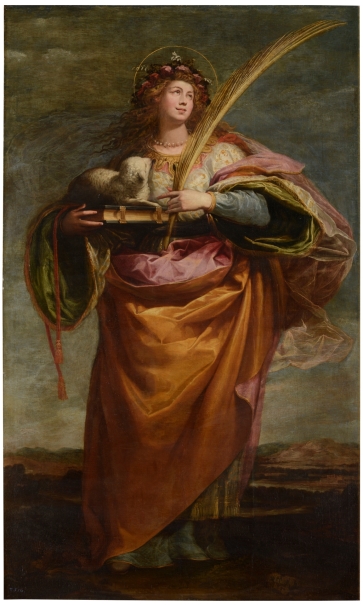
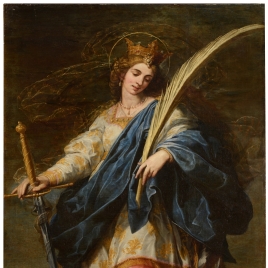
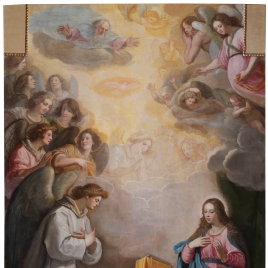
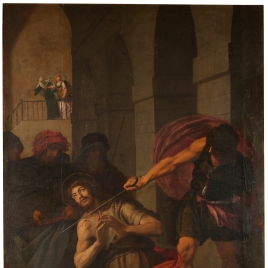
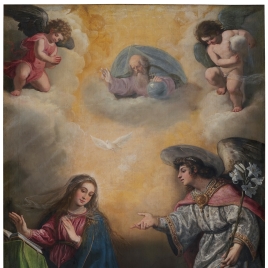
Vicente Carducho painted this work and Saint Catherine (P4916) for the side altarpieces of the main altar of the Convent of los Trinitarios Descalzos in Madrid. They were transferred from there to the Museo de la Trinidad and later to the Museo del Prado. Carducho worked for this convent during the early 1630s. Specifically, on the 4th of May 1632, he was contracted to paint the main altarpiece for the church, for which he was paid in July 1634. In November of the same year, the convent signed another contract with the painter for fourteen paintings: twelve of them would consist of a series on the Life of Saint John of Mata and the remaining two, about which the contract does not specify anything, would be the two canvases with saints intended for the side altarpieces of the main altar.
The inventory carried out in the convent in 1836 by the commissioners of the Royal Academy of Fine Arts of San Fernando describes these two paintings in the church as follows: Saint Catherine, full-length, with the head of the tyrant under the left foot. Saint Agnes, full-length, with the lamb on a book. Each of them measures 7 and a half feet high by 4 and a half feet wide, i.e. 2.08 x 1.25 metres, approximately, and both are marked in the margin of the inventory as medium-sized. Given their dimensions and characteristics, these canvases undoubtedly correspond to numbers P4916 (Saint Catherine) and P4917 (Saint Agnes) in the Museo del Prado´s updated inventory. Both correspond to the description given in the 1836 inventory and measure 2.13 x 1.26 metres and 2.12 x 1.25 metres respectively. These measurements almost completely coincide with those expressed in feet. The second of these is also signed by Vicente Carducho in 1637, a date very close to the signing of his last contract with the convent which, as we have seen, dates from November 1634.
Their status as patrons of the Trinitarian Order is the reason these two saints occupy a prominent place in the convent church, together with the Virgen of Los Remedios. The patronage of Saint Agnes is based on the fact that it was on the 28th of January 1193, the feast of Saint Agnes (octave of the feast of Saint Agnes on the 21st), that Saint John of Mata, during his first mass, received the divine revelation that would lead him to found this religious order. The reasons for the patronage of Saint Catherine of Alexandria are not so clear, although according to some ancient chronicles, Saint John of Mata was ordained to mass on her feast day, as recorded in an ancient breviary, so that this feast day was also celebrated in a special way. Therefore, the representations of both saints in the convent of los Trinitarios were very common and often placed in prominent places in the church: in the former convent of los Trinitarios in Ronda (Málaga) and Torrejón de Velasco (Madrid) they were located in the main altarpiece; and they were also placed in the vault of the main chapel of the former convent of los Trinitarios in Cuéllar (Segovia) and many other examples. As for the type of representations, they tended to appear as in this case, in isolated figures, sometimes dressed in the Trinitarian habit (the aforementioned example from the convent of Cuéllar or the two canvases from the former convent of los Trinitarios Descalzos in Córdoba which are now in the Museo de Bellas Artes in that city). Representations of the scenes of their martyrdom were also frequent, such as those made by Marco Benefial for the former convent of los Trinitarios Descalzos in Rome. Therefore, the iconographic scheme developed in the chevet of the church of this convent of the Discalced Trinitarians in Madrid would be made up of the Holy Trinity of the main altarpiece, flanked by the founding saints of the Order and two indeterminate scenes from their lives; and the two patron saints of the Order, Saint Agnes and Saint Catherine in the side altarpieces.
Carlos Varona, Mª Cruz de, Nuevas noticias sobre las pinturas de Vicente Carducho para el convento de Trinitarios Descalzos de Madrid. Archivo español de arte y arqueología, Consejo Superior de Investigacion, 1999, p.505-520