formularioRDF
The itinerary <em>TITULORECORRIDO</em> has been successfully created. Now you can add in works from the Collection browser
<em>TITULOOBRA</em> added to <em>TITULORECORRIDO</em> itinerary

Close Continuar a ficha de la obra Continuar a ficha de la obra
02-06-2026
Fernando Yáñez de la Almedina

Almedina, Ciudad Real (Spain), 1475 - Almedina, Ciudad Real (Spain), 1537

See author's file

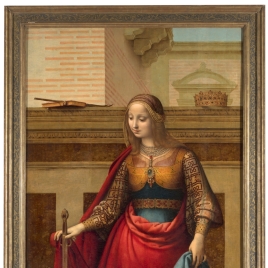
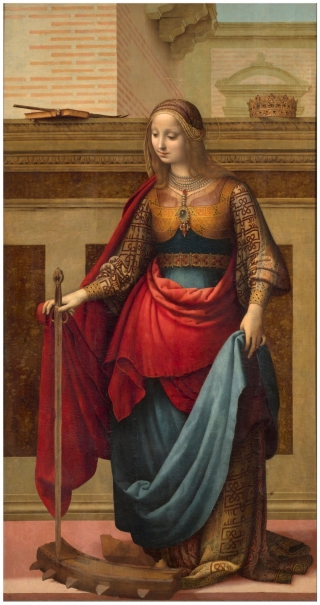
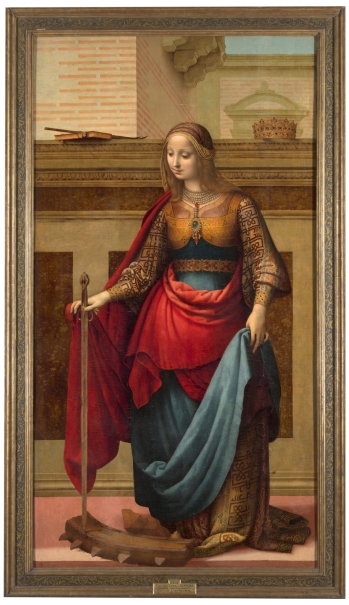
Saint Catherine

Ca. 1510. Oil on panel.
Room 052C

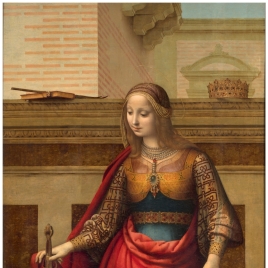
This is one of the Spanish Renaissance’s most emblematic depictions of a female figure and the best known of Yáñez de la Almedina’s works. Both considerations are due to the visibility this work has received at the Museo del Prado, where it has been one of the essential icons in its galleries of 16th-century Spanish painting ever since it arrived in 1946. According to Jacopo de la Vorágine’s The Golden Legend, Saint Catherine of Alexandria was a young, wise and virtuous princess who loved the Lord. That beautiful young woman reject marrying emperor Maximilian and was therefore subjected to a long martyrdom that included the amputation of both breasts, torture on the wheel, and decapitation. The different episodes of this legend were assiduously depicted, often as narrative sequences in which the faithful could follow the saint’s heroic vicissitudes. This form of representation perfected in the Gothic era persisted in Spain throughout the 16th century, but Yáñez, who fully adopted the new formulas of the Italian Renaissance, opted to depict Saint Catherine without narrative components, suggesting them only through her attributes: the sword that decapitated her, the palm leaf of martyrdom and the book that alludes to her wisdom. His depiction offers a monumental and serene figure directly related to Leonardo da Vinci’s work. The figure’s sculptural corpulence is marked by a powerful verticality elegantly countered by the harmonious movement of her arms, a trait characteristic of Yáñez, who derived it from Perugino. The entire figure is conceived with a clarity emphasized by the clear and tranquil lighting that captures her in a single, eternal moment. Like the female model, the architecture in the background was repeated on other occasions. Drawn from Florentine models, it suggests the Saint’s regal surroundings, strengthens the figure’s monumentality and defines the composition and space. Outstanding in this representation is the saint’s rich clothing, a handsome and surprising conjunction of Italian and Spanish elements that range from the Moorish fabric of her tunic, which is decorated with large Kufic and Nesjíe letters and has a luxurious belt at the waist, to the striking pearl choker that bears a splendid Renaissance pendant. This panel must have been made in Valencia during Fernando Yáñez’s first known period, after he returned to Spain from his studies in Italy. That would date it from between 1505 and 1510. The panel was acquired by the Spanish state in 1946 from the Marquis of Casa-Argudín’s collection (Text drawn from Ruiz, L.: Pintura Española del Renacimiento. Guía, Museo Nacional del Prado, 2001, pp. 22-24).
Technical data

Imagen del carrusel
Imagen del carrusel
Inventory number
P002902
Author
Fernando Yáñez de la Almedina
Title
Saint Catherine
Date
Ca. 1510
Technique
Oil
Support
Panel
Dimension
Width: 112 cm; Height: 212 cm
Provenance
Creixell Collection, Valencia; Vicente Peleguer, Madrid, 1865; Dositeo Cullen, Madrid, 1866-1880; Marquess of Casa Argudín, 1939; brothers Cruzat Suárez de Argudín, 1939-1946; Acquired by the Ministerio de Educación Nacional for the Prado Museum, 1946.
Entry date
1946

Bibliography +

Tormo, Elías, Yáñez de la Almedina, Boletín Sociedad Española de Excursiones., 23, 1915, pp. 199.

Exhibition of Spanish Paintings at the Royal Academy : 1920-, Royal Academy, London, 1920, pp. 8 / lám 20.

Beruete y Moret, Aureliano de, Spanish painting: [the works of El Greco, Velázquez, Murillo, Goya etc. and artists of the present day], Geoffrey Holme, London ; París ; Nueva York, 1921, pp. lám 1.

Post, Chandler Rathfon, A History of Spanish Painting, Harvard University Press, Cambridge, Massachusetts, 1930, pp. 224 /lám 80.

Tormo y Monzó, Elías, Pintura, escultura y arquitectura en España: estudios dispersos de Elías Tormo y Monzó, Instituto Diego Velázquez de Arte y Arqueología, Madrid, 1949, pp. 20 / lám.3.

Bosque, A.De, Artisti italiani in Spagna: dal XIVº secolo ai Re Cattolici, Alfieri & Lacroix, Milano, 1968.

Garín Ortiz de Taranco, Felipe María, Letreros y letroides, Archivo español de arte y arqueología, 44, 1971, pp. 259, 269 / lám. 4.

Wardwell, Anne E., A fifteenth-century silk curtain from Muslim Spain, The Bulletin of the Cleveland Museum of Art, 70, 1983, pp. 58-72 / lám. 19.

Checa Cremades, Fernando, Pintura y escultura del renacimiento en España: 1450-1600, Cátedra, Madrid129, 1983.

Museo Nacional del Prado, Catálogo de las pinturas, Museo del Prado, Madrid, 1985, pp. 784.

Martínez Mihura, Enrique, Los herederos de Leonardo, Lápiz: revista mensual de arte, 4, 1986, pp. 53.

Museo Nacional del Prado, Museo del Prado. Inventario general de pinturas (I) La Colección Real, Museo del Prado, Espasa Calpe, Madrid, 1990, pp. nº 1761.

Martínez-Burgos García, Palma, Ídolos e imágenes: la controversia del arte religioso en el, Universidad, Secretariado de PublicacionesCaja de, Valladolid, 1990, pp. 160 / lám. 15.

Marías, Fernando, El siglo XVI: gótico y renacimiento, Silex, Madrid, 1992, pp. 105.

Buendía, José Rogelio, El Prado. Colecciones de Pintura, Lunwerg Editores, Barcelona, 1994, pp. 55.

Benito Doménech, Fernando, Los Hernandos. Pintores hispanos del entorno de Leonardo, Consorci de Museus de la Comunitat Valenciana, Valencia, 1998, pp. 166-169.

Ibañez Martinez, Pedro Miguel, Fernando Yáñez de Almedina: (La incógnita Yáñez), Ediciones de la Universidad Castilla-La ManchaDipu, Cuenca, 1999, pp. 320 /lám. 136.

Ruiz Gómez, Leticia, El Greco y la pintura española del Renacimiento: guía, Museo del Prado, Aldeasa, Madrid, 2001, pp. 22.

Portús Pérez, Javier, La colección de pintura española en el Museo del Prado, Edilupa, Madrid, 2003, pp. 40.

Enciclopedia del Museo del Prado, VI, T.F. Editores: Fundación Amigos, Madrid, 2006, pp. 1983.

Ibañez Martinez, Pedro Miguel, La huella de Leonardo en España: los Hernandos y Leonardo, Canal de Isabel II, Comunidad de Madrid, 2011, pp. 257-259.

Franco Llopis, Borja, 'El trazo oculto de la alteridad'. Mas allá del hibridismo cultural en la pintura española de inicios del siglo XVI, Boletín del Museo del Prado, XXXVIII, 2022, pp. 22-37 [26,27,29 f.7,f.8].

Muñiz Muñoz, Angel, Vicente Peleguer, Dositeo Cullen y el marqués de Casa Argudín. tres propietarios para una colección., Goya, 379, 2022, pp. 154-167 [158-160].

Muñoz Clares, Manuel y López Marcos, Pablo, La pintura del siglo XVI en Murcia, Real Academia de Bellas Artes Santa María de la Arrixaca, 2022, pp. 30.

Other inventories +

Inv. Nuevas Adquisiciones (iniciado en 1856). Núm. 1761.
Autor, Hernando Yañez / 1761 Asunto, 'Santa Catalina' / Tabla 212 x 112 cms / Nº del catalogo 2902. / Adquirido por el Estado en 156.000 ptas, a las Srtas. Cruzat y Suarez de Argudin el 4-junio de 1946.

Inscriptions +

JUNTA DELEGADA DE INCAUTACIÓN Y PROTECCIÓN / Y SALVAMENTO DEL / TESORO ARTÍSTICO / Nº de Inventario 9436 / Procedencia Argudin / Nº Colec. 26 [Nota en margen derecho] 2 [Nota en registro inferior] F 18 x 24
Handwritten label. Frame, back, left side bar

Exhibitions +

Reunited
Madrid
06.06.2020 - 25.07.2021

Location +

Room 052C (On Display)

Expuesto
Update date: 02-06-2026 | Registry created on 28-04-2015

Visor 360

Drag with the cursor to rotate the piece

Other works by Fernando Yáñez de la Almedina

Print on demand

Print artworks available in our catalogue in high quality and your preferred size and finish.

Image archive

Request artworks available in our catalogue in digital format.

Up