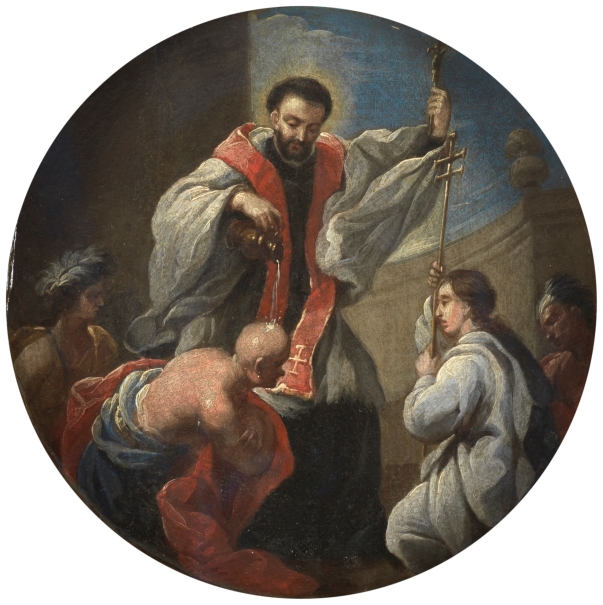
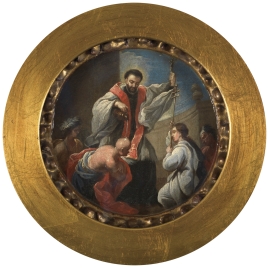
Saint Francis Xavier baptising Native Americans
Ca. 1770. Oil on panel.Not on display
The tondo depicts Saint Francis Xavier dressed in a cassock, surplice and stole, baptising people of different races who are kneeling down to receive the sacrament. The figures depicted are reminiscent of Native American and Asian archetypes. He baptized them with his own hands during their long sea voyages. Kneeling beside them is an allegory of Faith holding a patriarchal cross. A background containing curved architecture –completed with a vase– lends solemnity to this baptism scene. It represents the peak of the evangelizing work of Saint Francis Xavier from the time he left Lisbon on the 7 April 1541, until his death in 1552. During his missionary work in the East, the Jesuit saint travelled over an extensive territory including Goa, India, Malacca, Moluccas, the Philippines, Japan and China. He achieved wide renown and recognition for his work during his lifetime. The immensity of his apostolic work brought him glory, and in 1609 Pope Paul V beatified him. He was later canonised as a saint in 1622 by Gregory XV.
The panel painting, by an anonymous artist, is notable for its rich colouring. The Artist created the figure of the Saint using the engraving by Greert Edelinckas as a reference. This engraving was widely published in the "Life of Saint Francis Xavier" by the Jesuit Bouhours and inspired many later versions from a number of artists. Compositionally, the work bears similarities with a painting of the same subject at the San Jorge el Real Church in Tudela, which Vicente Berdusán painted in the last third of the 17th century. The physical forms of the natives and the saint´s posture come from the same source, which inspired both of the works.
The work entered the Museo del Prado from the Museo de la Trinidad, although its previous origins are unknown. Its size and shape are reminiscent of the badges worn by nuns over their habit during conventual ceremonies. These representations are very common in Mexico, where some portraits showing these artistic features are preserved. For example, there is the portrait of Sor Juana Inés de la Cruz at the Museo Nacional de Historia, painted by Miguel Cabrera, or an anonymous 18th-century portrait of Sor Juana at the Philadelphia Museum of Art. This badge can also be seen in the painting of Sor Josefa, credited to the painter Francisco Javier Salazar, in the former Mexican convent of Churubusco. However, it should be noted that, the badge differs from these representations given the material on which it was painted. The discs are usually executed on canvas or parchment, while this image was painted on panel. This work is probably the result of a commission for a private oratory, given its size and quality.
Sociedad Estatal para la Accion Cultural Exterior, Filipinas. Puerta de Oriente de Legazpi a Malaspina, Madrid, S.E.A.C.E.X., 2003, p.237-238