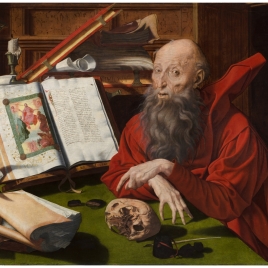
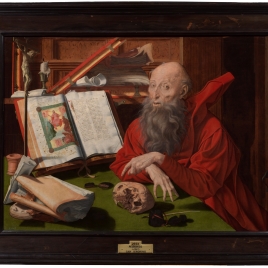
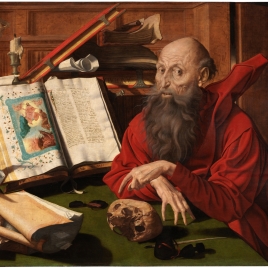
Saint Jerome in his Study
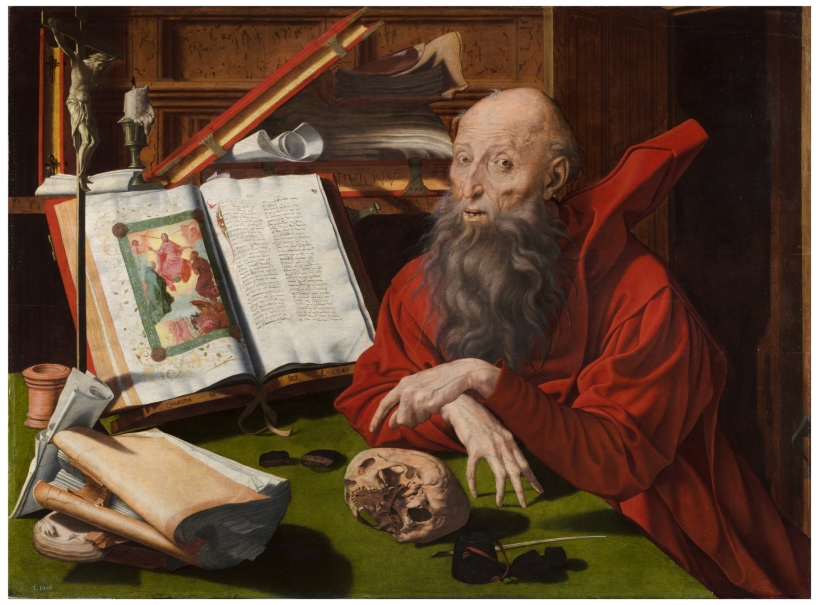
1541. Oil on panel.Room 057A
By far one the most popular themes in Marinus’ surviving work, Saint Jerome in his study has come down to us in several compositions. The preoccupation with this particular subject was a reaction to the early sixteenth-century concern with the depiction of the saint, who was venerated as one of the four fathers of the Western Church and held in high esteem as a scholar and the translator of the Bible. Its popularity in Northern Europe is associated with the influence of Erasmus of Rotterdam, who edited the works of Saint Jerome together with a biography of the holy man in 1516. The newly found interest in the study of the life and work of the saint also had a crucial influence on the emergence of the scholar’s portrait. Instead of being portrayed in the moment of divine inspiration or surrounded by hagiographic embellishment, the sage is depicted in a portrait-like manner and without a halo sitting in a domestic study. Marinus himself created different versions of the theme, most of which have survived in copies with small variations made by him or under his supervisión.
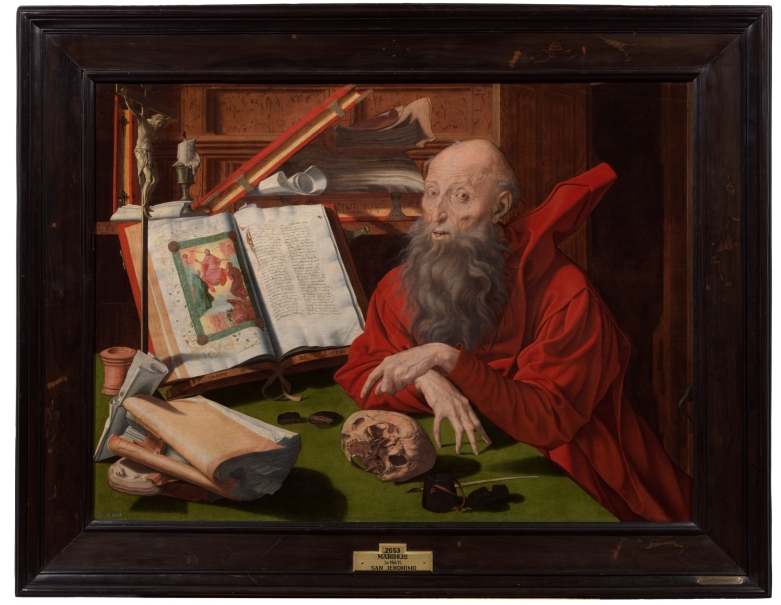
Marinus’ version of Saint Jerome discussed here is dated 1541 and combines the focus on the contemplation of worldly transience already in Dürer’s renderings of the motif with a landscape format that was introduced in Antwerp by the variants made in the workshop of Quinten Massys (1466-1530) and his son Jan (c. 1509-1575). While the versions from Massys’ workshop show an aged, sometimes melancholic but always physically strong and energetic scholar that appears to align with the ideas spread by Erasmus of Rotterdam, according to whom the saint was a learned and vigorous person, not an ancient cardinal, Marinus, like Dürer before him and in accordance with medieval tradition, characterised his Saint Jerome as an old intellectual whose physical appearance seems to have shrivelled with time. The focus is shifted toward another prevalent theme in the humanist circles following Erasmus’ teaching: the importance of a return to the study of the text of the Bible as the sole source of learning and a constant reminder of the Last Judgement. This is highlighted through the representation of the Christ Judge enthroned between the Virgin and Saint John the Baptist above the resurrection of the souls, which opens the reading from the Gospel of Matthew describing the Second Coming of Christ. By pointing at the skull on his desk, the saint, who looks directly at the spectator, warns viewers of the impending end and their own transience. Marinus created an evocative image that both reacts to the influence of humanist thought on the representation of the saint and also introduces an obvious admonitory element. The manuscript on the bookrest shows both an image of the Last Judgement and a fragment of the Vulgate in a script that was not commonly used for Latin Bibles, neither in manuscript books nor prints, but for texts written in vernacular language.
As in another version of this composition in the Prado Collection (P2100), the scribal peculiarities of copying the biblical text as well as the variations in the painted decoration of the book, which betrays a familiarity in dealing with decorative patterns typical of Northern Dutch illuminated manuscripts, are important indications that both works were created under the direction or in the workshop of Marinus. However, the two renditions slightly differ in painterly execution: the version dated 1541 is distinguished by its thin application of paint and the focus on the graphic modelling of the saint’s physiognomy with the help of white highlights, as is also the case in another Prado picture (P2100), while the shaping of the hands is limited to blended painted layers executed in a different technique (the graphic structuring of the surface of the hand by means of lines and shadows in the other version is absent here). The technique used in both works is the same, but here it is less elaborate on account of the painter’s focus on the face (Christine Seidel in Marinus. Painter from Reymerswale, Museo Nacional del Prado, 2021, pp. 117-119).