Saint Lawrence
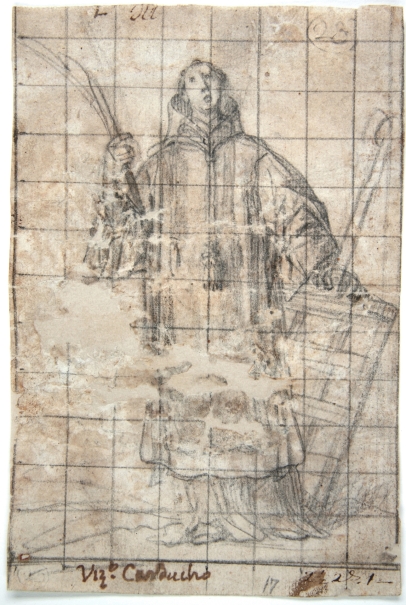
Ca. 1598. Black chalk, Squared-up on laid paper.Not on display
Although there is no documentary evidence, it is very probable that, in 1598, Vicente Carducho helped his brother Bartolomé with the scenes of the Life of Saint Lawrence of the High Cloister of El Escorial and with the doors of the high Shrine of the altar of Saint Jerome in the basilica. This drawing of Saint Lawrence could bear witness to this fact and could consequently bestow upon it an unusual value. It is a small sketch in which Saint Lawrence, wearing the habit and pontifical dalmatic, directs his gaze upwards. In his right hand, he holds the palm branch of martyrdom while in his left, he holds the grid. The grid implies an imminent transfer to canvas. From a stylistic point of view, it is somewhat different from Vicente Carducho’s usual style of drawing. Nevertheless, as Pérez Sánchez pointed out, this is almost certainly due to the fact that it is one of the artist’s very early works. This also explains the simplicity of the sketch despite the appearance of certain characteristic features of the painter, namely the stylised figures with long hands or the rapid strokes with which certain details are studied (for example, the handle of the grid or the hand holding the palm branch).
The artist drew inspiration from the Saints Stephen and Lawrence that Alonso Sánchez Coello had painted in 1582 for the basilica. Nevertheless, he based it, above all, on the Saint Lawrence (1584–85) painted on a wall by Luca Cambiasso in the choir room of El Escorial. According to P. Zarco, Sánchez Cantón stated that it appears to be a study for the painting – in the entrance hall of El Escorial – in which the saint directs his gaze downwards. However, as indicated by Angulo and Pérez Sánchez, the canvas in question has neither been located, nor is there any trace of it in the descriptions of Francisco de los Santos (1657–1698) or Andrés Jiménez (1764), or even in the later works of Zarco Cuevas himself. Although the resemblance to another sketch of Saint Lawrence in the Museo de Bellas Artes in Córdoba is evident, it is limited to the iconography and corresponds to the model of the saint with chasuble and pontifical vestments produced in the reformed monastery of El Escorial. As García de la Torre stated, the technique employed has little or no affinity with Carducho’s style, but rather with the Sevillian artists around the turn of the century.
Pascual Chenel, Á.; Rodríguez Rebollo, A., Vicente Carducho. Dibujos Catálogo razonado, Madrid, Biblioteca Nacional de España - Centro de Estudios Europa Hispánica, 2015, p.56-57 n.1