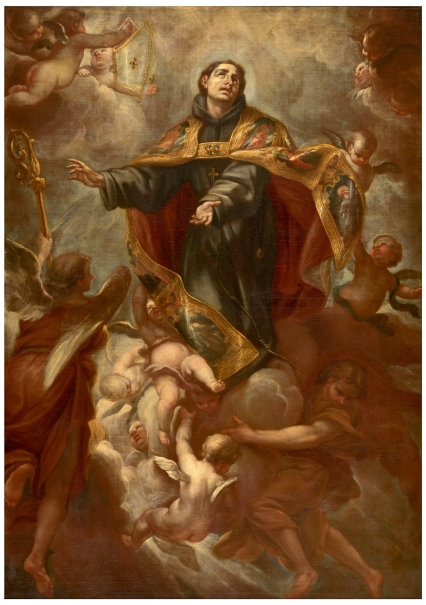
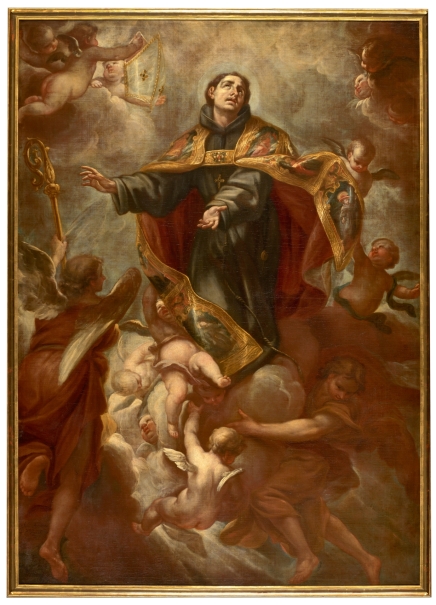
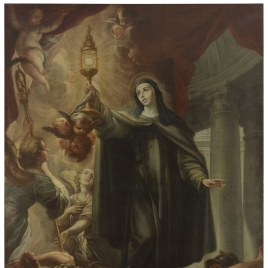
Saint Louis, Bishop, in Glory
1693. Oil on canvas.Not on display
As Lafuente Ferrari (1941) pointed out when publishing this work, it is a significant example of the passionately baroque tone of late 17th-century painting in Madrid. The same critic mentions the clear influence of the Triumph of Saint Augustine (P664), which Claudio Coello painted thirty years earlier in 1664. And it is indeed possible to draw a certain correlation between the postures of the two saints and their celestial entourages, including the angel whose significant placement at the left accentuates the dynamic drive and the sense of an interposed space. As is always the case with these compositions, the Flemish echo of Rubens is obvious. The child angel at the saint´s feet, with his face partially hidden by the cape, is taken from Van Dyck and was used on multiple occasions by other artists from Madrid, but the robust young man who seems to be holding up the outcropping of cloud on which the saint stands already reveals his unmistakable origins in Luca Giordano.
This work and its companion, Saint Clare Driving Away the Infidels with the Eucharist (P3264), were registered by Palomino in 1724: He also made two large paintings for the side walls of the convent church of Our Lady of Constantinople in this Court. One of Saint Louis, Bishop, and the other of Saint Clare when she held up the Most Holy [Eucharist] and drove away the barbarians attempting to assault the convent. Both were registered in the same location by Ponz (1776) and Ceán (1800).
The General Inventory of paintings from La Trinidad in its warehouse and chosen by the commission of the Academy unquestionably indicates that both belonged to the Museo Nacional de la Trinidad. They were either stolen from the museum or fraudulently sold as unusable at one of the auctions held in 1843. Surprisingly, their appearance in the Inventory of Paintings and Statues presented at the Inauguration of the Museo Nacional de la Trinidad on June 24, 1838, indicates that they did not leave the museum until after they had been exhibited in its halls. This painting entered the Museo del Prado in 1985 as a donation by José Saldaña Suanzes.