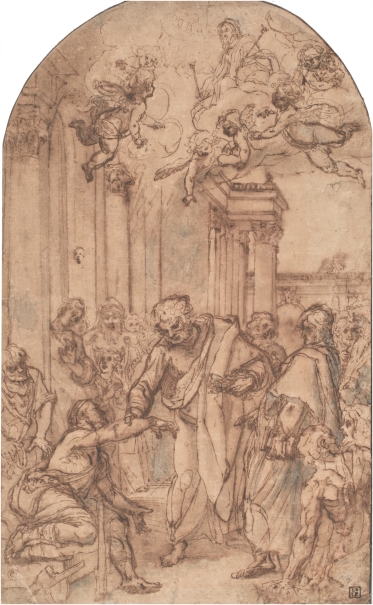
Saint Peter healing the lame
Ca. 1606. Wash, Grey-brown ink, Pencil, Pencil ground on dark yellow paper.Not on display
A decisive breakthrough in the career of the Tuscan painter Lodovico Cigoli came with his contribution to a series of six paintings required for the new altars for St Peter’s Basilica in Rome. According to the reliable account of the Florentine biographer Filippo Baldinucci, the intervention of Grand Duke Ferdinando de Medici was critical towards Cigoli being awarded the contract in 1604 for the large slate altarpiece, Saint Peter healing the lame, 1606, aided by Cardinal Francesco Maria del Monte, who had famously lent his support to Caravaggio. During his stay in Rome, Cigoli was granted every honour and was housed in the Villa Medici at the Trinità dei Monti.
This brief period covering the spring and summer of 1604 was sufficient for Cigoli to absorb the new artistic trends circulating around Rome, from Annibale Carracci to the school of Caravaggio. Cigoli’s altarpiece - which was inspired by Raphael’s tapestry The healing of the possessed, 1514-15, in the Sistine Chapel - was almost completely destroyed by a fire in the eighteenth century. All that survives, besides a small fragment in the Museo Petriano in the Vatican, is a group of preparatory drawings (many of which are in Florence) that present us with two variants of the composition. The explanation for these two compositions is found in Baldinucci’s account, which tells how Cigoli, upon returning to Rome in May 1606, repainted the entire altarpiece from scratch.
The Prado drawing, which had formerly been in the distinguished collection of Sir Joshua Reynolds, was first identified by Alfonso E. Pérez Sánchez in 1977 as one of the final studies relating to the slate panel painted for St Peter’s in 1606. The definitive preparatory study of the project was identified in the drawing 1016F of the Gabinetto dei Disegni e Stampe of the Uffizi, Florence, realised with figures of the same format as the Prado drawing, but with more strongly defined shadows, in a typically seventeenth-century style, reflecting the widespread use of dark watercolour. The two drawings differ in minor details noted by scholars, most recently by Nicholas Turner in 2004 (Farina, V.: Italian Masterpieces. From Spain´s Royal Court, Museo del Prado, 2014, p. 166).