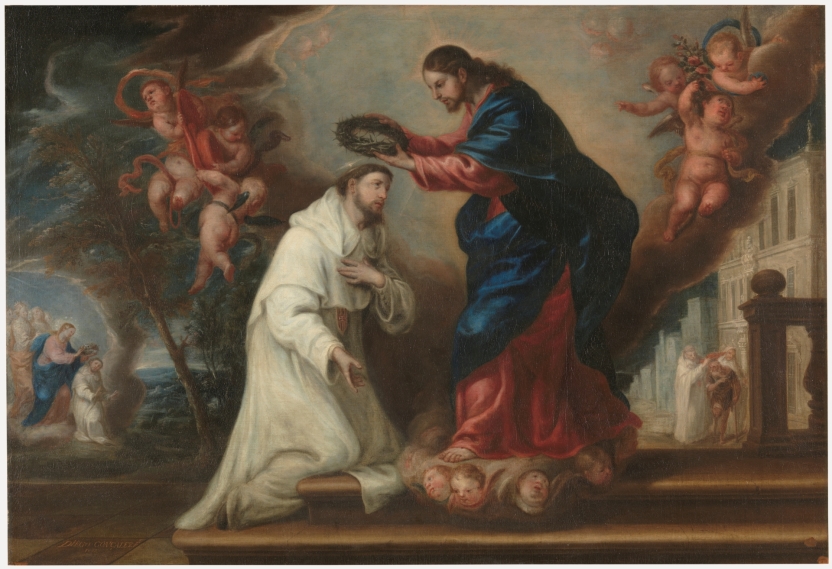
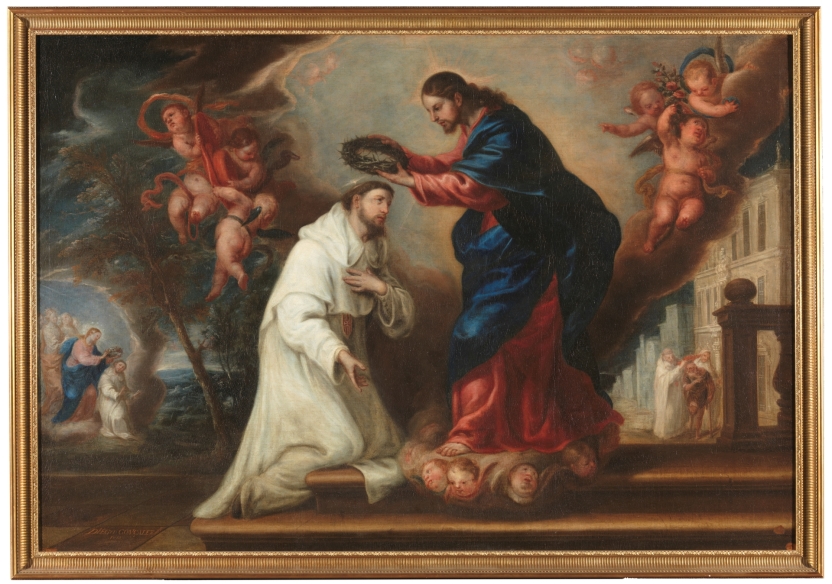
Saint Raymond Nonnatus crowned by Christ
1673. Oil on canvas.Not on display
Saint Raymond Nonnatus was born in the diocese of Solsona around 1200. His surname was most likely Sarró, but he received the nickname Nonnatus because he was taken from his mother´s womb shortly after her death in childbirth. Working as a shepherd, the Virgin of Mercy asked him to enter this order, where he befriended Saint Peter Nolasco. He went to Algiers to redeem captives and underwent imprisonment himself. He was named cardinal in 1239 by Gregory IX and died at the age of forty in Cardona.
The scene represents a vision that Saint Raymond had. The left side shows the moment in which the saint, helped by another the Mercedarian order, covers a poor man with his cardinal´s cape. Saint Raymond found him in rags and gave him his cardinal´s hat. Afterwards, he took him to the convent´s hospice and fed him. In the central part there is the apparition of Christ who offers him a crown of thorns alluding to the sufferings he had agreed to endure. On the right, the Virgin is seen giving him a crown of roses, which the Saint rejects. These visions reaffirmed the belief that the beggar was none other than Christ himself, who had appeared to Saint Raymond at night accompanied by his Mother to offer him these crowns. Saint Raymond only accepted the one of thorns.
The general idea of the painting, as well as the pattern for Saint Joseph, are very similar to the ones he used for his painting The Imposition of the Collar and Mantle on Saint Teresa (Valladolid, San Quirce). Both show his excellent taste in coloring and good technique, which Palomino speaks of. This is undoubtedly the masterpiece of his known production, not only for its skillful execution, but also for its beautiful and refined use of colour. Although González de la Vega uses an elongated pattern for his figures like those of Francisco Camilo, his use of perspective elements or his taste for architecture are typical of Coello. Rizi´s nervous brushstrokes and sharp profiles were also part of his painting. The painting comes from the Convent of Our Lady of Mercy in Madrid, where it was located on the main staircase in the second flight of stairs leading up to the upper cloister. A preparatory drawing for this same painting is preserved in the National Library.
Pintores del Reinado de Carlos II, Madrid, Museo del Prado, 1996, p.62