Saint Veronica
1620 - 1625. Oil on canvas.Room 006
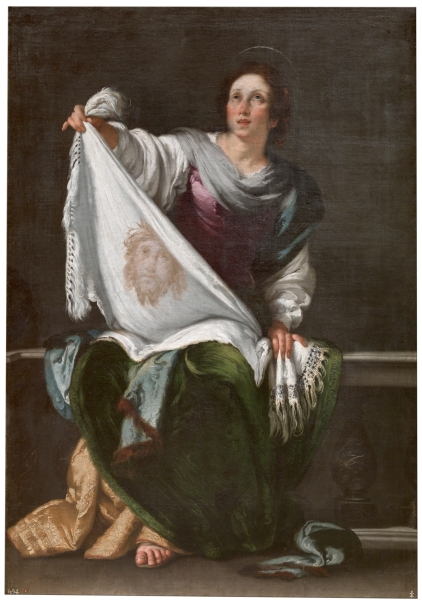
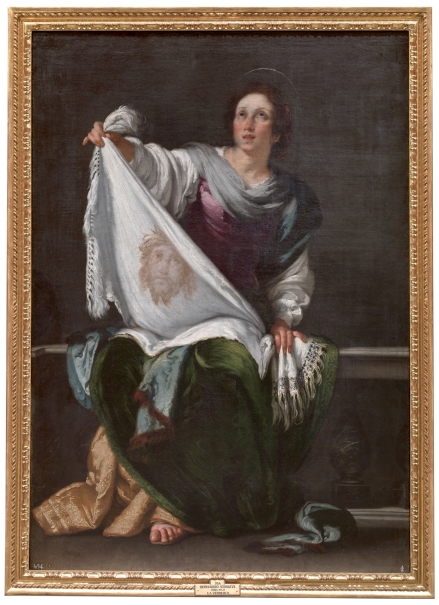
Bernardo Strozzi was one of Genoa´s most outstanding early Baroque artists, and his work exemplifies the qualities and evolution of painting in the Ligurian capital. Moreover, his practice forged a brilliant artistic link between Genoa and Venice. Known as Il Prete Genovese, because he was a Capuchin monk, Strozzi received early training in the late Mannerist tradition from Cesare Corte (1550-c.1613) and Pietro Sorri (c.1556-1621/22). After an early flirtation with naturalism he developed a personal artistic approach inspired by the Bolognese artist Giulio Cesar Procaccini (1574–1625) and Peter Paul Rubens. Both were working in Genoa at the beginning of the seventeenth century and both profoundly transformed art practices there. To this vibrant mix Strozzi added his knowledge of the Venetian Renaissance masters, with particular emphasis on Veronese´s concept of light and colour. He also visited Rome in the 1620s, around the time he painted the present work. After two highly successful decades working in his native city he was prosecuted for working professionally as a painter while a Capuchin monk. To avoid prison Strozzi fled to Venice around 1632, where he lived until his death. His restless personality seems to emerge in his paintings. The vibrant brushstrokes with which he constructs his figures are laden with paint, but are applied agilely to create particularly rich and contrasted colour effects. His painting is luminous, especially his flesh tones, and he also deftly employs chiaroscuro effects. Strozzi´s figures stand out for their explicit gestures and attitudes, as well as for their powerfully expressive gazes. Although the religious meaning in Saint Veronica, 1620-25, is expressed though a sole figure, Strozzi manages to subtly communicate the complexity of divine revelation. Veronica is a legendary saint who appears in medieval apocryphal texts, where she is said to have dried Christ´s sweat and blood as he carried his cross to Calvary. When she removed the cloth from Christ´s face, Veronica discovered that, miraculously, it bore his image. That cloth, known as Mandylion in the Byzantine tradition, was supposed to bear witness to Jesus´s true appearance. Indeed, the saint´s own name derives from the Greek veraoikon (true image). Various churches in Italy and abroad claim to possess the original cloth, but the one depicted by Strozzi here resembles the cloth venerated at St Peter´s Basilica. Strozzi portrays the conclusion of the miracle when Veronica, alone and trembling, finally unfolds the cloth. She is sitting on a balustrade and her left hand rests on it uncertainly. With her right hand Veronica raises the cloth, creating a white diagonal that contrasts with her green and pink clothing. The saint´s pose, a gently inclined contrapposto, expresses hesitation and brings a sense of movement to the scene. But it is her upward gaze, focused beyond the limits of the composition, which reveals the sacred nature of the image. Veronica´s teary eyes and illuminated face, rendered with Strozzi´s flushed flesh tones, convey the moment´s explicit emotion. The paint-laden and energetic brushstrokes on her clothing perfectly capture its weight, becoming smoother and more diluted on her attractive face, whose physiognomy is typical of Strozzi. In the eighteenth century this painting was acquired in Seville by King Philip V´s wife, Elisabeth Farnese, and it remained in the Spanish Royal Collection until it entered the Museo del Prado.
Aterido Fernández, Ángel, 'Bernardo Strozzi. Saint Veronica'. Italian masterpieces from Spain's royal court, Museo del Prado, National Gallery of Victoria Thames & Hudson, 2014, p.128