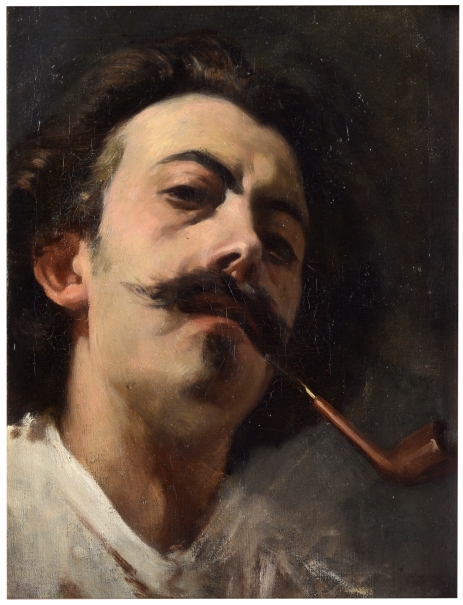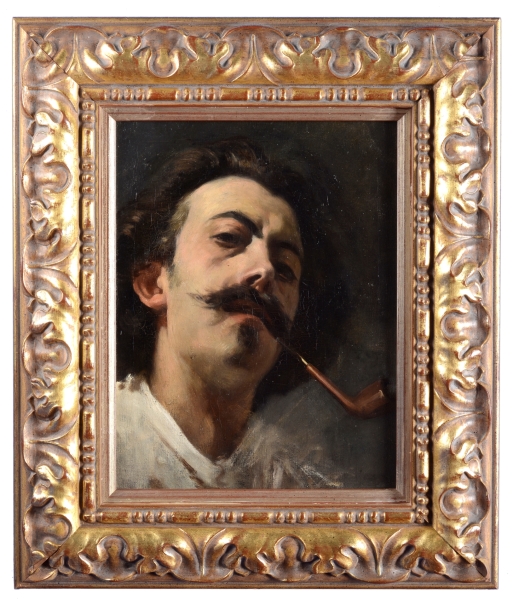
Self-portrait
1866. Oil on canvas.On display elsewhere
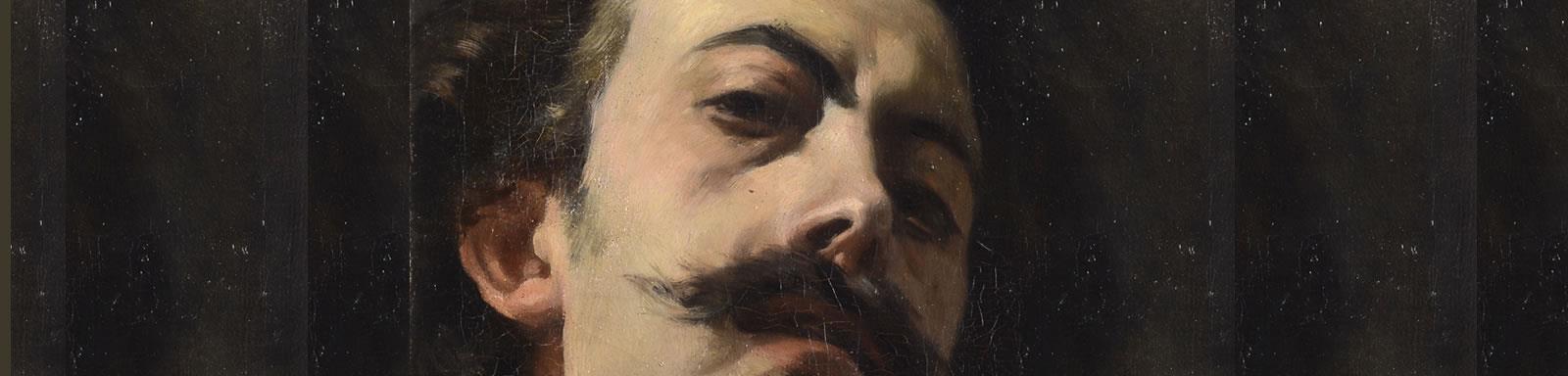
The purpose of Casanova Ruiz in this self-portrait is not to pass on his own objective and timeless image to posterity, as was often the case, but to capture himself in a profound and powerful instant. The smoking pipe reflects the snapshot character of the work. The original perspective that the artist uses to create his own image by approaching it not directly from the front but from a low point and tilted to the left allows him to emphasise the shading of the dark circles under the eyes and the wrinkles between the eyebrows. This conveys a state of intense concern given the darkness in his eyes. The long hair gives him a certain bohemian look.
Lorenzo Casanova ended up settling in Alicante after his stays in Madrid and Rome. In Alicante he surrounded himself with many students. In this self-portrait he offers an image that seems somewhat lackadaisical and distanced. The viewer looks at the subject from a lower position, just where the mirror is, in which the painter looks at himself to capture his image from a more unusual and distorting angle. This gives this self-portrait a certain eccentricity as well as a strong desire for realism. An inscription by Jadraque on the back of the painting indicates that the painter painted the self-portrait by looking directly at himself in the mirror. In this way he sought to capture a snapshot, a circumstantial state of mind. Casanova opted for an iconography that is unusual among the self-portraits by Spanish artists, and which inevitably recalls, despite all their differences, the famous gesture of Courbet in "Bonjour Monsieur Courbet", who painted himself in a haughtier and more elaborate pose than Casanova.
Museo Nacional del Prado, Artistas pintados: retratos de pintores y escultores del siglo XIX en el Museo del Prado, Madrid, Ministerio de Educación y Cultura, Dirección General de Bellas Artes y Bienes Culturales, 1997, p.110-111