Self-portrait
1947. Tempera on canvas mounted on panel.Room 062A
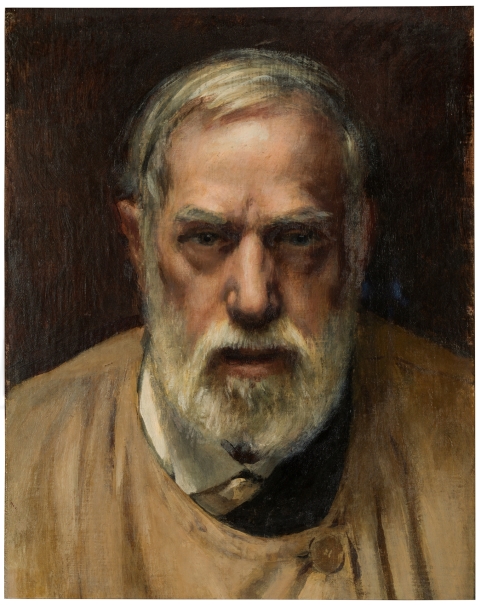
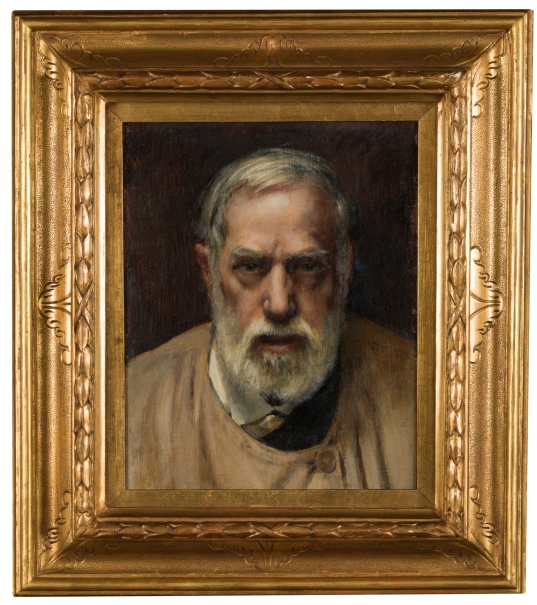
Mariano Fortuny Madrazo (Granada, 1871–Venice, 1949) appears in a bust-length self-portrait, forehead to shoulders, at the age of 76. He is dressed in the smock he usually wore to work, with the collar of his shirt showing underneath. The artist – who made an analysis of the aging features of his face – still has abundant white hair and a thick white beard that conceals a gaunt face with deep dark circles under the eyes, but with an intense gaze.
The artist was the son of the great master Mariano Fortuny Marsal (Reus, 1838–Rome, 1874), who married Cecilia de Madrazo in 1867, thus making Mariano Fortuny Madrazo a descendant through his mother’s side of the most influential family in 19th-century Spanish painting.
The work, painted in ochre, pinkish tones, and very luminous whites, stands out against an uneven brown background, picking up the deep blue gaze from the face. In this painting, Fortuny Madrazo used a reduced chromatic palette of the tempera paints of his own invention. These were actually tempera colours diluted in water with a binder and which could be applied to a canvas, panel or paper after different layers of preparation. The painter developed these pigments through information provided by craftsmen in northern Italy. He zealously kept this composition for years, but eventually commercialised them at the end of his life due to financial problems.
This self-portrait can be included within the painter’s most characteristic style in the last years of his life. (Cuenca, M. L. in: Artistas pintados. Retratos de pintores y escultores del siglo XIX en el Museo del Prado [Painted artists. Portraits of 19th-century painters and sculptors in the Museo del Prado], Museo del Prado, 1997, p. 192).