Semiprecious-stone table
1749 - 1763. Agate, Lapis lazuli, Gilt-bronze, Ebony wood, Paragone, Chalcedony, Jasper.Not on display
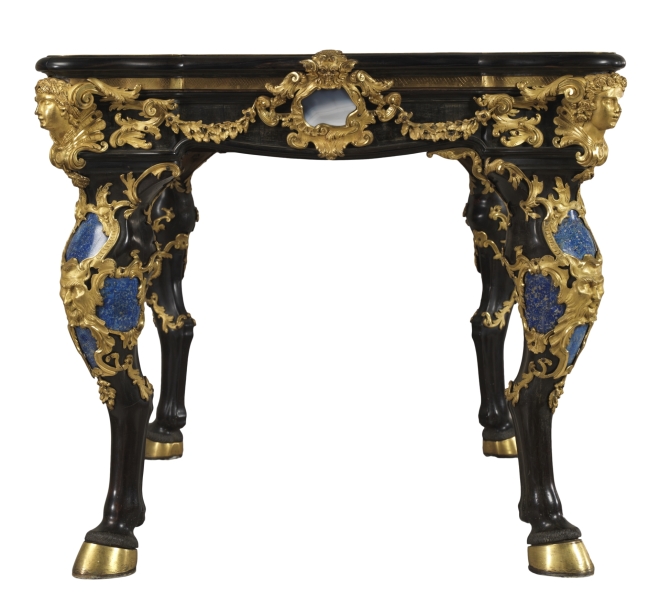
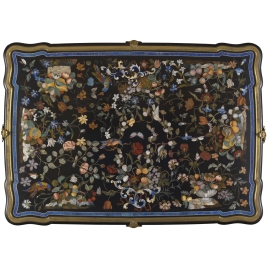
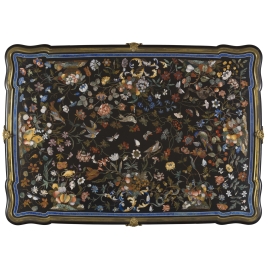
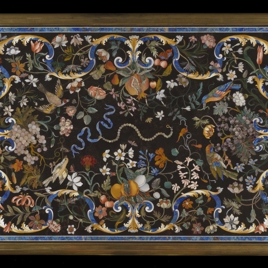
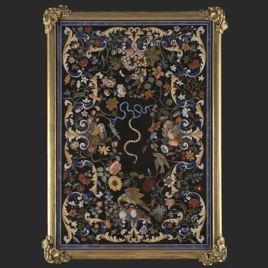
This semiprecious-stone inlaid tabletop on a paragone background has moulded corners and is bordered with a lapis lazuli band. Flowers and fruit with birds, insects and volutes are depicted on it, all in several types of jasper, lapis lazuli, chalcedony, and agate. The supports are located between gilt-bronze cartouches with grotesque masks. They are shaped in horse´s hooves and are decorated with lapis lazuli plates. On either side of the high lignite band below the panel are semiprecious-stone cartouches with bronze frames, connected by gilt festoons to the female heads that decorate the corners. These heads, made by Giovanni Morghen, epitomize the Seasons. The structure of the cabinet, by Gaspero Donnini, is made in ebony. Donnini succeeded Ghinghi as director of the Royal Laboratory after his death. It is known from Lluigi Poggetti´s appraisal of the Queen´s apartments in the Royal Palace in 1794 that this table and its companion were extant there. Francesco Ghinghi´s letter to Anton Francesco Gori of 24 April 1753 confirms that after carrying out two tables (O00511 and O00512) the King commissioned a new pair of tables, including the one analysed here (O00466 and O00467).
Made in Naples, in the Real Laboratorio delle Pietre Dure, between 1749 and 1763, it belongs to the period when Francesco Ghinghi was in charge of the manufacture and he may have made the drawing and model for all the non-figurative bronzes of the tables. These finishes were cast by Ceci, as stated in the memoir of 1749.
González-Palacios, Alvar, Las colecciones reales españolas de mosaicos y piedras duras, Madrid, Museo Nacional del Prado, 2001, p.146-151, nº 25