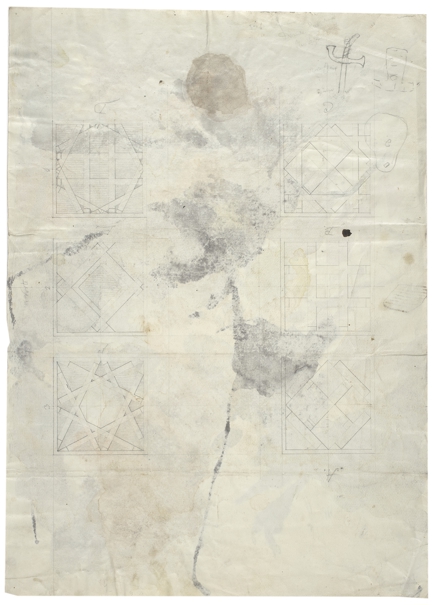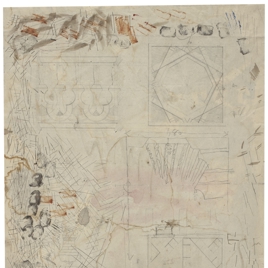
Sketches of Islamic ceiling decorations and colour tests
1848 - 1851. Pencil, Coloured wash on wove paper.Not on display
This drawing is part of a set made during Madrazo’s student days for the purposes of analysis and research. The majority of these analytical drawings are fairly schematic sketches that focus on one particular part of an architectural structure. They contain an abundance of geometric designs of capitals, borders and floors for embellishing monuments and stalks, flowers and other plant motifs that display organic forms rather than elemental symmetry. The most interesting thing about these student drawings is how they document Madrazo’s evolution in terms of visual representation and architectural motivations, year after year; they offer proof of his skill and imaginative vision, and most of the sketches envision projects that had already been built.
The plan shows Islamic geometric decorative patterns and different colour tests. Six drawings in total are arranged on the page, divided into two groups of three, with lines drawn using pencils of varying thickness. The decorative designs echo the geometry of the elements rather than imitating nature. Geometry is very important in Islamic art, as it represents the indivisible nature of God. The designs tend to be simple and based on the principles of symmetrical repetition, multiplication or subdivision. Rooted in mathematics, it is a more intellectual than emotional type of art. In this case, the sketched patterns consist of intersecting mixtilinear branches that form lozenges, intertwined ribbons, meanders, zigzags, chequerboards and strips forming stars. The edges of the paper have deteriorated, and there are a few dirt stains spread across the surface.
Fernández Martínez, Margarita, La arquitectura de Juan de Madrazo: análisis histórico y catalogación de su obra, Repositorio institucional Universidad San Pablo-CEU, 2025, p.323, 324, 326