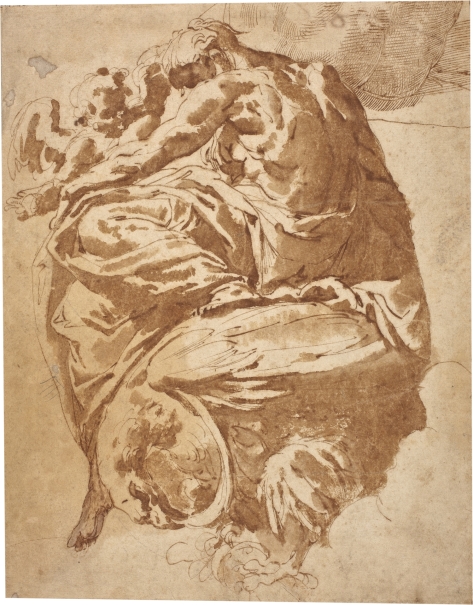
St. John the Evangelist
Second third of the XVI century. Pencil, Wash, Grey-brown ink on yellow paper.Not on display
Carderera probably accepted the old attribution to the Pellegrino Tibaldi (1527-1596), who had spent almost a decade in Spain at the end of his life, mostly working at El Escorial, and was an important influence on Late Mannerism in Spain. The attribution to Bertoia is here proposed on stylistic grounds. A particularly striking comparison may be made between the present drawing and Bertoia´s pen-and-wash Madonna and Child, and Other Studies in the University Art Museum, Princeton (inv. no. 48-667; Gibbons, 1977, no. 53; Washington D. C. and Parma, 1984, no. 69). The application and texture of the brown wash in the robes of the Madonna in the Princeton drawing are identical to the shadows indicated in the back and cloak of St. John the Evangelist. Although the central study of the Madonna and Child in the Princeton drawing remains unidentified, the more rapidly drawn pen-and-ink studies that surround it are directly related to the artist´s fresco decorations of the Sala dei Sogni at Caprarola, a connection that allows the Princeton drawing to be dated in the period 1569-1573. In both handling and technique, another good comparison may be made with Bertoia´s Sheet of Studies in the Capodimonte, Naples (inv. no. 1016; Muzii, 1987, no. 24). The same fluidity of touch and strong accents of dark brown wash here also characterize the artist´s execution of these lively sketches. Finally, also typical of Bertoia is the fine cross-hatching in the separate study for St. John´s nude buttocks, drawn in the top right-hand corner of the Prado sheet (Text drawn from Turner, N.: From Michelangelo to Annibale Carracci. A century of Italian drawings from the Prado, Art Services International-Museo Nacional del Prado, 2008, p. 140).