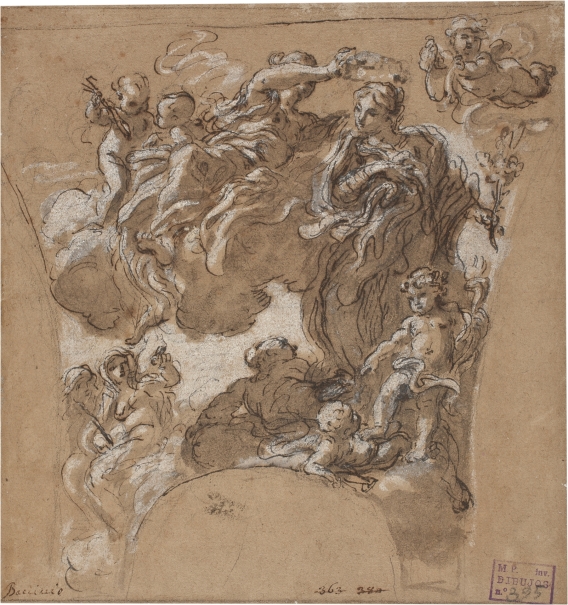
Temperance, Hope, Wisdom and Chastity
1669 - 1671. Grey-brown wash, Pencil strokes, White lead, Pencil on brown paper.Not on display
The Genoese painter Giovanni Battista Gaulli, known as Baciccio, arrived in Rome in 1657, escaping the plague that had devastated his native city and his family. According to his biographer Lione Pascoli, around 1664 the powerful Genoese art dealer Pellegrino Peri introduced Baciccio to Gian Lorenzo Bernini, the prince of the Roman Baroque. This was the beginning of an important working partnership. It was Bernini who negotiated Baciccio’s first commission for Prince Camillo Pamphilj, the nephew of Pope Innocent X: the decoration of the four pendentives of the cupola of Saint Agnes in Agony in the Piazza Navona, next to the Palazzo Pamphilj. Bernini was the designer of this elaborate project, and it received considerable input from him. His contribution is seen in an abundant series of drawings and models (the model relating to the pendentive associated with this drawing is in the Lemme collection, Rome) on which Baciccio worked between 1666 and 1671.
Identified by Hugh Macandrew in 1972, the Prado drawing is a first study for the pendentive representing Temperance, Hope, Wisdom and Chastity, on the right as one enters the church.
The complex iconography of the entire cycle, derived from Cesare Ripa’s Iconology (1645), is based on the depiction of the cardinal virtues, along with the three theological virtues (Faith, Hope and Charity) and numerous other allegories of virtues and vices, and presented in a decorative-symbolic ensemble that is unique to the Roman Baroque.
In the pendentive relating to the Prado drawing, Temperance is the woman on the left, accompanied by a putto holding reins, a symbol of moderation of the soul. She places a crown on the figure of Hope, the third theological virtue included in the mural cycle, represented by a young girl dressed in white and holding a bunch of lilies. Lying on the ground is Lust, shown richly bedecked and holding the wings of a partridge to her chest. At the centre, Unchaste Love struggles against Virtuous Love. The blindfolded Cupid is a symbol of hope. In the distance Charity caresses a unicorn, while a putto with a flaming torch relates to Wisdom, the second female figure in white. The preliminary study on paper only alludes to these additional features -the main differences are notable in the lower part of the composition, where in the drawing Lust sits with her back turned, in front of the group featuring Eros and Anteros.
More than one scholar has noted how the drawing appears to be an overt homage to Correggio, in contrast to Baciccio’s vital and sensual fresco. Indeed, in the course of 1668, while working on the Pamphilj commission, Baciccio went to Modena and Parma expressly to study firsthand the frescoes of Correggio, the great master of the sixteenth century. As we can see in the Prado drawing, a less languid grace and strong interest in foreshortened figures demonstrate the painter’s interest in the northern Italian artist (Farina, V.: Italian Masterpieces. From Spain´s Royal Court, Museo del Prado, 2014, p. 176).