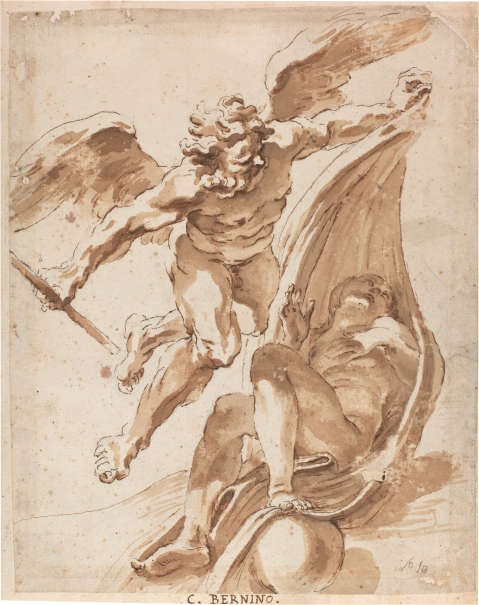
Allegory of Time and Truth
1646 - 1647. Grey-brown wash, Pencil on laid paper.Not on display
The centuries-old reference to Gian Lorenzo Bernini, seen on the support of this drawing, was first accepted by Alfonso E. Pérez Sánchez, who identified the work as a preliminary study relating to Truth (Borghese Gallery, Rome), the marble sculpture on which Bernini worked between 1646 and 1652. It was Manuela Mena Marqués who, alerted by the highly luminous application of washes, recognised the drawing as one of the studies made by Giovanni Battista Gaulli (Baciccio) at the end of the 1660s and early 1670s, during his closest association with Bernini.
Indeed, it is only possible to explain Baciccio’s characterisation of the theme in terms of its relation to Bernini’s sculpture. It is known that the great master had initially planned to create for himself a statuary group showing old Father Time floating in the air, scythe in one hand and lifting the cloth covering the naked form of his daughter, Truth, with the other. Bernini’s original project began in 1646, in the wake of the infamous bell-tower fiasco at St Peter’s Basilica, and has most often been interpreted as a consolatory response to that humiliating setback.
This idea is supported by a number of preparatory studies: three autograph works in the Leipzig Museum and three workshop drawings are believed to derive from an original and lost drawing by Bernini. These may have been studies for a painting on the same subject. The best preserved of these, executed with a technique similar to that of the Prado drawing, suggests Baciccio composed this homage to Bernini based both on drawings recovered from the master’s workshop and the original statue of Truth. In contrast to the Bernini drawing in Leipzig and a well-preserved, high-quality workshop copy in the Louvre, Baciccio’s interpretation of the subject is the only version that places the figure of Time on the left and Truth on the right. Other notable differences can be found in the drawing’s stronger gestural effects, as well as in the terrestrial sphere that accompanies Truth: a small planet on which the young woman rests a foot, just as we see in Bernini’s sculpture, now in the Borghese Gallery, rather than the large globe on which the young woman rests in the other drawings mentioned above (Farina, V.: Italian Masterpieces. From Spain´s Royal Court, Museo del Prado, 2014, p. 178).