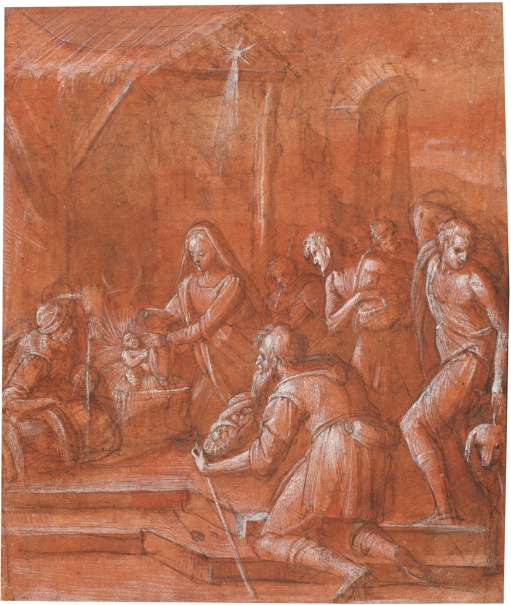
The Adoration of the Shepherds
Late XVI century. Grey-brown ink, Wash, White lead, Pencil ground on pink paper.Not on display
This attractive compositional study is typical of Balducci´s style of drawing from the 1580s, the period of the artist´s early maturity. The pictorial effect is enhanced by the hot, brick-red ground, a paler tint of which was often used by Florentine artists as a preparation for drawing from as far back as the late fifteenth century and was used by such artists as Leonardo da Vinci (1452-1519), Fra Bartolommeo (1472/75-1517), and Lorenzo di Credi (c. 1458-1537). Balducci´s warm, washed ground, combined with the emphatic highlights and the frieze-like arrangement of the figures within a shallow compositional space, conveys the impression of a shallow terracotta relief.
As emphatically Florentine as the technique is Balducci´s stylistic vocabulary, with its echoes of the figurative formulae of his master, Naldini. These are subtly intermixed with equally harmonious effects derived from Vasari (1511-1574) whose intricate fresco decorations were highly fashionable at the Medici court throughout the third quarter of the sixteenth century.
The Prado Adoration of the Shepherds shares a number of compositional features with Balducci´s drawing of the subject in the British Museum, London, this time arranged in a horizontal, arched format (inv. no. 1946-7-13-245; London, 1986, no. 179). In both the Prado and British Museum drawings a shepherd with a long beard and holding a basket kneels in the right foreground, while behind him stands a companion reaching up with his right arm over his shoulder as he supports his gift on his back. Although St. Joseph is differently posed in the two drawings, his headgear is much the same, and a number of further parallels may also be adduced.
The British Museum drawing is a design for one of the lunettes in the Chiostro Verde of S. Maria Novella, Florence, which was decorated by a number of different painters with Scenes from the Life of Christ and Scenes from the Lives of St. Dominic and other Dominican Saints, between 1570-1584. It is not impossible that the Prado drawing may have formed part of the preparatory process in the evolution of Balducci´s design for his lunette with the Adoration of the Shepherds. On the other hand, it may have come into being as a later derivation from the fresco, for a smaller, painted variant. Against such an interpretation are the several pentiments, or minor changes to the figures, that have occurred as the artist worked on the sheet: the alterations to the position of the steps in the foreground; the head of St. Joseph, originally drawn higher up the sheet; the right knee of the kneeling Virgin, an alternative for which may be seen in the front of the crib; and in the raised right arm of the youthful shepherd on the right. All these suggest the evolution of a compositional idea rather than its simple repetition.
Turner, Nicholas, From Michelangelo to Annibale Carracci. A century of Italian drawings from the Prado, Chicago, Art Services International, 2008, p.178