The Annunciation
1631 - 1635. Oil on canvas.On display elsewhere
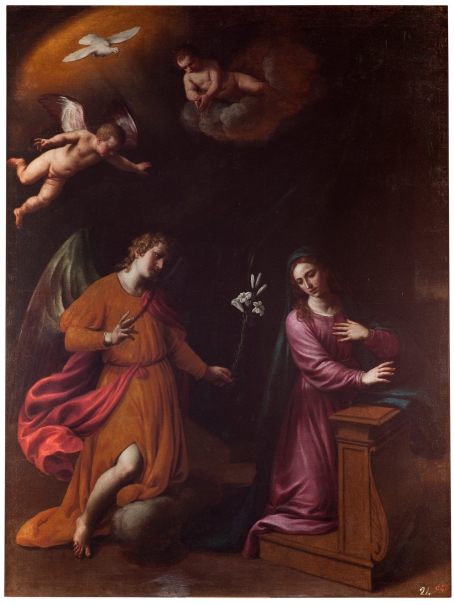
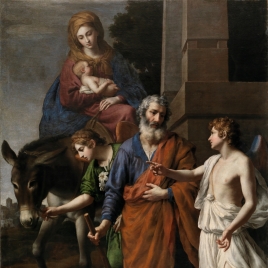
This panting belongs to a series consisting, initially, of nine Feasts of our Lady that Spain’s ambassador to the Vatican, Cardinal Gaspar de Borja y Velasco (1580-1645), sent from Rome, in 1635 or earlier, for the decoration of the Queen’s new prayer chapel at the Alcázar. Five of those nine works are now at the Prado, while at least three were lost in the fire that damaged that palace in 1734. Madrazo originally attributed them to Vicente Carducho (ca. 1576-1638) and they have more recently been attributed to an anonymous artist of the Italian school. In fact, they are the work of Alessandro Turchi, known as l’Orbetto Veronese.
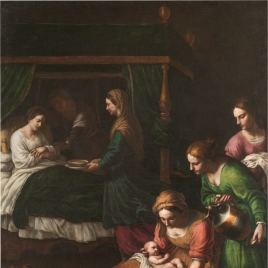
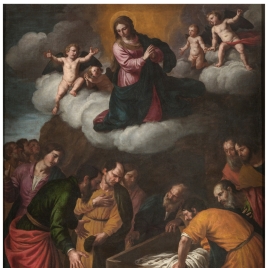
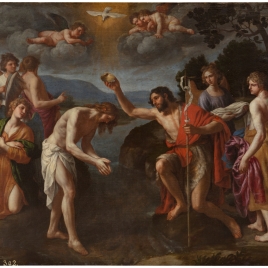
The series of works that Turchi was commissioned to paint can be reconstructed as follows: the first was presumably an Immaculate Conception (lost), followed by a Birth of the Virgin (P3864), The Presentation (lost), this Annunciation, and a Visitation (P3165), a Nativity (lost), The Purification (or The Presentation of Jesus in the Temple, P5388), The Coming of the Holy Ghost (lost) and finally The Assumption (P5128). Velázquez was commissioned to complete the series with a Crowning of the Virgin (P1168), possibly to replace a lost work by Turchi.
Turchi embodies the most classicist tendencies in Italian painting from the first half of the 17th century. After studying with Felice Brusasorci (1539/40-1605) he moved to Rome, where he worked alongside Carlo Saraceni, Giovanni Lanfranco and Agostino Tassi on the decoration of the Quirinale’s Sala Regia (1616-17) and painted canvases for the cardinal-nephew Scipione Borghese. His essentially Veronese approach, with it rich colors and measured compositions, was later shaped by contact with the work of Domenichino and the second generation of Caravaggist painters, and from then on it remained fundamentally unchanged until his death. Turchi made his fortune in Rome. An active member of the Accademia di San Luca, he became a principal in 1637. Besides this series, he painted other works for the Spanish Crown, and he had at least one other known Spanish client: the Count of Monterrey, ambassador to Rome (1629-31) and viceroy of Naples (1631-37). An elegant and refined painter, as well as a prolific and original draftsman, he made altarpiece paintings, votive images, cabinet paintings and exquisite small-format works on slate. During almost all of his years in Rome he attended mass at the parish church of San Lorenzo in Lucina, for which he also made an altarpiece painting. Following his death, he was buried there.
In all of Turchi’s paintings, the figures occupy the immediate foreground, wear heavy clothing and are painted with powerful colors and rich glazes. The palette of orange brown, copper greens and violet reds; the postures and stances, as well as the types of figures, are all known from other pieces by this artist. Also characteristic of his work are a rather literal narration and a tendency to minimize supernatural elements (Text drawn from Finaldi, G. in: Fábulas de Velázquez. Mitología e Historia Sagrada en el Siglo de Oro, Museo Nacional del Prado, 2007, pp. 325-326).