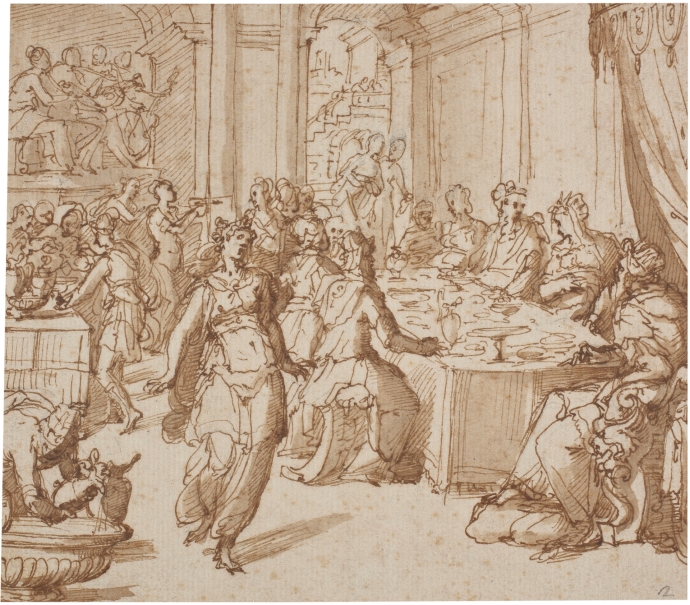
The Dance of Salome
Mid-XVIcentury. Grey-brown ink, Wash, Pencil on yellow paper.Not on display
The setting of this Dance of Salome resembles more a Florentine palazzo from the middle of the sixteenth -complete with a special balcony for the band of musicians, top left- than a palace in Jerusalem in the early years of the first century. Almost completely lacking from this elegantly conceived little compositional study are the reminiscences of Andrea del Sarto (1486-1530) and Jacopo Carucci, called Pontormo, whose work for so long exerted a powerful influence on Naldini. Taking their place are traits from the more up-to-date courtly style developed in Florence around the middle of the sixteenth century, which reached its highpoint in the decoration of the Studiolo di Francesco I de´ Medici (1570-1572) in the Palazzo Vecchio, Florence, a project directed by Vasari (1511-1574), with the help of the letterato Vincenzo Borghini. Naldini was one of a small, carefully selected group of artists invited to contribute to the decoration, painting the exquisite, small-scale composition of The Gathering of Amber.
The handling of the Prado drawing illustrates Naldini´s drift away from the heavier, more classical style favored in Florence for much of the early sixteenth century, towards the lighter, more abstract formal language in vogue around the middle of the century, which was often given added piquancy by erudite literary allusion. Supplanting Andea del Sarto and Pontormo was the imprint of Vasari´s elegant style, a good example of which is St. Luke Painting the Virgin. Besides the calligraphic pen work combined with pale brown wash, another characteristic that is reminiscent of Vasari is the tendency to give a spatulate shape to the heads of the figures, at the same time emphasizing their hair or headgear with exaggerated loops of the line. On stylistic grounds, the drawing may be dated from Naldini´s mature or late period (Text drawn from Turner, N.: From Michelangelo to Annibale Carracci. A century of Italian drawings from the Prado, Art Services International-Museo Nacional del Prado, 2008, p. 128).