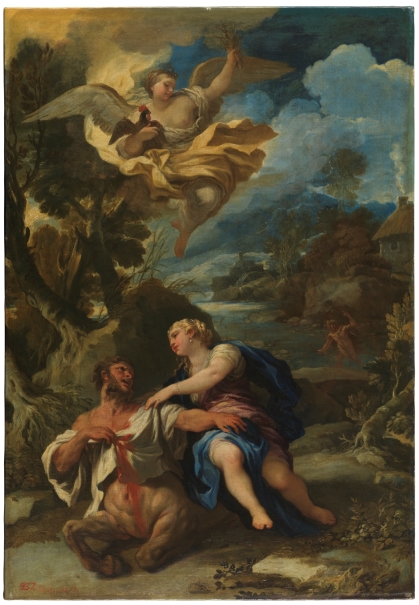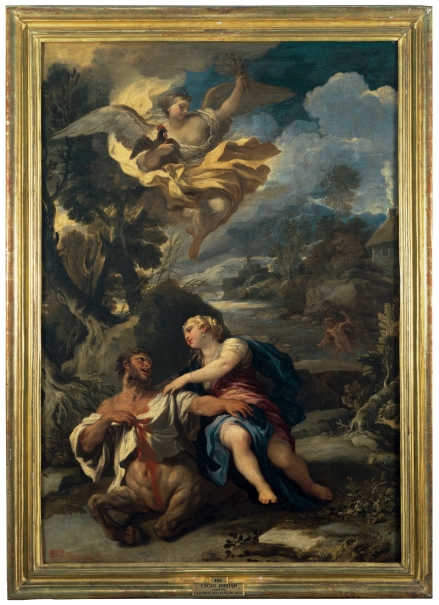
The Death of the Centaur Nessus
1696 - 1697. Oil on canvas.Room 086
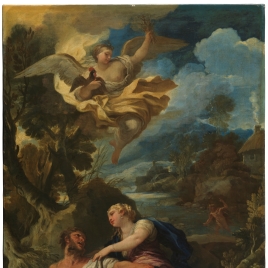
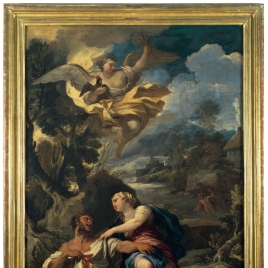
Hercules wades effortlessly across the powerful Euenos River while his wife, the beautiful Deianira, requires the aid of the centaur Nessus to do so. While ferrying her across, the centaur attempts to rape her. In her defense, Hercules mortally wounds Nessus with his arrows, but with his last breath, the centaur tricks Deianira, promising her that if her husband wears his shirt, he will never look at another woman. This is the centaur´s revenge. In a fit of jealousy, Deianira gives Hercules the shirt, which, being soaked in the creature´s poisonous blood, burns the hero´s chest, causing his death. The artist placed the main characters in this drama in the foreground, with intense lighting that brings out the woman´s serene expression and Nessus´s blood-soaked white shirt. In successive planes, the light grows weaker, emphasizing the nearly nude figure of Hercules, who has just shot the arrow that kills his enemy and still holds the bow in his right hand. Luca Giordano thus represented the story´s climax and the source of its tragedy. The winged woman flying over the main group represents Jealousy, and Giordano drew her fundamental characteristics from a book that was required reading for all artists at that time: Cesare Ripa´s Iconologia. Of those characteristics, the most important is the rooster that she holds in her right hand. According to Ripa, that animal is especially jealous, its wings displaying the rapid mood swings suffered by those experiencing that emotion. Her left hand bears a thorny hammer representing the wounds that torment the jealous stemming from their lack of trust. The scene is set against a strongly colored cloud-filled sky, which, like the rest of the composition, Giordano rendered with color glazes over the entire ground. This thorough technique allows the clouds to pop from the background, while also revealing the artist´s fine and precise brushwork. Chronologically, the Death of the Centaur Nessus belongs to the Neapolitan artist´s Spanish period, specifically between 1692 and 1702, when he was employed by King Charles II (r. 1665-1700).The first known mention of this painting in the Spanish Royal Collections, however, dates only from 1734, when it appeared in the inventory of paintings rescued from that year´s fire at Madrid´s Alcazar Palace. It was at the Buen Retiro Palace in Madrid in 1747, listed at the New Royal Palace in that same city in 1772. Interestingly, it hung in various antechambers of the crown princess and prince in 1794, 1811, and 1814, respectively. It is first mentioned as part of the Museo Nacional del Prado´s collections in 1834, cited as located in the sala reservada. It is not easy to explain why this work was confined to the Prado´s recently inaugurated sala reservada, where the collection´s lascivious paintings were hidden from view. There are, however, two possible reasons: first, the bare breast of the allegorical figure near the top, and, second, the intense gaze of desperation or desire that Nessus directs at Deianira, despite being mortally wounded, and the fact that not even his impending death can keep him from fondling her. The centaur´s seminude torso, accentuated by the blood that drips down his chest, also lends the work a great degree of sensuality (Text drawn from Úbeda de los Cobos, A.: Splendor, Myth, and Vision. Nudes from the Prado, 2016, pp. 160-163).