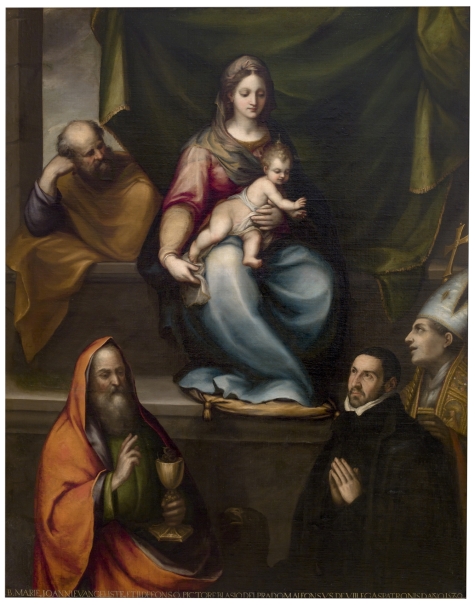
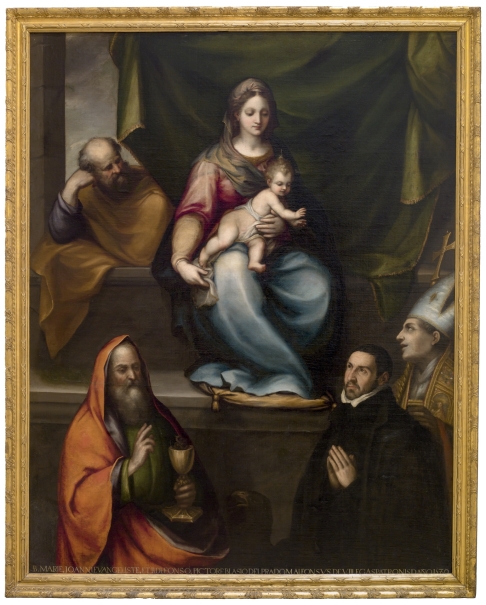
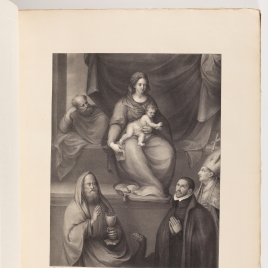
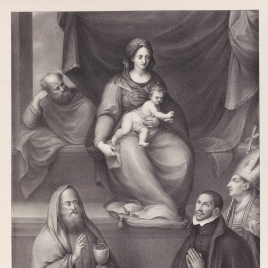
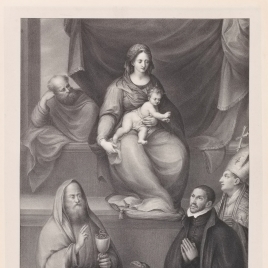
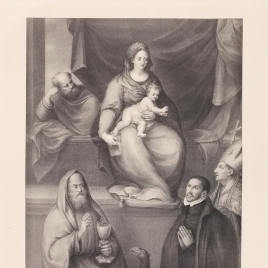
The Holy Family, Saint Ildephonsus, Saint John the Evangelist and Master Alonso de Villegas
1589. Oil on canvas.Room 052C
A high surface acts as a sort of altar bearing an image of the Virgin and Child with Saint Joseph behind them. Saint John the Evangelist and Saint Ildephonsus stand at a lower level in front, flanking clergyman and writer Alonso de Villegas, who is presented in a three-quarters view. His devout posture, with hands joined at chest level and a serene, withdrawn expression as he contemplates Mary and her child, are customary in depictions of Medieval donors. Villegas (1534-1615) was an important figure in 16th-century Spanish cultural and religious life, due mostly to his book, Flos Sanctorum,whose first volume was published in 1578 and became a fundamental work intended to clarify traditions from the Christian sanctorale considered insufficiently rigorous and unacceptable in the orthodox context of the Council of Trent. Villegas also wrote Favores de la Virgen, an ode to the Virgin Mary of uncertain date that was aligned with the Conceptionist fervor sweeping Spain at that time. In that sense, it is interesting that this painting places him alongside Saint Ildephonusus, who was the patron saint of both Villegas and the city of Toledo and was always a fierce advocate of Mary´s virginity, as is patent in his book, De illibata Virginitate Sanctae Mariae. Saint John had also demonstrated his dedication to the Virgin in his description of the Apocalypse, and here the artist chose to present him according to Byzantine iconography—as a bearded old man who blesses the chalice employed in an effort to poison him in Ephesis—rather than the traditional Western presentation as a beardless young man. This painting is important, both as one of the few works signed and dated by this interesting artist from Toledo, and for the use at such a late date of medieval conventions in the depiction of Villegas as the donor. Of course this type of image was deeply rooted in Toledo, and Blas de Prado (ca.1546-1599) himself has been attributed another very similar work in that regard: Virgin with Saints and Donors, at the Academy of San Fernando in Madrid. Here, the portrait of Villegas stands out for the detailed naturalist rendering of his face, which reveals the artist´s skill at portraiture and must certainly have pleased the clergyman, as it became the model used by engraver Diego de Astor for a plate that Villegas included as a sort of signature in authorized editions of his Flos Sanctorum. The realism of his depiction contrasts with the rest of the composition, whose Renaissance idealism constitutes an exercise in eclecticism very characteristic of this artist: Roman-style monumentalism in the figures and a palette closer to the Venetian school, but nuanced by an enveloping light that ties it to Correggio´s work.
Ruiz Gómez, L., La Sagrada Familia, san Ildefonso, san Juan Evangelista y el maestro Alonso de Villegas (1589).. En: Ruiz Gómez, L.: El retrato español en el Prado. Del Greco a Goya, Madrid, Museo Nacional del Prado, 2006, p.74, n. 16