The Martyrdom of Saint Lawrence
1622 - 1624. Oil on canvas.Room 007A
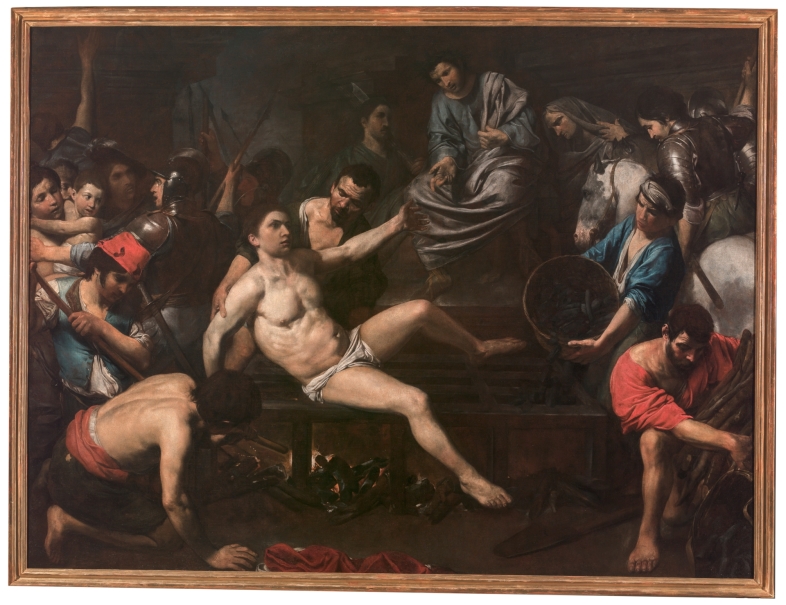
The Martyrdom of Saint Lawrence, 1620s, is the only painting by Valentin de Boulogne in the Museo del Prado. One of his most ambitious works, it was almost certainly painted in the mid 1620s. It depicts the martyrdom of Deacon Lawrence (c.225–258), who was executed on a grill for refusing to surrender the Church´s treasures to Emperor Valerian. Instead, the deacon distributed them among the needy. Appearing before Prefect Cornelius with a group of poor individuals -visible at the left of the composition- he declared that they were the Church´s true treasure. Saint Lawrence appears at the centre of the composition, extending his hand towards the prefect. His figure is the most carefully crafted example of male anatomy in Valentin´s entire career, although it is a body with great muscular tension that does not represent an idealised apollonian nude. Instead, it is probably a faithful representation of a model posing for the artist, a custom established by Caravaggio and his immediate followers in Rome. The saint´s executioners are arranged with a symmetrical use of blue and red, and their postures reflect the effort of carrying coal or firewood and fanning the flames under the grill where the young deacon is to be martyred. One of them blows on the fire through a cane, bringing a virtuosity to the depiction of the flames that recalls Caravaggio´s Denial of Saint Peter, c.1610, (Metropolitan Museum of Art, New York) and the National Gallery of Victoria´s Martyrdom of Saint Lawrence, 1620-24, by Jusepe de Ribera. The present work reflects the enormous effort by Valentin to create a complex scene with many figures, a proletarian tragedy that takes the form of an urban scene of authoritarian oppression and resultant protest and public disorder.
Valentin was born in Coulommiers, some 60 kilometres east of Paris, to a family originally from the northern French coastal city of Boulogne-sur-Mer. He moved to Rome around 1610, where he associated with French and Northern painters in the popular neighbourhood around the Piazza del Popolo. There he followed the tenets of Bartolomeo Manfredi, Caravaggio´s closest follower. Valentin´s repertoire consists mainly of tavern scenes or groups of musicians, but he also painted portraits and allegorical and religious works, including an important altarpiece for St Peter´s Basilica. A tenebrist to the end, he died prematurely in 1632, by which time Caravaggesque painting was no longer in vogue. The Martyrdom of Saint Lawrence was first listed in the Spanish Royal Collection in 1666, in the Alcázar Palace in Madrid, attributed to Nicolas Poussin and assigned the high value of 400 silver ducats. Two accompanying works are listed with the same attribution (and were almost certainly by Valentin, as well): Christ driving the merchants from the Temple and Last Supper. Both were destroyed in the fire that devastated the Alcázar Palace in late 1734 and, of the three, only The Martyrdom of Saint Lawrence survives. We do not know how the painting reached the court, but we can speculate that all three were acquired in Rome by a Spanish ambassador or nobleman as a gift to the monarch for the halls of the Alcázar or the new Buen Retiro Palace.
Finaldi, Gabriele, 'Valentin de Boulogne. The Martyrdom of Saint Laurence'. Italian masterpieces from Spain's royal court, Museo del Prado, National Gallery of Victoria Thames & Hudson, 2014, p.132