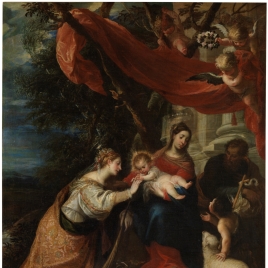
The Mystical Wedding Vows of Saint Catherine
1660 - 1661. Oil on canvas.On display elsewhere
The story of Saint Catherine of Alexandria is part of the Golden Legend by Jacopo da Varazze (Jacopo de Voragine), a biographer of saints’ lives. This story was constructed over the course of the Middle Ages with the addition of information from different sources including that of the figure of a pure maiden, a wise Alexandrian princess of noble birth, who was converted to Christianity by a hermit who taught her that Jesus was both a life model and the only husband in mystical terms worthy of her lineage. This is the origin of the legend of the mystical marriage, first depicted in 1438 in an English translation of the Golden Legend. The theme represented thereafter had to do with the visual reconstruction of a spiritual ideal in which this mystical marriage occurred.
In this famous composition by Cerezo (of which there are several extant versions), we see Saint Catherine with the broken wheel and the palm symbolising her martyrdom. The figure is shown in her courtly finery and royal crown, kneeling on the steps and stretching out her hand so as to receive the ring imposed upon her by the Christ Child at her mystical wedding. Her attitude is ceremonious and solemn, in contrast to the Christ Child’s position, as he almost falls from his mother’s arms. Likewise, the Virgin focuses her attention on the infant John the Baptist with the lamb. Saint Joseph remains in the shadows. Each figure remains on its own space, without juxtaposing each other, but the composition results from the combination of different spatial compositions: a lateral plane reveals how Saint Catherine reaches the steps of the throne in all the splendour of her green brocade cloak; a frontal plane arranges, more solemnly, the Virgin and Child; and finally, another diagonal foreshortened plane determines the position of Saint John the Baptist. The naturalness imbued in the scene was well-analysed by Cerezo, making all these elements converge in the centre of the diagonals. It is here where the hands of the saint and the Christ Child are located, thus highlighting the key gesture of the imposition of the ring.
Cerezo undoubtedly worked on the composition of The Mystical Wedding Vows of Saint Catherine, establishing its main lines from the outset and subsequently developing it with minor variations. This success is attested by the four known versions, a few others mentioned in old documents, a supposed sketch, several drawings that have been related, and a partial copy which should be analysed around (or rather after) the signed and dated paintings in the Prado (P000659), dated 1660, and in Palencia, dated 1661.
Of all the versions on this theme by Mateo Cerezo, the best documented one is in Palencia Cathedral. The version in the Museo del Prado (P000659) begins its story on 15 June 1829, when King Ferdinand VII acquired it as a work by Juan Antonio Frías Escalante from the heirs of the Valencian merchant José Antonio Ruiz for 12,000 reales. There is a drawing by the painter Pablo Montaña Cantó (1775–1801), made during his stay in Madrid between 1795–1798 (Museo del Prado, D007512), of the one owned by Bernardo de Iriarte in the second half of the 18th century. It bears a caption written in ink that identifies the owner and attributes the painting to Antonio de Pereda, even though the composition is undoubtedly by the hand of Cerezo in his diverse versions of the theme. This drawing is said to be a reproduction of Cerezo’s Wedding Vows in the Prado (P000659), therefrom deducing that the painting is from the prestigious Iriarte collection. Nonetheless, Montaña’s drawing shows differences with respect to the Prado painting, which suggests that these works are different. Some differences may be the result of not having finished certain parts, such as the brocade of the saint’s dress, whereas others are structural, such as the absence of the broken wheel, the loose strands of hair on the saint’s cheek, the position of Saint Joseph, and the steps covered by a cloth. It is difficult to imagine that Montaña altered them on his own.
The version kept in the Museo de Burgos, the fourth one, is characterised by its horizontal format, which at one point gave the impression that it had been cropped. Nevertheless, its measurements share similarities with those of the painting attributed to Cerezo mentioned in the will of the silversmith Luis de Zabalza. This painting was taxed by Andrés Smith in February 1678. Francisco Rizi also appraised it in September of the same year amongst the assets of Pedro de Vallejo: ‘an original painting by Matteo Zerezo, of the betrothal of Saint Catthaline on a canvas two varas high and two and a half wide, with its black frame and ten gilded cartridges’. Buendía and Gutiérrez Pastor thought that this painting could have been the one in the Prado; however, its measurements differ. Its landscape format measured in varas (approximately 186 x 228 cm) is practically the same as the autographed copy in the Museo de Burgos. Although its remote provenance raises these doubts, it is said to have belonged to the Adanero collection in the 19th century, passing through the New York and Madrid art markets between 1994 and 1998.
There are records of two other references to paintings of the wedding vows of Saint Catherine attributed to Mateo Cerezo. The first was in 1694, when Antonio Palomino taxed a copy among the assets of Juan de Castañeda, valued at 550 reales. The second belonged to the estate of Francisco del Olmo, a knight of Santiago, in 1746 and was considered by the painter Hipólito Obivan to be an original by Cerezo, valued at 2,500 reales. As there are no references to the measurements, it is not possible to establish any relationship between the copy recorded in 1694 and a partial copy focused on the figures of the Virgin, the Christ Child and Saint Catherine, photographed by Vicente Salgado for the Arbaiza Archive (ARB-MAM-0533_P) in which some variations can be perceived.
Gutitérrez Pastor, Ismael, 'Mateo Cerezo, el joven. Desposorios místicos de Santa catalina de Alejandría. Catedral de Palencia' En:. Mateo Cerezo, el joven (1637-1666): materia y espíritu, Fundación VIII Centenario de la Catedral,, 2021, p.90 y 164-173 o.r